
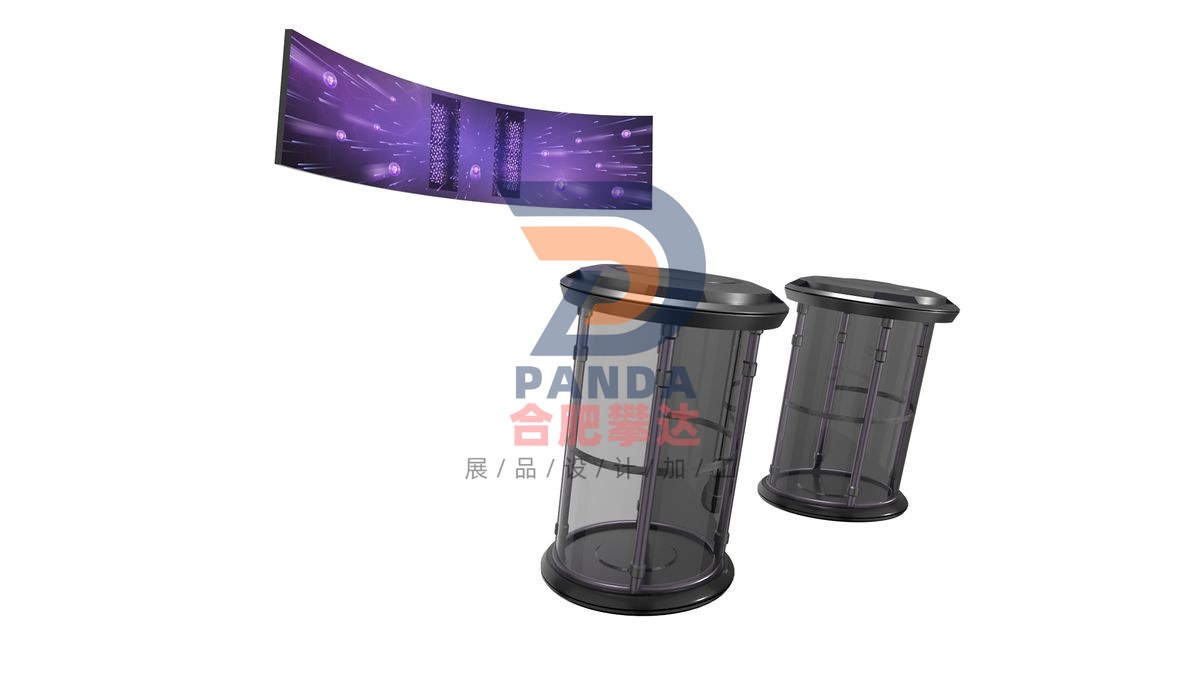
Collapsed Superposition
Quantum Technology · Interactive
- DimensionsSubject to on-site plan
- PresentationInteractive
- PricingQuoted by manufacture spec
Collapsed Superposition is a hands-on, mechanical & electromechanical interactive exhibit manufactured by Hefei Panda for science centers, children’s museums, discovery centers, STEM learning centers and family entertainment centers. Engineered for durable, robust, low-maintenance, high-traffic gallery installation, it turns abstract scientific concepts into direct, interactive visitor exploration. Hefei Panda is a global exhibit manufacturer exporting hands-on science displays to 50+ countries, with in-house engineering, fabrication, installation and commissioning.
Exhibit Summary
Collapsed Superposition is a Interactive interactive exhibit in the Quantum Technology category, designed for science centers, children’s museums, discovery centers, STEM learning centers and family entertainment centers. Built as a hands-on, mechanical & electromechanical display, it turns an abstract scientific concept into direct, interactive visitor exploration, and is engineered for durable, low-maintenance, high-traffic gallery use.
Scientific Principle
The exhibition allows the audience to experience the behavior of electrons in the double-slit interference experiment from a first-person perspective, demonstrates the interference phenomenon, and enables the audience grasp the quantum theory that the state of matter depends on observation or not.
Operation
This unit uses multimedia simulation to experience the electronic double-slit interference experiment. The unit uses an LED screen to simulate the interference results. The LED screen is tilted and hoisted in the air. On the ground on the vertical line of the screen, an inclined launcher is set up. There is a camera in the launcher for the audience to experience. Also set up an observation button to experience the phenomenon of superposition collapse. Copenhagen Interpretation: We can use the wave function Ψ to represent the state of microscopic particles. If a microscopic particle has a probability of being in two different states, then the linear superposition of these two states is also a possible state. This means that, unlike the classical theory of “either in state 1 or state 2,” microscopic particles can be “in both state 1 and state 2,” which is a state in which multiple possibilities coexist. When an observer observes a particle, its state "collapses" into one of two possible states with varying probabilities. This exhibition allows guests to experience the double-slit interference experiment process from the perspective of electrons and observers, and gain an in-depth understanding of the theory of quantum state collapse.
Export-Ready Features
- Durable, robust construction for high-traffic gallery environments
- Low-maintenance electromechanical design with reliable, safe components
- Custom sizing, theming & multilingual labeling available
- OEM & turnkey exhibit solutions with full project management
- Overseas shipping, export documentation & on-site installation supported
- Shipped to science centers and museums in 50+ countries