
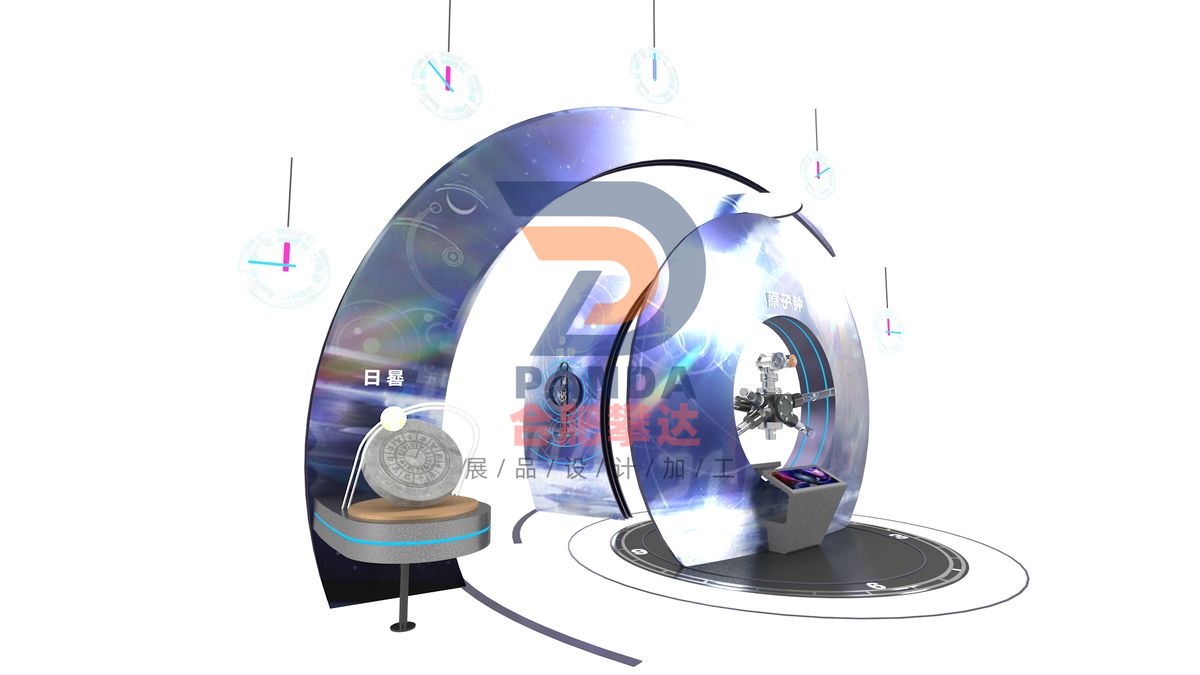
Quantum Time
Quantum Technology · Interactive
- DimensionsSubject to on-site plan
- PresentationInteractive
- PricingQuoted by manufacture spec
Quantum Time is a hands-on, mechanical & electromechanical interactive exhibit manufactured by Hefei Panda for science centers, children’s museums, discovery centers, STEM learning centers and family entertainment centers. Engineered for durable, robust, low-maintenance, high-traffic gallery installation, it turns abstract scientific concepts into direct, interactive visitor exploration. Hefei Panda is a global exhibit manufacturer exporting hands-on science displays to 50+ countries, with in-house engineering, fabrication, installation and commissioning.
Exhibit Summary
Quantum Time is a Interactive interactive exhibit in the Quantum Technology category, designed for science centers, children’s museums, discovery centers, STEM learning centers and family entertainment centers. Built as a hands-on, mechanical & electromechanical display, it turns an abstract scientific concept into direct, interactive visitor exploration, and is engineered for durable, low-maintenance, high-traffic gallery use.
Scientific Principle
By restoring sundials, hourglasses, mechanical clocks, quartz clocks to atomic clocks, the audience can actually experience the accuracy of various timing devices, grasp concepts such as atomic clocks and Planck time based on quantum mechanics, and grasp the ultra-high accuracy of atomic clocks and their importance to the development of quantum technology.
Operation
The exhibition items consist of sundials, hourglasses, mechanical clocks, quartz clocks, atomic clock models, timers, multimedia consoles, etc. The audience can operate the real objects or models one by one, such as flipping the hourglass model, adjusting the length of the pendulum, etc., to grasp the working concept of human timing tools and the development of timing accuracy, compare the errors of various timing devices, and realize the great superiority and importance of quantum timing. The clocks and watches that people use daily have a high-precision error of about 1 minute per year, which has no impact on daily life. However, in high-demand production and science research fields, more accurate timing tools are needed. The most accurate timekeeping tool in the world is the atomic clock, which appeared in the 1950s. Atomic clocks use electromagnetic waves emitted when atoms absorb or release energy to keep time. Because this electromagnetic wave is very stable and controlled by a series of precision instruments, the timing of the atomic clock can be very accurate. The elements currently used in atomic clocks include Hydrogen, Cesium, Rubidium, etc. Atomic clocks are accurate to only 1 second every 20 million years. This provides a strong guarantee for astronomy, navigation, and space navigation. By displaying the principles and accuracy of various timing devices in history, this exhibition reflects the importance of timing accuracy and the huge boost that quantum technology has given to timing capabilities.
Export-Ready Features
- Durable, robust construction for high-traffic gallery environments
- Low-maintenance electromechanical design with reliable, safe components
- Custom sizing, theming & multilingual labeling available
- OEM & turnkey exhibit solutions with full project management
- Overseas shipping, export documentation & on-site installation supported
- Shipped to science centers and museums in 50+ countries