
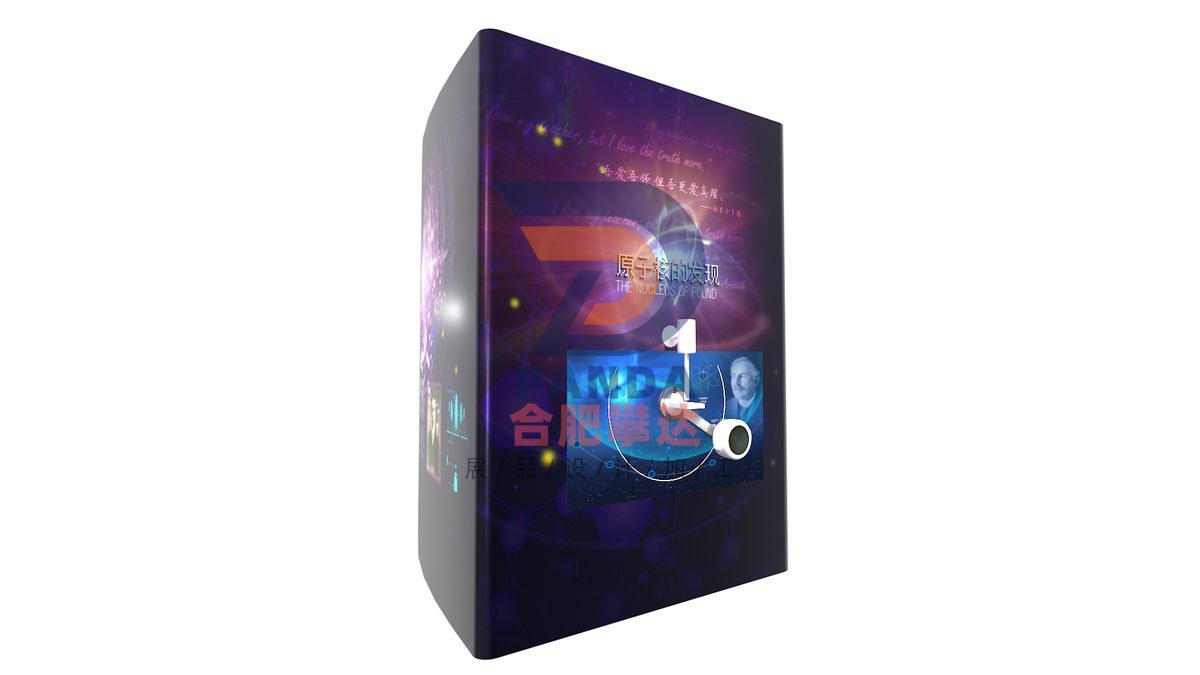
Discovery of the Atomic Nucleus
Quantum Technology · Interactive
- DimensionsSubject to on-site plan
- PresentationInteractive
- PricingQuoted by manufacture spec
Discovery of the Atomic Nucleus is a hands-on, mechanical & electromechanical interactive exhibit manufactured by Hefei Panda for science centers, children’s museums, discovery centers, STEM learning centers and family entertainment centers. Engineered for durable, robust, low-maintenance, high-traffic gallery installation, it turns abstract scientific concepts into direct, interactive visitor exploration. Hefei Panda is a global exhibit manufacturer exporting hands-on science displays to 50+ countries, with in-house engineering, fabrication, installation and commissioning.
Exhibit Summary
Discovery of the Atomic Nucleus is a Interactive interactive exhibit in the Quantum Technology category, designed for science centers, children’s museums, discovery centers, STEM learning centers and family entertainment centers. Built as a hands-on, mechanical & electromechanical display, it turns an abstract scientific concept into direct, interactive visitor exploration, and is engineered for durable, low-maintenance, high-traffic gallery use.
Scientific Principle
This exhibition allows the audience to grasp the process and method of Rutherford's discovery of the atomic nucleus by restoring Rutherford's alpha particle scattering experiment, and discover Rutherford's practical method of exploring problems. This experiment opened the door to subatomic research and laid the foundation for the proposal of the Bohr atomic model, which contrasted with the Bohr atomic model.
Operation
This exhibition consists of models such as alpha particle sources, particle beam tubes, gold targets, and fluorescent screens, as well as projectors. The fluorescent screen is replaced by a screen. The audience can manually rotate the fluorescent screen. The fluorescent screen rotates around the gold target within a certain angle to simulate the observation of scattering results. The projection simulates the path of Ϊ particle scattering and emission. The screen on the fluorescent screen displays fluorescent points, and their distribution and angle satisfy the Rutherford scattering formula. Viewers can also discover about Rutherford's alpha scattering experiment, the composition of atomic nuclei, and the atomic planet model on the screen. In 1909, Rutherford guided his students Hans Geiger and Ernst Marsden to complete the famous alpha particle scattering experiment, which is known as one of "the most beautiful experiments in physics." The experiment used alpha rays (high-speed moving helium atoms) to bombard a very thin gold foil. It was found that the vast majority of alpha particles passed straight via the thin gold foil with very small deflection. However, a few alpha particles were deflected at a much larger angle than predicted by the Thomson model. Scattering with a deflection angle equal to 150° was even observed, which is called large-angle scattering, and cannot be explained by the Thomson model. Based on this experiment, Rutherford proposed a nuclear structure model in 1911, also called the "atomic planet model." In 1919, Rutherford discovered a particle ejected from the helium nucleus in further experiments, which he named "proton". The exhibition items use models combined with multimedia explanations to simulate and restore Rutherford's alpha scattering experiment to grasp the basic structure of atoms and the inheritance spirit of science.
Export-Ready Features
- Durable, robust construction for high-traffic gallery environments
- Low-maintenance electromechanical design with reliable, safe components
- Custom sizing, theming & multilingual labeling available
- OEM & turnkey exhibit solutions with full project management
- Overseas shipping, export documentation & on-site installation supported
- Shipped to science centers and museums in 50+ countries