
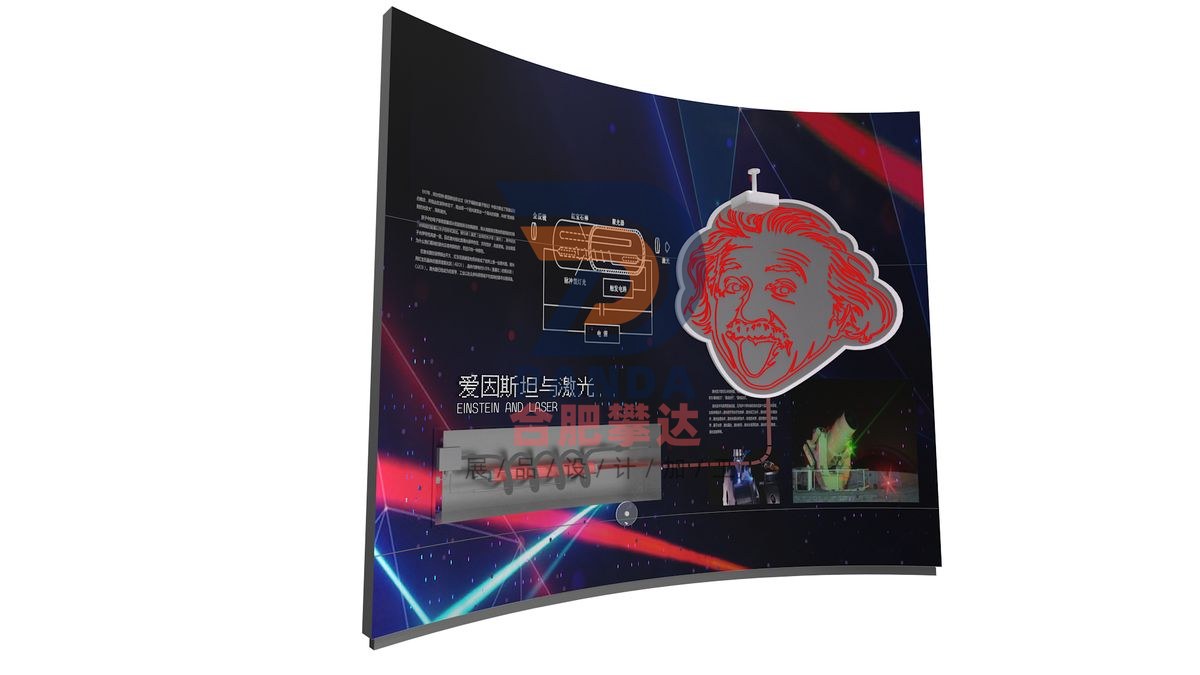
Einstein and Laser
Quantum Technology · Interactive
- DimensionsSubject to on-site plan
- PresentationInteractive
- PricingQuoted by manufacture spec
Einstein and Laser is a hands-on, mechanical & electromechanical interactive exhibit manufactured by Hefei Panda for science centers, children’s museums, discovery centers, STEM learning centers and family entertainment centers. Engineered for durable, robust, low-maintenance, high-traffic gallery installation, it turns abstract scientific concepts into direct, interactive visitor exploration. Hefei Panda is a global exhibit manufacturer exporting hands-on science displays to 50+ countries, with in-house engineering, fabrication, installation and commissioning.
Exhibit Summary
Einstein and Laser is a Interactive interactive exhibit in the Quantum Technology category, designed for science centers, children’s museums, discovery centers, STEM learning centers and family entertainment centers. Built as a hands-on, mechanical & electromechanical display, it turns an abstract scientific concept into direct, interactive visitor exploration, and is engineered for durable, low-maintenance, high-traffic gallery use.
Scientific Principle
Laser is a theoretical hypothesis proposed by Einstein based on quantum theory. This exhibition uses hands-on model demonstrations to explain the working concept of ruby lasers and help guests grasp the application of lasers in various industries.
Operation
The exhibition items are composed of transparent screens, laser models, laser galvanometer modules, and long afterglow material walls. Guests can click on the screen to discover about the structure and principles of lasers. The audience accumulates energy for the laser by turning the handle. When achieved, the ruby laser emits a red laser (light strip) and triggers the laser galvanometer to light up Einstein's head on the wall. The portrait of Einstein is in the form of a line drawing. When lit, the lines appear to be randomly scattered and chaotic. When all appear, they form a complete pattern. In 1917, Albert Einstein first proposed the concept of stimulated emission in his paper "On the Quantum Theory of Radiation" and pointed out that under certain conditions, a weak light can stimulate a strong light, which is called "light amplification of stimulated emission of radiation", or laser for short. Ruby was first used to make the world's first laser. The matrix of ruby crystal for laser is aluminum oxide (Al2O3), and the crystal is doped with about 0.05% (weight ratio) chromium oxide (Cr2O3). Lasers have become indispensable basic instruments and equipment in medicine, industry and many science research fields. This exhibition item demonstrates the important role of laser as a product of quantum science by introducing the structure of ruby laser.
Export-Ready Features
- Durable, robust construction for high-traffic gallery environments
- Low-maintenance electromechanical design with reliable, safe components
- Custom sizing, theming & multilingual labeling available
- OEM & turnkey exhibit solutions with full project management
- Overseas shipping, export documentation & on-site installation supported
- Shipped to science centers and museums in 50+ countries