
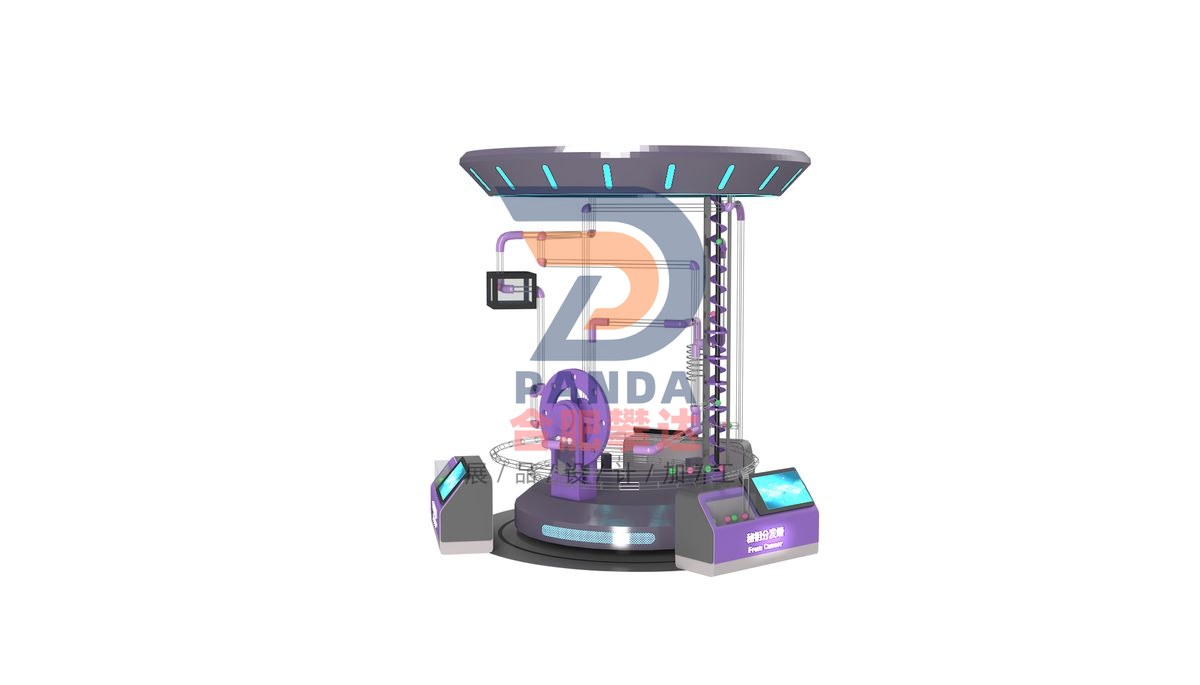
Quantum Key Distribution
Quantum Technology · Interactive
- DimensionsSubject to on-site plan
- PresentationInteractive
- PricingQuoted by manufacture spec
Quantum Key Distribution is a hands-on, mechanical & electromechanical interactive exhibit manufactured by Hefei Panda for science centers, children’s museums, discovery centers, STEM learning centers and family entertainment centers. Engineered for durable, robust, low-maintenance, high-traffic gallery installation, it turns abstract scientific concepts into direct, interactive visitor exploration. Hefei Panda is a global exhibit manufacturer exporting hands-on science displays to 50+ countries, with in-house engineering, fabrication, installation and commissioning.
Exhibit Summary
Quantum Key Distribution is a Interactive interactive exhibit in the Quantum Technology category, designed for science centers, children’s museums, discovery centers, STEM learning centers and family entertainment centers. Built as a hands-on, mechanical & electromechanical display, it turns an abstract scientific concept into direct, interactive visitor exploration, and is engineered for durable, low-maintenance, high-traffic gallery use.
Scientific Principle
The exhibition item uses electromechanical interaction to simulate the sending, receiving and stealing behaviors in the key distribution process with small balls rolling in the track of the Gothenburg unit, helping the audience discover the principles of quantum key distribution.
Operation
The exhibition consists of a Gothenburg unit track, color-changing luminous balls, a ball dispensing assembly and a screen. A large-scale QKD Gothenburg unit is designed. First, a combination of yellow flashing luminous balls falls from the top one by one to simulate the key generated by the sender. The stealing bit is set in the distribution channel. If no one steals, the luminous balls arrive at the receiving end normally and collapse into the corresponding color; if someone steals, the flashing ball will "collapse" after stealing, and the color is fixed to red or green. After that, the stealing bit needs to send out a small ball of that color and finally reach the receiving position. Only when the luminous ball reaches the receiving position, the sending end will send another ball. Viewers can compare the colors on the LED dot matrix screen to determine whether someone has stolen the information and check the accuracy of the information. The BB84 protocol and its improved BBM92 protocol, as well as the 2012 MDI-QKD protocol, are internationally accepted quantum key distribution protocols. Since it was proposed in 1984, increasing the safe communication distance, improving the safe code rate and improving the security of real systems have become the three major goals of developing practical quantum key distribution. The exhibition item uses a small ball to simulate the key distribution and communication process in the BB84 protocol, and explains how this method ensures that communications are not eavesdropped.
Export-Ready Features
- Durable, robust construction for high-traffic gallery environments
- Low-maintenance electromechanical design with reliable, safe components
- Custom sizing, theming & multilingual labeling available
- OEM & turnkey exhibit solutions with full project management
- Overseas shipping, export documentation & on-site installation supported
- Shipped to science centers and museums in 50+ countries