
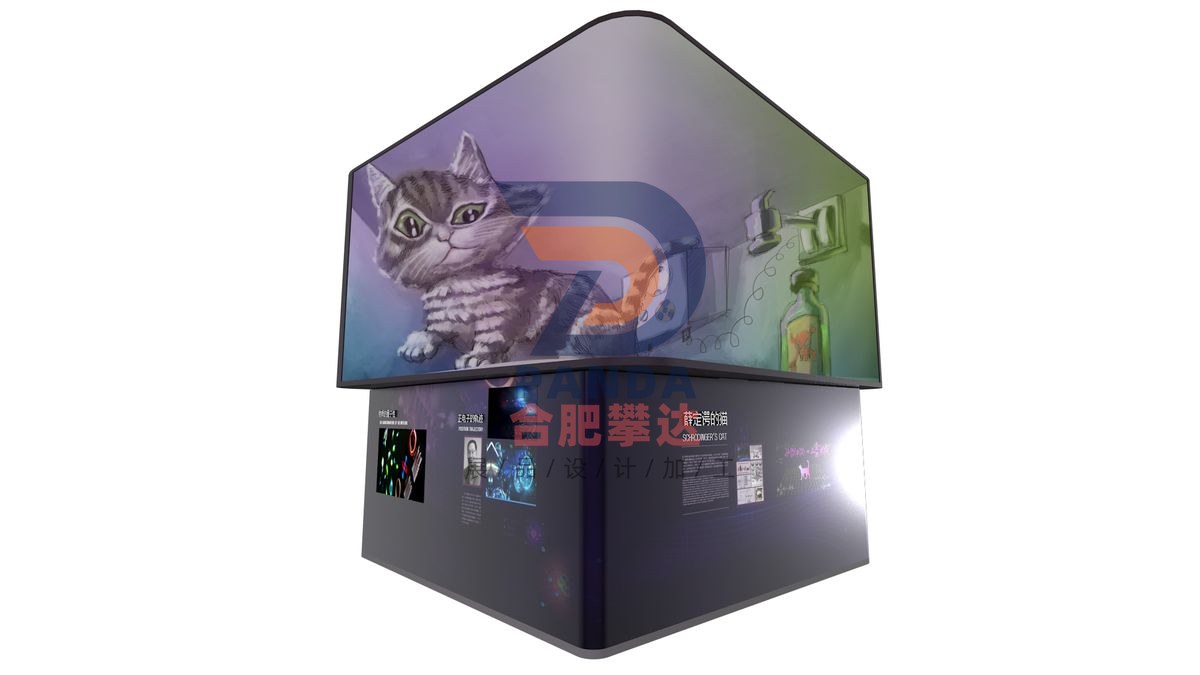
Schrödinger's Cat
Quantum Technology · Interactive
- DimensionsSubject to on-site plan
- PresentationInteractive
- PricingQuoted by manufacture spec
Schrödinger's Cat is a hands-on, mechanical & electromechanical interactive exhibit manufactured by Hefei Panda for science centers, children’s museums, discovery centers, STEM learning centers and family entertainment centers. Engineered for durable, robust, low-maintenance, high-traffic gallery installation, it turns abstract scientific concepts into direct, interactive visitor exploration. Hefei Panda is a global exhibit manufacturer exporting hands-on science displays to 50+ countries, with in-house engineering, fabrication, installation and commissioning.
Exhibit Summary
Schrödinger's Cat is a Interactive interactive exhibit in the Quantum Technology category, designed for science centers, children’s museums, discovery centers, STEM learning centers and family entertainment centers. Built as a hands-on, mechanical & electromechanical display, it turns an abstract scientific concept into direct, interactive visitor exploration, and is engineered for durable, low-maintenance, high-traffic gallery use.
Scientific Principle
The exhibition item uses a corner screen to create a naked-eye 3D visual effect, intuitively representing Schrödinger's cat thought experiment, and creating a landmark display in the quantum mechanics exhibition hall, attracting the audience to explore issues related to quantum uncertainty and superposition states.
Operation
This unit simulates the experimental environment of "Schrödinger's Cat". The unit uses a closed rectangular space to simulate a box where the cat hides. LED screens are used on two sides of the box to create a naked-eye 3D video effect. The screen is used to simulate a cat in a superposition of life and death, explaining the theoretical basis and conclusion of Schrödinger's cat thought experiment. The setting for the "Schrödinger's Cat" experiment is: a cat and a small amount of radioactive material in a box. There is a 50% chance that the radioactive material will decay and release poisonous gas that kills the cat, while there is a 50% chance that the radioactive material will not decay and the cat will survive. According to classical physics, one of these two outcomes must occur inside the box, and an outside observer cannot know what is inside until the box is opened. According to the Copenhagen interpretation, when the box is closed, the entire system remains in a state of uncertainty, that is, the cat is in a state of "both dead and alive", which is contrary to our general understanding.
Export-Ready Features
- Durable, robust construction for high-traffic gallery environments
- Low-maintenance electromechanical design with reliable, safe components
- Custom sizing, theming & multilingual labeling available
- OEM & turnkey exhibit solutions with full project management
- Overseas shipping, export documentation & on-site installation supported
- Shipped to science centers and museums in 50+ countries