
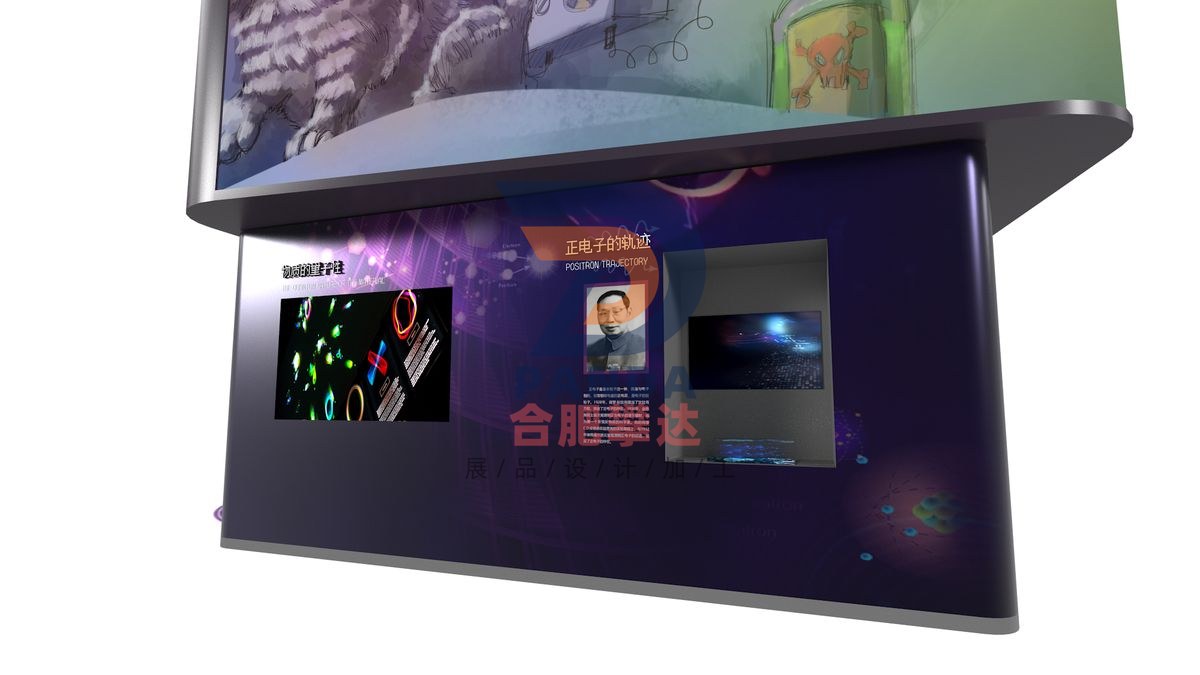
Quantum Nature of Matter
Quantum Technology · Interactive
- DimensionsSubject to on-site plan
- PresentationInteractive
- PricingQuoted by manufacture spec
Quantum Nature of Matter is a hands-on, mechanical & electromechanical interactive exhibit manufactured by Hefei Panda for science centers, children’s museums, discovery centers, STEM learning centers and family entertainment centers. Engineered for durable, robust, low-maintenance, high-traffic gallery installation, it turns abstract scientific concepts into direct, interactive visitor exploration. Hefei Panda is a global exhibit manufacturer exporting hands-on science displays to 50+ countries, with in-house engineering, fabrication, installation and commissioning.
Exhibit Summary
Quantum Nature of Matter is a Interactive interactive exhibit in the Quantum Technology category, designed for science centers, children’s museums, discovery centers, STEM learning centers and family entertainment centers. Built as a hands-on, mechanical & electromechanical display, it turns an abstract scientific concept into direct, interactive visitor exploration, and is engineered for durable, low-maintenance, high-traffic gallery use.
Scientific Principle
The exhibition item uses multimedia hands-on content to grasp the concepts of a series of particles such as atoms, nuclei, electrons, protons, and neutrons, and their relationship with quantum.
Operation
The exhibition items display the properties and characteristics of different particles such as molecules, atoms, electrons, protons, and neutrons, and connect them with quantum to introduce their relationship with quantum. The most basic concept of quantum is the smallest indivisible unit. On this basis, different quantum concepts are extended, and particles that conform to the characteristics of the quantum concept will show quantum characteristics in a certain scene. Therefore, quantum is a concept and theory, not a kind of particle. Elementary particles are the smallest or most basic units of matter that people recognize and are the basis for composing various objects. Elementary particles are much smaller than atoms and molecules, and cannot be observed even with the highest magnification electron microscope available. The size of protons and neutrons is only one hundred thousandth that of an atom. The size of leptons and quarks is even smaller, less than one ten thousandth of that of protons and neutrons. This exhibition uses an artistic visual representation of various microscopic particles, and uses multimedia hands-on display to show the differences in types of microscopic particles and the participation of energy in the reaction process between particles, so as to grasp the difference between quantum and particles.
Export-Ready Features
- Durable, robust construction for high-traffic gallery environments
- Low-maintenance electromechanical design with reliable, safe components
- Custom sizing, theming & multilingual labeling available
- OEM & turnkey exhibit solutions with full project management
- Overseas shipping, export documentation & on-site installation supported
- Shipped to science centers and museums in 50+ countries