
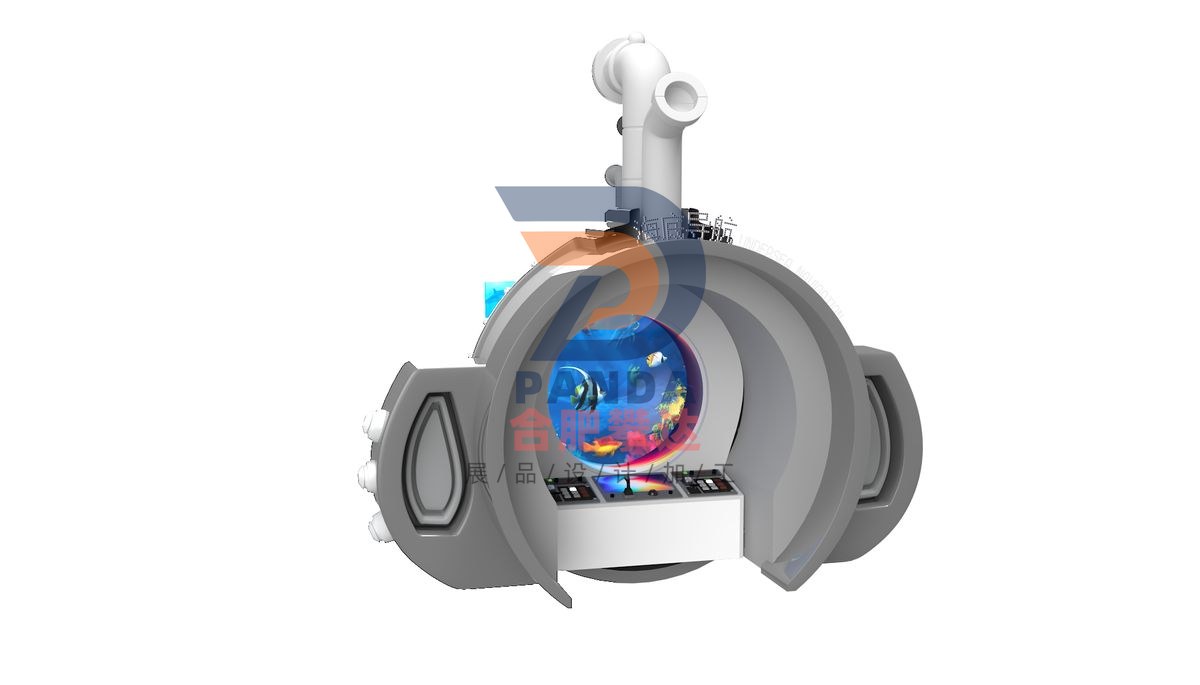
Undersea Navigation
Quantum Technology · Interactive
- DimensionsSubject to on-site plan
- PresentationInteractive
- PricingQuoted by manufacture spec
Undersea Navigation is a hands-on, mechanical & electromechanical interactive exhibit manufactured by Hefei Panda for science centers, children’s museums, discovery centers, STEM learning centers and family entertainment centers. Engineered for durable, robust, low-maintenance, high-traffic gallery installation, it turns abstract scientific concepts into direct, interactive visitor exploration. Hefei Panda is a global exhibit manufacturer exporting hands-on science displays to 50+ countries, with in-house engineering, fabrication, installation and commissioning.
Exhibit Summary
Undersea Navigation is a Interactive interactive exhibit in the Quantum Technology category, designed for science centers, children’s museums, discovery centers, STEM learning centers and family entertainment centers. Built as a hands-on, mechanical & electromechanical display, it turns an abstract scientific concept into direct, interactive visitor exploration, and is engineered for durable, low-maintenance, high-traffic gallery use.
Scientific Principle
The exhibition item uses multimedia hands-on display to show the principles, advantages and disadvantages of radar, GPS, sonar, ordinary accelerometer navigation and quantum navigation and positioning systems, highlighting the huge advantages of quantum technology in the field of navigation.
Operation
Audiences can choose different navigation technologies, including radar, GPS, sonar, ordinary accelerometers and quantum navigation and positioning systems. By choosing different navigation equipment, different cruising scenes will be displayed on the screen. The audience needs to complete driving, obstacle avoidance and other tasks according to the scene to reach the destination. During the experience, they will grasp the advantages and disadvantages of each navigation equipment and the huge advantages of cold atom technology in the navigation field. The concept of navigation has existed since ancient times. Astronomical navigation in the Stone Age and geomagnetic navigation in the Age of Navigation pointed out the direction for ancient people to travel. With the development of space technology, electronic information technology, computer science, optical communication and other science and technology, these ancient navigation methods have gradually evolved into various navigation systems represented by radio navigation and inertial navigation in recent decades. Quantum inertial navigation technology uses the concept of cold atom interference to create atomic gyroscopes and atomic accelerometers, which are several orders of magnitude more accurate than traditional inertial devices. When a submarine is traveling, the offset distance of a traditional inertial navigation system can reach about 1 kilometer per day, while the offset distance of a quantum accelerometer is only one meter per day.
Export-Ready Features
- Durable, robust construction for high-traffic gallery environments
- Low-maintenance electromechanical design with reliable, safe components
- Custom sizing, theming & multilingual labeling available
- OEM & turnkey exhibit solutions with full project management
- Overseas shipping, export documentation & on-site installation supported
- Shipped to science centers and museums in 50+ countries