
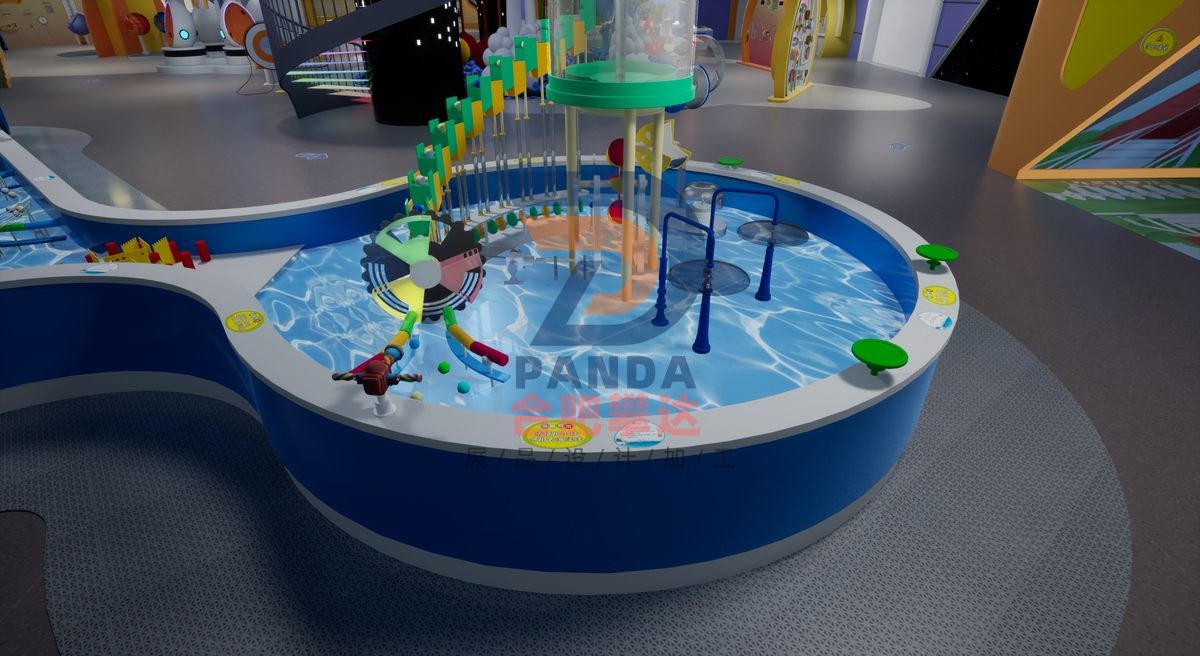
The travel of water - pushing into the vortex
Kids' Zone · Interactive
- DimensionsSubject to on-site plan
- PresentationInteractive
- PricingQuoted by manufacture spec
The travel of water - pushing into the vortex is a hands-on, mechanical & electromechanical interactive exhibit manufactured by Hefei Panda for science centers, children’s museums, discovery centers, STEM learning centers and family entertainment centers. Engineered for durable, robust, low-maintenance, high-traffic gallery installation, it turns abstract scientific concepts into direct, interactive visitor exploration. Hefei Panda is a global exhibit manufacturer exporting hands-on science displays to 50+ countries, with in-house engineering, fabrication, installation and commissioning.
Exhibit Summary
The travel of water - pushing into the vortex is a Interactive interactive exhibit in the Kids' Zone category, designed for science centers, children’s museums, discovery centers, STEM learning centers and family entertainment centers. Built as a hands-on, mechanical & electromechanical display, it turns an abstract scientific concept into direct, interactive visitor exploration, and is engineered for durable, low-maintenance, high-traffic gallery use.
Scientific Principle
The displays are designed to help children grasp the relevant theories of vortices. Shoot the ball from a low place to a high vortex, watch the trajectory of the ball in the vortex, and grasp the characteristics and related applications of the vortex. Improve children's observation and thinking ability.
Operation
The displays consist of water spray guns, step tracks, and vortex buckets. The audience uses a water gun to drive the small ball into the hole. The motor-driven step unit lifts the small ball step by step and sends it into the vortex. Since the flow speed is greater and the pressure is smaller towards the middle of the vortex, the surrounding water will press the small ball to the center of the vortex. The small ball comes out of the hole in the middle of the vortex unit and is discharged back to the water surface with the water flow. The discharged water drives the water wheel to rotate. Due to the geostrophic deflection force, when an object moves perpendicular to the earth's latitudes on the earth's surface, the linear speed of the earth's rotation changes with the change of latitude. Due to inertia, the object will tend to maintain the direction of movement at the original speed relative to the ground. This is called the geostrophic deflection force. In the northern hemisphere, objects move from south to north, and the linear velocity of the earth's rotation becomes smaller (the linear velocity is maximum at the equator). The object maintains a constant linear velocity due to inertia, so it deflects eastward, which is to the right in terms of relative motion direction. When moving from north to south, the linear speed of the earth's rotation increases, so it deflects westward, and the relative motion direction is also to the right. Therefore, when objects in the northern hemisphere move, they are uniformly affected by the geostrophic deflection force to the right. In the same way, objects moving in the southern hemisphere experience a uniform geostrophic force to the left. Now let's look at the vortex generated by this water flow. If there is no geostrophic deflection force, then the water flow will flow in along radial lines starting from the center, and the direction of the inflow velocity will point to the center.
Export-Ready Features
- Durable, robust construction for high-traffic gallery environments
- Low-maintenance electromechanical design with reliable, safe components
- Custom sizing, theming & multilingual labeling available
- OEM & turnkey exhibit solutions with full project management
- Overseas shipping, export documentation & on-site installation supported
- Shipped to science centers and museums in 50+ countries