
Ant House
Kids' Zone · Interactive
- DimensionsSubject to on-site plan
- PresentationInteractive
- PricingQuoted by manufacture spec
Ant House is a hands-on, mechanical & electromechanical interactive exhibit manufactured by Hefei Panda for science centers, children’s museums, discovery centers, STEM learning centers and family entertainment centers. Engineered for durable, robust, low-maintenance, high-traffic gallery installation, it turns abstract scientific concepts into direct, interactive visitor exploration. Hefei Panda is a global exhibit manufacturer exporting hands-on science displays to 50+ countries, with in-house engineering, fabrication, installation and commissioning.
Exhibit Summary
Ant House is a Interactive interactive exhibit in the Kids' Zone category, designed for science centers, children’s museums, discovery centers, STEM learning centers and family entertainment centers. Built as a hands-on, mechanical & electromechanical display, it turns an abstract scientific concept into direct, interactive visitor exploration, and is engineered for durable, low-maintenance, high-traffic gallery use.
Scientific Principle
focuses on experiential interaction, helping the audience grasp the living habits of ants via hands-on operations, and cultivate children's operational skills and natural cognition.
Operation
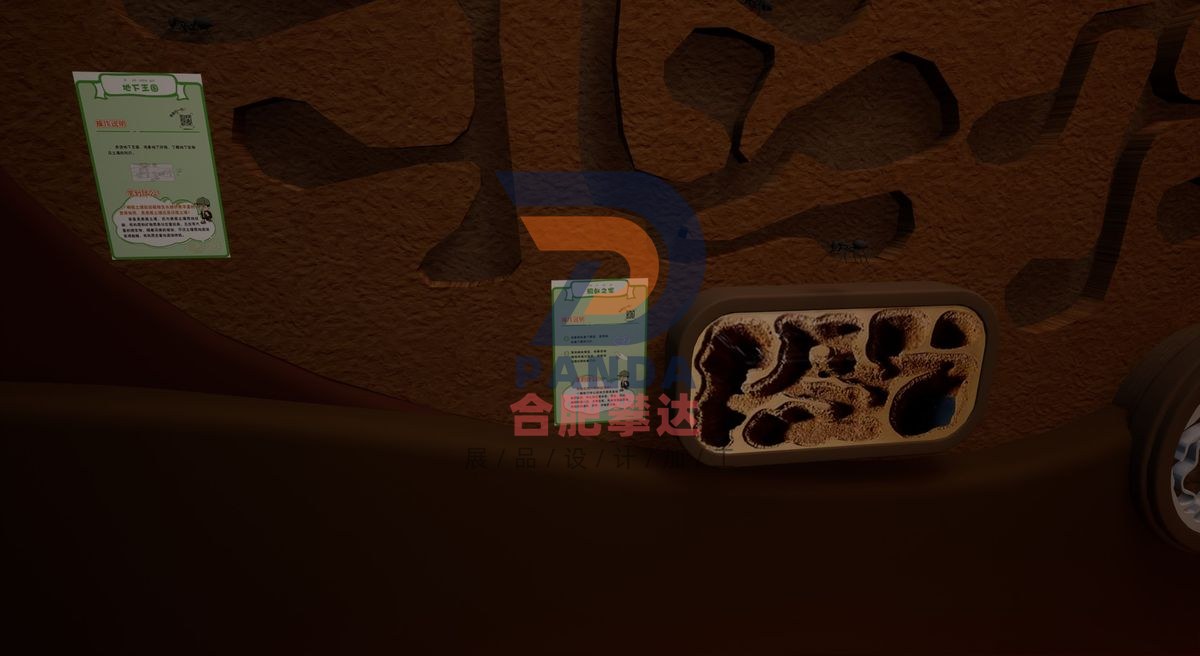
The exhibition items mainly consist of ant nest models, ant mazes, graphic and text versions, etc. Look at the ant nest model on the wall and feel the wonder of ant nest architecture. There are two ant mazes set up on the wall. The audience can pick up the ant model on the glass, attract the real objects under the glass via the glass, and help the ants carry the real objects to the ant nest via the maze game. There are various forms of ant nests. Most species build their nests in the underground soil and dig tunnels, chambers and shelters. The excavated materials and leaves are piled near the entrance to form a hillock shape for protection. Some ants also use plant leaves, stems, petioles, etc. to build paper-like nests and hang them on trees or between rocks. There are also ants that live in dead wood in forest areas. What's even more special is that some ants build their nests in or next to the nests of other types of ants; the two "homes" do not have any disputes and can live in harmony. This kind of ant nest is called a mixed ant nest, and it is actually a symbiosis of different species. The number of ants in a nest can vary greatly among different ant species or the same species. The smallest colonies only have dozens or nearly a hundred ants, but there are also thousands of ants, while large colonies can have tens of thousands or even more ants.
Export-Ready Features
- Durable, robust construction for high-traffic gallery environments
- Low-maintenance electromechanical design with reliable, safe components
- Custom sizing, theming & multilingual labeling available
- OEM & turnkey exhibit solutions with full project management
- Overseas shipping, export documentation & on-site installation supported
- Shipped to science centers and museums in 50+ countries