
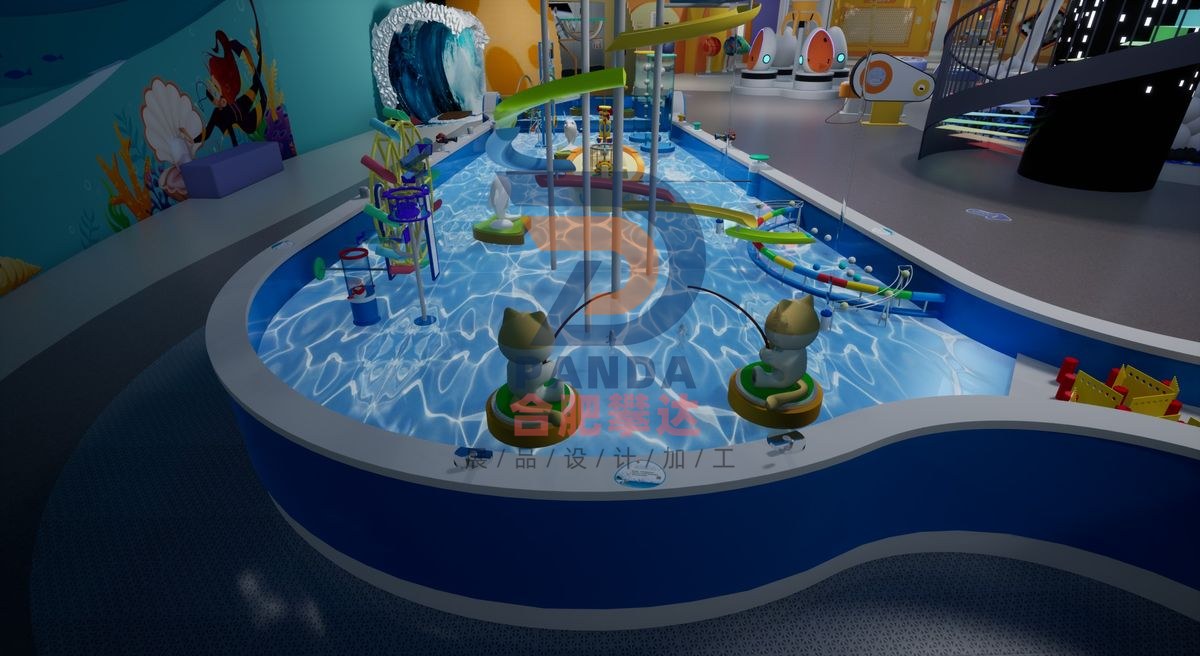
Water travel - catching invisible fish
Kids' Zone · Interactive
- DimensionsSubject to on-site plan
- PresentationInteractive
- PricingQuoted by manufacture spec
Water travel - catching invisible fish is a hands-on, mechanical & electromechanical interactive exhibit manufactured by Hefei Panda for science centers, children’s museums, discovery centers, STEM learning centers and family entertainment centers. Engineered for durable, robust, low-maintenance, high-traffic gallery installation, it turns abstract scientific concepts into direct, interactive visitor exploration. Hefei Panda is a global exhibit manufacturer exporting hands-on science displays to 50+ countries, with in-house engineering, fabrication, installation and commissioning.
Exhibit Summary
Water travel - catching invisible fish is a Interactive interactive exhibit in the Kids' Zone category, designed for science centers, children’s museums, discovery centers, STEM learning centers and family entertainment centers. Built as a hands-on, mechanical & electromechanical display, it turns an abstract scientific concept into direct, interactive visitor exploration, and is engineered for durable, low-maintenance, high-traffic gallery use.
Scientific Principle
The displays control the fish model to experience the magical changes of light in the water, enhance children's observation ability, and let children grasp that light will refract in the water.
Operation
The exhibition items consist of a handwheel control unit and a kitten fishing model. When light enters water from air, its propagation direction changes due to different refractive indexes. Rotate the handwheel, and the fish model at the end of the fishing line in the kitten fishing model slowly descends into the water. The refractive index of one of the fish models is the same as that of water, so a certain fish will be invisible during the lifting and lowering into the water. Refractive index, the ratio of the speed of light in a vacuum to the speed of light in that medium. The higher the refractive index of a material, the greater its ability to refract incident light. The higher the refractive index, the thinner the lens, that is, the center thickness of the lens is the same, the same power and the same material, the lens with a high refractive index is thinner at the edge than the lens with a low refractive index. The refractive index is closely related to the electromagnetic properties of the medium. According to the classical electromagnetic theory, εr and μr are the relative permittivity and relative permeability of the medium respectively. The refractive index is also related to frequency, which is called dispersion phenomenon. When light is emitted from a relatively optically dense medium to a relatively optically sparse medium, and the incident angle is greater than the critical angle, total reflection occurs.
Export-Ready Features
- Durable, robust construction for high-traffic gallery environments
- Low-maintenance electromechanical design with reliable, safe components
- Custom sizing, theming & multilingual labeling available
- OEM & turnkey exhibit solutions with full project management
- Overseas shipping, export documentation & on-site installation supported
- Shipped to science centers and museums in 50+ countries