
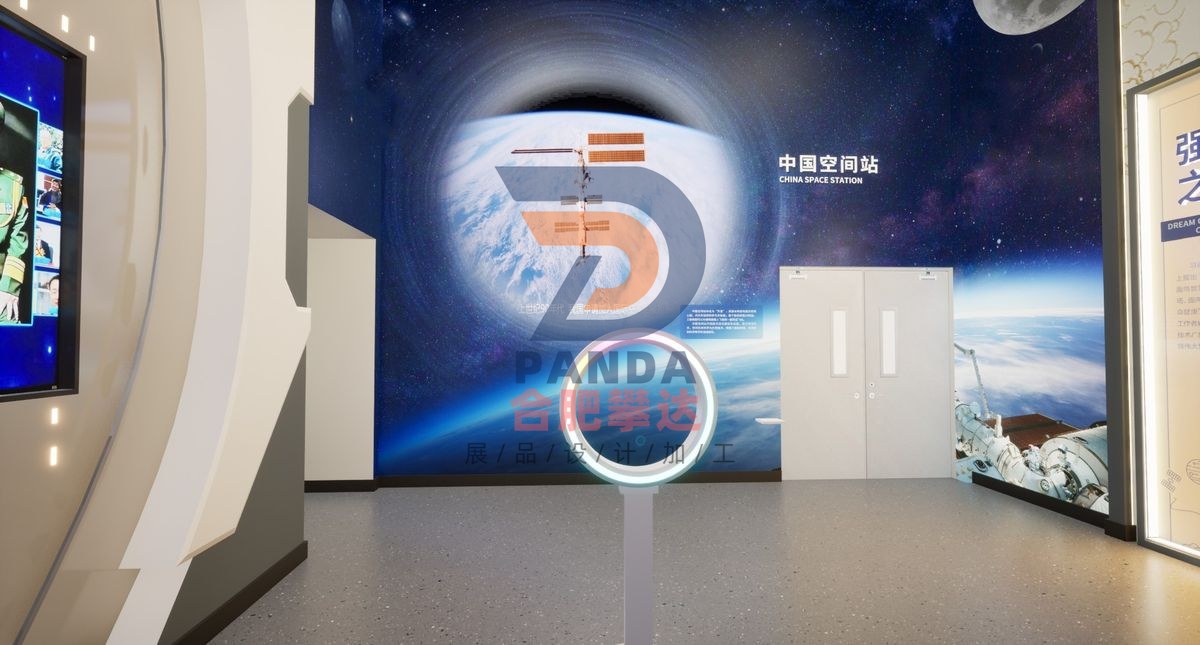
China Space Station
Smart Technology · Interactive
- DimensionsSubject to on-site plan
- PresentationInteractive
- PricingQuoted by manufacture spec
China Space Station is a hands-on, mechanical & electromechanical interactive exhibit manufactured by Hefei Panda for science centers, children’s museums, discovery centers, STEM learning centers and family entertainment centers. Engineered for durable, robust, low-maintenance, high-traffic gallery installation, it turns abstract scientific concepts into direct, interactive visitor exploration. Hefei Panda is a global exhibit manufacturer exporting hands-on science displays to 50+ countries, with in-house engineering, fabrication, installation and commissioning.
Exhibit Summary
China Space Station is a Interactive interactive exhibit in the Smart Technology category, designed for science centers, children’s museums, discovery centers, STEM learning centers and family entertainment centers. Built as a hands-on, mechanical & electromechanical display, it turns an abstract scientific concept into direct, interactive visitor exploration, and is engineered for durable, low-maintenance, high-traffic gallery use.
Scientific Principle
This display aims to display relevant knowledge of the space station to the public from multiple aspects, so that it can comprehensively and systematically grasp the basic structure of the space station, how astronauts live in space, various experiments in space, the operation control of the space station itself, etc.
Operation
China Space Station (Tiangong Space Station, English name: China Space Station) is a space station system under construction in the People's Republic of China and is expected to be completed around 2022. The space station has an orbital height of 400-450 kilometers, an inclination angle of 42-43 degrees, a design life of 10 years, long-term residence of 3 people, and a total weight of up to 180 tons, allowing for larger-scale space applications. In 1992, the Chinese government formulated a "three-step" development strategy for the manned space project. The completion of the space station is an important goal of the development strategy. At 8:54 on May 10, 2022, the Tianzhou-4 cargo spacecraft adopted the autonomous rapid rendezvous and docking mode and successfully docked with the rearward port of the Tianhe core module of the space station. According to the China Manned Space Engineering Office, after the Shenzhou 14 manned spacecraft and the space station assembly successfully achieved autonomous rapid rendezvous and docking, the astronaut crew entered the orbital module from the return capsule. After completing various preparations according to procedures, astronaut Chen Dong successfully opened the door of the Tianhe core module. At 20:50 on June 5, 2022, Beijing time, astronauts Chen Dong, Liu Yang, and Cai Xuzhe all entered the Tianhe core module in sequence. In the future, the astronaut crew will carry out relevant work as planned. The exhibition uses an induction ring, somatosensory interaction and multimedia to allow the public to grasp the basic structure, construction process, historical significance of the Chinese space station, and the story of Chinese aerospace scientists pursuing the dream of the Heavenly Palace.
Export-Ready Features
- Durable, robust construction for high-traffic gallery environments
- Low-maintenance electromechanical design with reliable, safe components
- Custom sizing, theming & multilingual labeling available
- OEM & turnkey exhibit solutions with full project management
- Overseas shipping, export documentation & on-site installation supported
- Shipped to science centers and museums in 50+ countries