
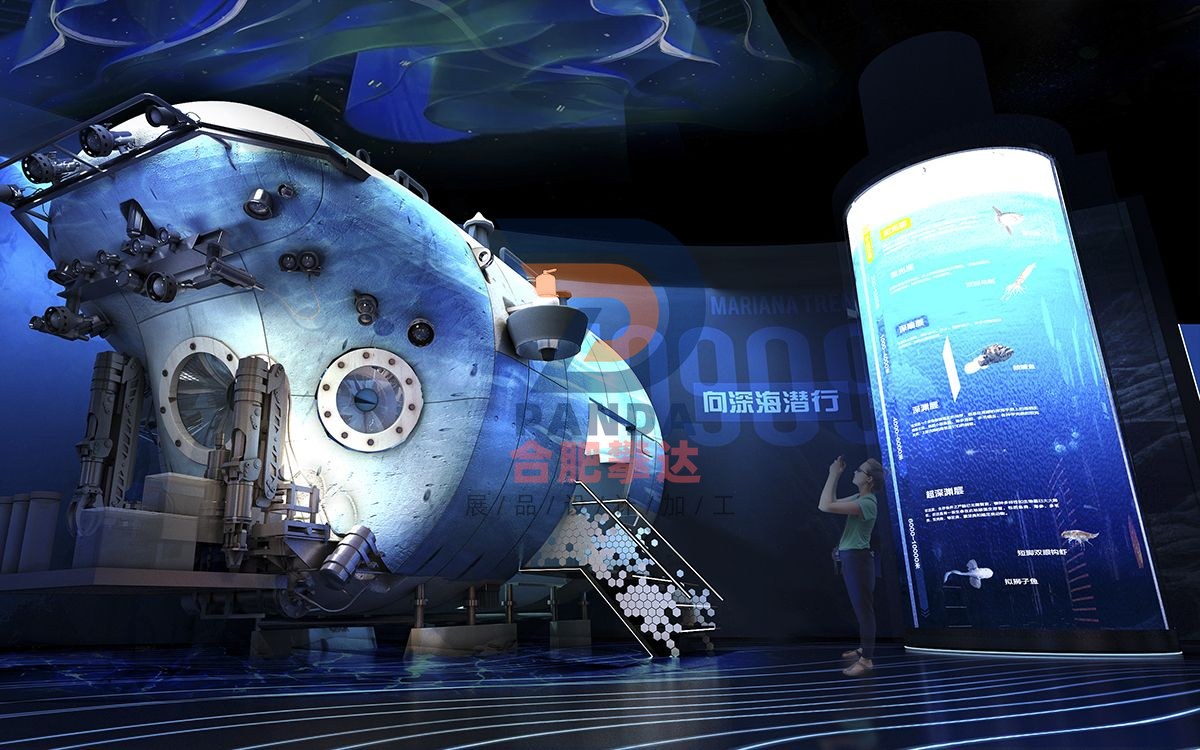
Ten Thousand Meters Under the Sea
Earth & Planet · Interactive
- DimensionsSubject to on-site plan
- PresentationInteractive
- PricingQuoted by manufacture spec
Ten Thousand Meters Under the Sea is a hands-on, mechanical & electromechanical interactive exhibit manufactured by Hefei Panda for science centers, children’s museums, discovery centers, STEM learning centers and family entertainment centers. Engineered for durable, robust, low-maintenance, high-traffic gallery installation, it turns abstract scientific concepts into direct, interactive visitor exploration. Hefei Panda is a global exhibit manufacturer exporting hands-on science displays to 50+ countries, with in-house engineering, fabrication, installation and commissioning.
Exhibit Summary
Ten Thousand Meters Under the Sea is a Interactive interactive exhibit in the Earth & Planet category, designed for science centers, children’s museums, discovery centers, STEM learning centers and family entertainment centers. Built as a hands-on, mechanical & electromechanical display, it turns an abstract scientific concept into direct, interactive visitor exploration, and is engineered for durable, low-maintenance, high-traffic gallery use.
Scientific Principle
This display reveals the secrets of the deep sea world via picture and text light boxes, allowing the audience to grasp the areas divided into different depths of the seabed, the environment and biological knowledge in different areas, feel the diversity of seabed organisms, and grasp the development history and important value of different submersibles, stimulating the audience to explore ocean knowledge.
Operation
The ocean can be divided into different regions according to its geographical plane, and can also be divided vertically into various zones or layers according to different depths. The deepest layer is the ultra-deep sea area, which is the most mysterious. (1) Translucent area: from the sea surface to 200 meters underwater. Since sunlight can penetrate into this area, photosynthesis can occur here. This is the warmest, most nutrient-rich layer of the ocean and is home to the plant-based plankton that form the basis of the ocean's food chain. The depth of this layer is variable and depends on the turbidity of the water. Biology: Most of the large marine animals such as whales and sharks are in this water layer. There are also schools of fish, phytoplankton, etc. forming rich and diverse biological communities. (2) Semi-transparent area: Extending to a depth of 500 meters, this area is also called the penumbra area. There is enough light here during the day for animals to view, and it is also the scene of the eternal struggle between predators and prey. Organisms: Lanternfishes, Pleurophoridae, cephalopods, krill and other crustaceans, sunfish, etc. (3) Aphotic zone: This area can be 200 to 4,000 meters underwater. Because there is too little light to carry out photosynthesis, food shortage has become a major problem for animals living at this depth. Organisms: small light fish and angler fish, fang fish, viper fish, black forked dragon, swallowing eel, etc. (4) Deep sea: Located between 3000 and 6000 meters, this area is characterized by coldness, scarce nutrients and absolute darkness. Some of the animals that live here are huge, and some are very weird looking. Organisms: small fish, sea cucumbers, sea urchins, hairy worms, various crustaceans and bivalves, etc. (5) Ultra-deep sea area: This very cold, high static water pressure area is 6,000 meters deep and below. Organisms: Blunt-mouthed lionfish, goddess-bottomed weaselfish, short-legged gammarids, etc. The displays focus on displaying the marine environment, biological knowledge and submersible information at different depths of the seabed. The underwater dynamic effects are simulated via dynamic graphic and text light boxes, creating an overall atmosphere and vividly displaying a series of marine knowledge.
Export-Ready Features
- Durable, robust construction for high-traffic gallery environments
- Low-maintenance electromechanical design with reliable, safe components
- Custom sizing, theming & multilingual labeling available
- OEM & turnkey exhibit solutions with full project management
- Overseas shipping, export documentation & on-site installation supported
- Shipped to science centers and museums in 50+ countries