
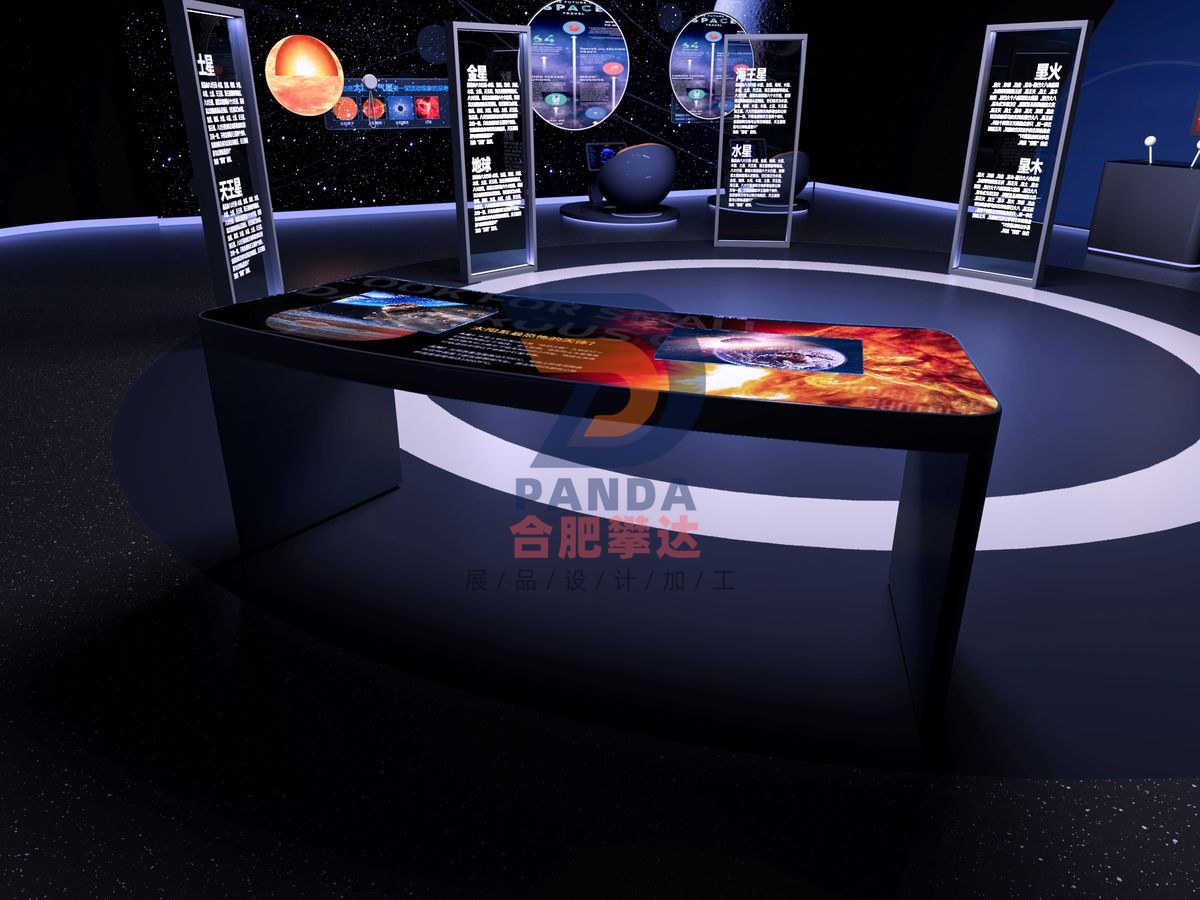
Searching for Dangerous Small Celestial Objects (VR Telescope)
Aerospace · Interactive
- DimensionsSubject to on-site plan
- PresentationInteractive
- PricingQuoted by manufacture spec
Searching for Dangerous Small Celestial Objects (VR Telescope) is a hands-on, mechanical & electromechanical interactive exhibit manufactured by Hefei Panda for science centers, children’s museums, discovery centers, STEM learning centers and family entertainment centers. Engineered for durable, robust, low-maintenance, high-traffic gallery installation, it turns abstract scientific concepts into direct, interactive visitor exploration. Hefei Panda is a global exhibit manufacturer exporting hands-on science displays to 50+ countries, with in-house engineering, fabrication, installation and commissioning.
Exhibit Summary
Searching for Dangerous Small Celestial Objects (VR Telescope) is a Interactive interactive exhibit in the Aerospace category, designed for science centers, children’s museums, discovery centers, STEM learning centers and family entertainment centers. Built as a hands-on, mechanical & electromechanical display, it turns an abstract scientific concept into direct, interactive visitor exploration, and is engineered for durable, low-maintenance, high-traffic gallery use.
Scientific Principle
The displays allow the audience to discover about planets, dwarf planets, comets and other celestial bodies in the solar system via touch inquiry, as well as knowledge about planets that may have life in the solar system, celestial bodies that may threaten the earth and their response strategies.
Operation
A satellite refers to a natural celestial body that orbits a planet and moves periodically in a closed orbit. Artificial satellites are generally also called satellites. Artificial satellites are devices built by humans, launched into space by space shuttles, etc., and orbit the earth or other planets like natural satellites. Gas planets often have many satellites. The eight planets have a total of 205 satellites. Except for Mercury and Venus, all other planets have satellites orbiting them. In order of the number of satellites, there are 82 Saturn, 79 Jupiter, 27 Uranus, 14 Neptune, 2 Mars and 1 Earth. The size and mass of different satellites vary greatly. There are 7 satellites with a radius greater than 1,000 kilometers, and the moon is one of them. Comet refers to a celestial body that enters the solar system and moves around the sun. Its brightness and shape change with the change of solar distance. It has a unique cloud-like appearance. It is also the broom star (official name of the star) in Chinese mythology. Comet is divided into three parts: nucleus, coma and tail. The comet's core is made of icy material. When the comet approaches the star, the comet's material sublimates, forming a hazy coma and a tail composed of a thin flow of material around the icy core. The mass and density of comets are very small. When they are far away from the sun, they are just frozen ice cubes made of water, ammonia, methane, etc. and a "dirty snowball" mixed with many solid dust particles. When it approaches the sun, the comet is broken down into a comet head and a tail by solar radiation, which looks like a broom. Comets can cause dramatic celestial phenomena when they enter the inner solar system. Their small coma cores are surrounded by bright clouds of gas and dust, called coma, about 100,000 kilometers in diameter. Large comets close to the sun also produce long, bright comet tails that extend tens of millions of kilometers in space and are bright enough to be seen from Earth. The displays are in line with the content of "02-05 The Formation of the Sun and the Solar System" and the Eight Planets, and mainly include the introduction of knowledge about planets, dwarf planets, comets and other celestial bodies in the solar system.
Export-Ready Features
- Durable, robust construction for high-traffic gallery environments
- Low-maintenance electromechanical design with reliable, safe components
- Custom sizing, theming & multilingual labeling available
- OEM & turnkey exhibit solutions with full project management
- Overseas shipping, export documentation & on-site installation supported
- Shipped to science centers and museums in 50+ countries