
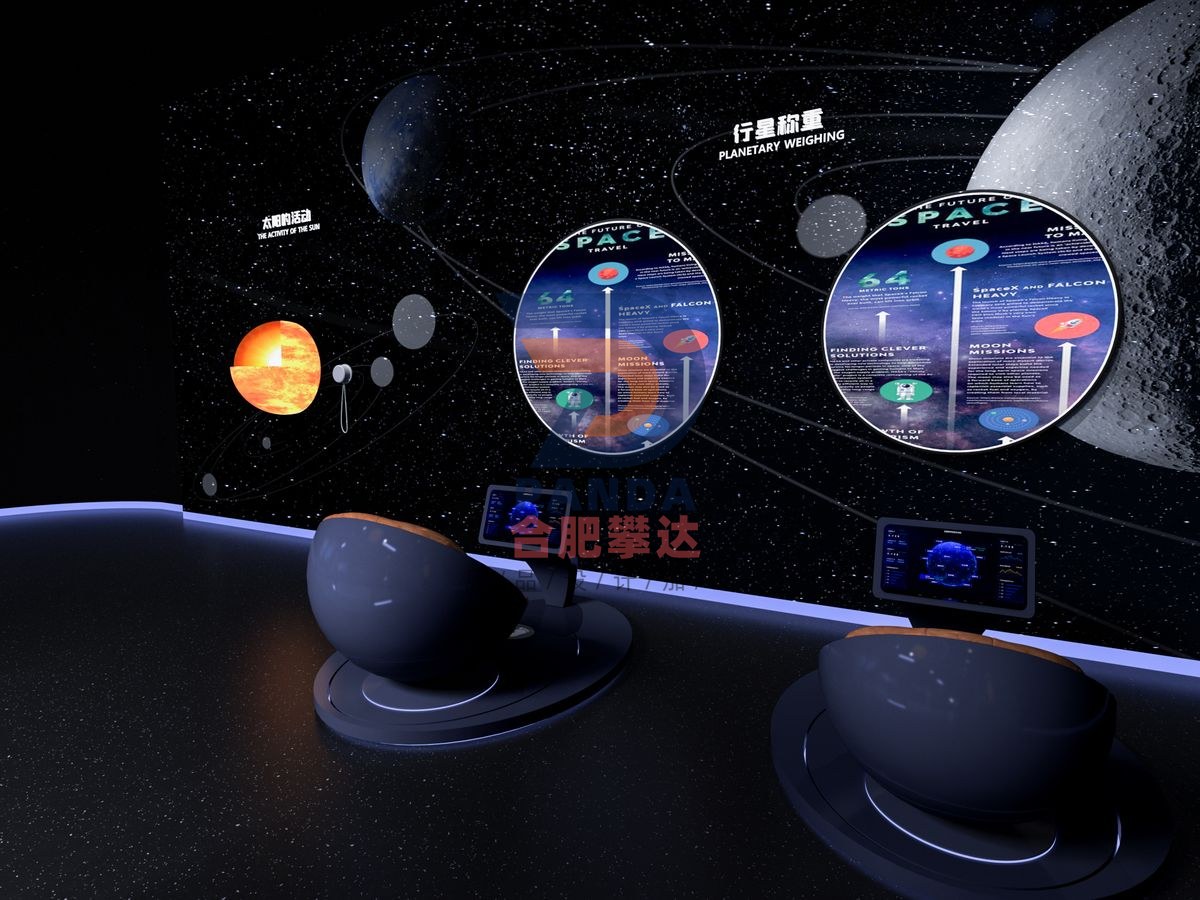
Planet Weighing
Aerospace · Interactive
- DimensionsSubject to on-site plan
- PresentationInteractive
- PricingQuoted by manufacture spec
Planet Weighing is a hands-on, mechanical & electromechanical interactive exhibit manufactured by Hefei Panda for science centers, children’s museums, discovery centers, STEM learning centers and family entertainment centers. Engineered for durable, robust, low-maintenance, high-traffic gallery installation, it turns abstract scientific concepts into direct, interactive visitor exploration. Hefei Panda is a global exhibit manufacturer exporting hands-on science displays to 50+ countries, with in-house engineering, fabrication, installation and commissioning.
Exhibit Summary
Planet Weighing is a Interactive interactive exhibit in the Aerospace category, designed for science centers, children’s museums, discovery centers, STEM learning centers and family entertainment centers. Built as a hands-on, mechanical & electromechanical display, it turns an abstract scientific concept into direct, interactive visitor exploration, and is engineered for durable, low-maintenance, high-traffic gallery use.
Scientific Principle
By simulating weighing on different planets, the displays allow the audience to grasp the different gravity experienced by the same object on different planets, grasp the reasons why the gravity of the eight planets are different, and grasp the relationship between planetary gravity and gravity.
Operation
Each celestial body in the solar system has different masses and densities, so the eight planets in the solar system also have different gravitational pulls. The surface gravity of a planet is directly proportional to the acceleration due to gravity. The gravitational acceleration of Venus is 8.87 meters/second square; the gravitational acceleration of the Earth is 9798 meters/second square; the gravitational acceleration of Mars is 3.71 meters/second square; the gravitational acceleration of Uranus is 8.87 meters/second square; Earth The gravitational acceleration of the star is 10.44 meters/second square; the gravitational acceleration of Neptune is 11.15 meters/second square; the gravitational acceleration of Mercury is 3.70 meters/second square; and the gravitational acceleration of Jupiter is 24.79 meters/second square. The eight planets in descending order of mass are: Jupiter, Saturn, Neptune, Uranus, Earth, Venus, Mars, and Mercury. For the same object, assuming that the Earth's gravity is 1, the gravity of the eight planets can be expressed as follows: Earth 1, Mercury 0.37, Venus 0.88, Mars 0.38, Jupiter 2.64, Saturn 1.15, Uranus 1.17, and Neptune 1.18. If an object weighs 100 Newtons on Earth, it would weigh 264 Newtons on Jupiter, 118 Newtons on Neptune, 117 Newtons on Uranus, 115 Newtons on Saturn, 88 Newtons on Venus, 38 Newtons on Mars, and 37 Newtons on Mercury. Different planets have different gravitational accelerations, resulting in different gravitational forces on the surfaces of different planets. If people stand on different planets and weigh themselves, they will have different results.
Export-Ready Features
- Durable, robust construction for high-traffic gallery environments
- Low-maintenance electromechanical design with reliable, safe components
- Custom sizing, theming & multilingual labeling available
- OEM & turnkey exhibit solutions with full project management
- Overseas shipping, export documentation & on-site installation supported
- Shipped to science centers and museums in 50+ countries