
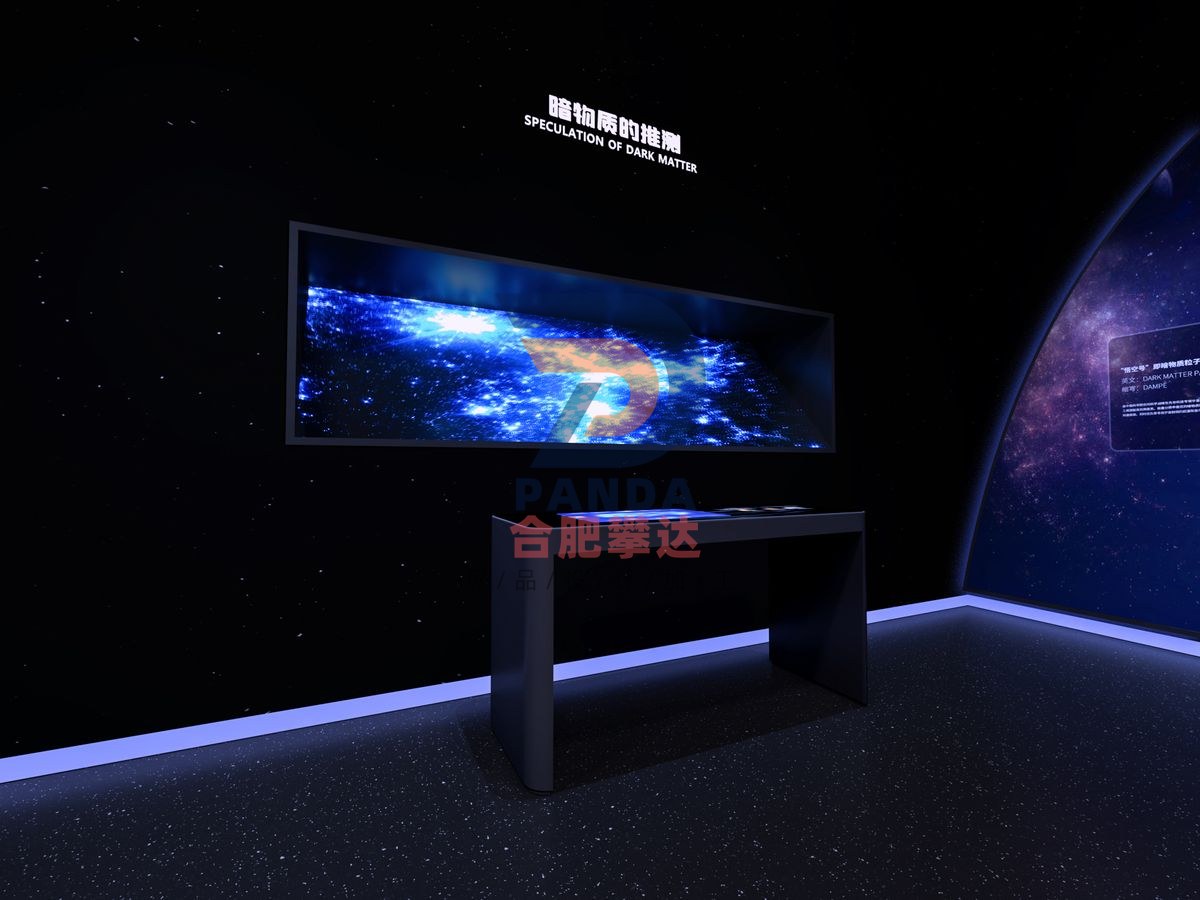
Speculations on Dark Matter
Aerospace · Interactive
- DimensionsSubject to on-site plan
- PresentationInteractive
- PricingQuoted by manufacture spec
Speculations on Dark Matter is a hands-on, mechanical & electromechanical interactive exhibit manufactured by Hefei Panda for science centers, children’s museums, discovery centers, STEM learning centers and family entertainment centers. Engineered for durable, robust, low-maintenance, high-traffic gallery installation, it turns abstract scientific concepts into direct, interactive visitor exploration. Hefei Panda is a global exhibit manufacturer exporting hands-on science displays to 50+ countries, with in-house engineering, fabrication, installation and commissioning.
Exhibit Summary
Speculations on Dark Matter is a Interactive interactive exhibit in the Aerospace category, designed for science centers, children’s museums, discovery centers, STEM learning centers and family entertainment centers. Built as a hands-on, mechanical & electromechanical display, it turns an abstract scientific concept into direct, interactive visitor exploration, and is engineered for durable, low-maintenance, high-traffic gallery use.
Scientific Principle
The displays combine phantom imaging and touch screens to allow the audience to grasp the process of scientists speculating on the existence of dark matter and the process of revealing evidence for the existence of dark matter. They will also realize the exploratory and empirical spirit of scientists, the mystery of the universe and the greatness of cutting-edge science, and thus become interested in exploring the universe.
Operation
Dark matter is a hypothetical form of matter thought to account for approximately 85% of the matter in the universe. Dark matter does not interact with electromagnetic fields and does not absorb, reflect or emit electromagnetic radiation, making it difficult to detect. Several observed phenomena cannot be explained by existing gravity theories and require the existence of more invisible "dark matter". (1) In a speech in 1884, Lord Kelvin estimated the mass of the Milky Way based on the velocity dispersion of stars and found that it was greater than the total visible stellar mass. Lord Kelvin therefore concluded: "Of the one billion stars we envisage, many, perhaps the vast majority, may be dark bodies." (2) In 1906, Henri Poincaré used the French word matière obscure ("dark matter") when discussing Kelvin's work in "The Theory of Galaxies and Gases" (3) In 1922, Dutch astronomer Jacobus Kapteyn was the first to suggest the existence of dark matter using stellar velocities. (4) In 1932, Dutchman and radio astronomy pioneer Jan Oort discovered that the mass of stars on the galactic plane was greater than observed, suggesting the existence of dark matter. (5) In 1933, Swiss astrophysicist Fritz Zwicky made a similar inference while studying galaxy clusters at the California Institute of Technology. Zwicky applied the virial force theorem to the Coma cluster and obtained evidence for an invisible substance he called "dunkle material." Zwicky estimated its mass based on the motion of galaxies near its edges and compared it with estimates based on its brightness and the number of galaxies. He estimated that the mass of the galaxy cluster is about 400 times the mass of visible matter. (6) The work of Vera Rubin and others in the 1960s and 1970s also provided further strong evidence using galaxy rotation curves. The research results of Rubin and others show that the invisible mass of most galaxies must be 6 times the visible mass. (7) A series of observations in the 1980s supported the existence of dark matter, including the gravitational lensing effect of galaxy clusters on background objects, the temperature distribution of hot gas in galaxies and galaxy clusters, and the anisotropic pattern of the cosmic microwave background. The displays show the process of scientists speculating on the existence of dark matter and the process of confirming the existence of dark matter. However, dark matter knowledge points themselves have unknown factors and are difficult to grasp. Therefore, the display method of phantom imaging is added to create an atmosphere of galaxies suspended in the sky. The audience can control the number of galaxies, making obscure science issues more fantasy and stimulating the curiosity of the audience.
Export-Ready Features
- Durable, robust construction for high-traffic gallery environments
- Low-maintenance electromechanical design with reliable, safe components
- Custom sizing, theming & multilingual labeling available
- OEM & turnkey exhibit solutions with full project management
- Overseas shipping, export documentation & on-site installation supported
- Shipped to science centers and museums in 50+ countries