
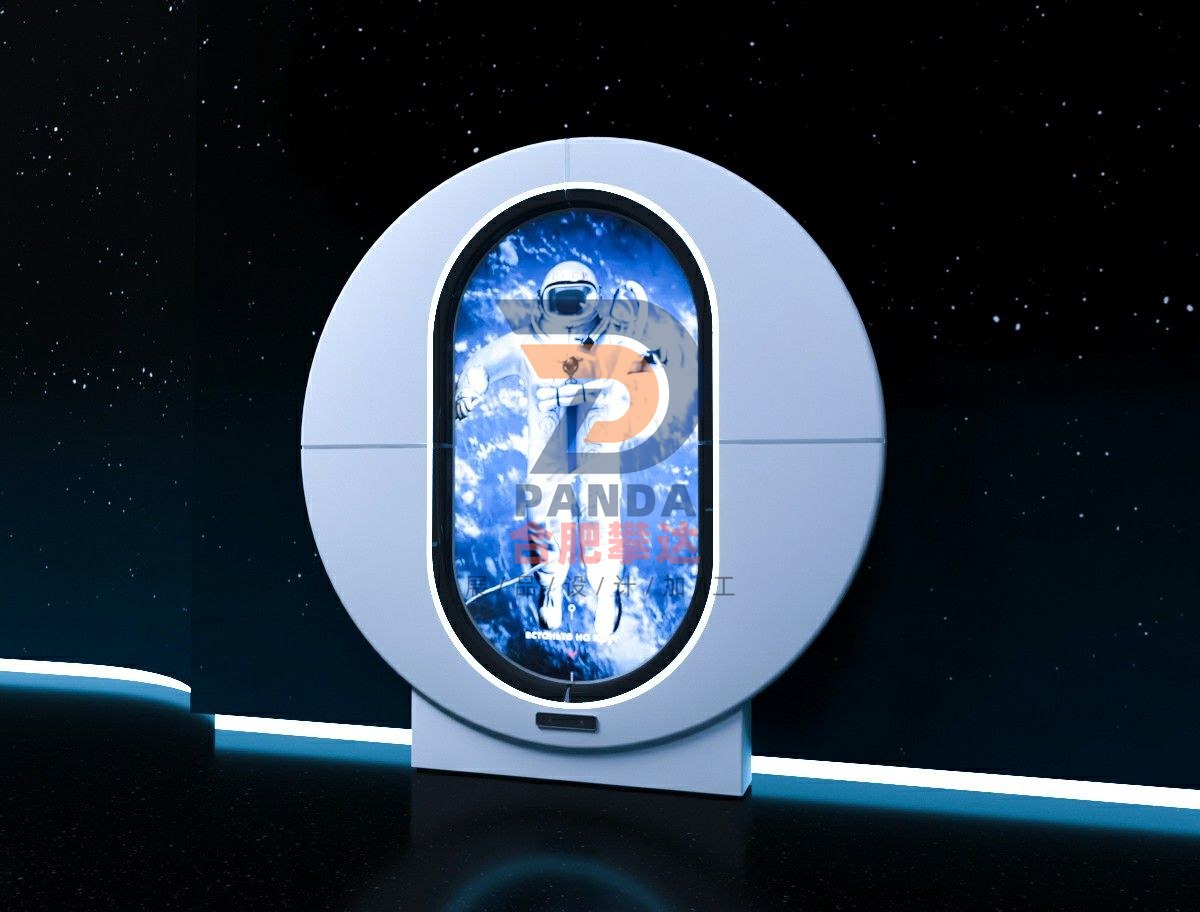
Virtual Wearing of Space Suits
Aerospace · Interactive
- DimensionsSubject to on-site plan
- PresentationInteractive
- PricingQuoted by manufacture spec
Virtual Wearing of Space Suits is a hands-on, mechanical & electromechanical interactive exhibit manufactured by Hefei Panda for science centers, children’s museums, discovery centers, STEM learning centers and family entertainment centers. Engineered for durable, robust, low-maintenance, high-traffic gallery installation, it turns abstract scientific concepts into direct, interactive visitor exploration. Hefei Panda is a global exhibit manufacturer exporting hands-on science displays to 50+ countries, with in-house engineering, fabrication, installation and commissioning.
Exhibit Summary
Virtual Wearing of Space Suits is a Interactive interactive exhibit in the Aerospace category, designed for science centers, children’s museums, discovery centers, STEM learning centers and family entertainment centers. Built as a hands-on, mechanical & electromechanical display, it turns an abstract scientific concept into direct, interactive visitor exploration, and is engineered for durable, low-maintenance, high-traffic gallery use.
Scientific Principle
The displays use a somatosensory multimedia hands-on method to show the audience the design features and different structures of China's aerial space suits (inside and outside the cabin) and space suits from around the world, allowing the audience to deepen their understanding of the shape, material, structure and function of the space suit.
Operation
Due to the harsh environment of space, astronauts must wear extravehicular spacesuits when leaving the spacecraft to isolate the astronaut's body from the harsh environment of space and provide the astronauts with an environment equivalent to the ground. The extravehicular space suit is equivalent to a miniature manned spacecraft. The technology is very complex and is an important manifestation of a country's manned space capabilities. It consists of clothing, helmets, gloves and space boots, etc. The most complex one is the clothing, which is composed of multiple layers. The innermost layer is the lining and urine collection unit; outside the lining is a liquid-cooling ventilation layer for heat dissipation; outside the liquid-cooling ventilation layer is a pressurized airtight layer used to generate a certain pressure; then there is a restriction layer that restricts the outward expansion of the pressurized airtight layer; outside the restriction layer is a layer to deal with the outside of the cabin. Thermal insulation layer with large temperature difference; the outermost layer is the protective layer, which is made of a variety of fiber composite fabrics and has good softness, penetration resistance, wear resistance, high temperature resistance, combustion resistance, corrosion resistance, radiation protection function and interface to connect other equipment. The helmet of the extravehicular space suit is composed of a helmet shell, a face window structure, a collar and other components. The material used in the helmet shell has the advantages of high strength and impact resistance. Before leaving the cabin, the inside of the helmet's visor window should be sprayed with anti-fog agent. The gloves and clothing are connected via wrist loops, and the boots consist of pressure boots and extravehicular thermal protective boots. The extravehicular spacesuit is equipped with a portable life support system on the back that provides oxygen and other conditions needed to maintain life. The "Flying" extravehicular spacesuit worn by Zhai Zhigang, my country's first spacewalker, in 2008 weighs 120 kilograms, is 2 meters high, and is equipped with a 1.30-meter-high life support system backpack. It can support at least 4 hours of extravehicular activities, can be reused more than 5 times, and is worth more than 30 million yuan. It is divided into 6 layers from the inside to the outside: comfort layer, backup airtight layer, main airtight layer, restriction layer, heat insulation layer, and outer protective layer. It has functions such as radiation protection, temperature regulation, and pressure regulation, as well as a complete life support system. The "Virtual Wearing of Space Suits" display focuses on the appearance, structure and function of various types of space suits, and uses somatosensory hands-on technology to virtually "wear" the space suits. The somatosensory acquisition system consists of somatosensory cameras and image processing systems, which are used to capture and process the hand and body movements of the audience. Audiences stand in the designated hands-on area and choose different space clothing and decorations by waving left or right. At the same time, they can take photos and upload avatars to get short videos or pictures of simulating wearing space suits.
Export-Ready Features
- Durable, robust construction for high-traffic gallery environments
- Low-maintenance electromechanical design with reliable, safe components
- Custom sizing, theming & multilingual labeling available
- OEM & turnkey exhibit solutions with full project management
- Overseas shipping, export documentation & on-site installation supported
- Shipped to science centers and museums in 50+ countries