
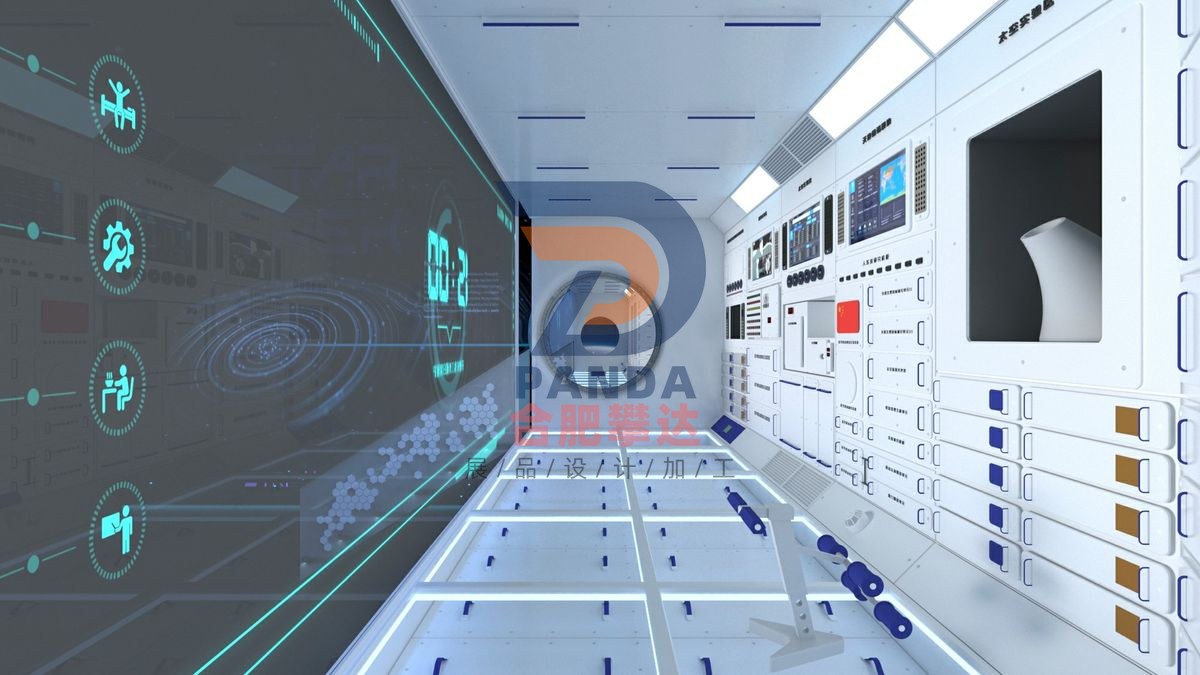
Core module work area
Aerospace · Interactive
- DimensionsSubject to on-site plan
- PresentationInteractive
- PricingQuoted by manufacture spec
Core module work area is a hands-on, mechanical & electromechanical interactive exhibit manufactured by Hefei Panda for science centers, children’s museums, discovery centers, STEM learning centers and family entertainment centers. Engineered for durable, robust, low-maintenance, high-traffic gallery installation, it turns abstract scientific concepts into direct, interactive visitor exploration. Hefei Panda is a global exhibit manufacturer exporting hands-on science displays to 50+ countries, with in-house engineering, fabrication, installation and commissioning.
Exhibit Summary
Core module work area is a Interactive interactive exhibit in the Aerospace category, designed for science centers, children’s museums, discovery centers, STEM learning centers and family entertainment centers. Built as a hands-on, mechanical & electromechanical display, it turns an abstract scientific concept into direct, interactive visitor exploration, and is engineered for durable, low-maintenance, high-traffic gallery use.
Scientific Principle
The displays allow the audience to personally walk into the "Tianhe" core module and truly grasp the working environment and experimental facilities of the astronauts in the core module. Through the multimedia system, they can compare and grasp knowledge content such as space planting, space cell experiments, and space experiment development, and feel the beauty and magic of space.
Operation
Science experiments are carried out in the "microgravity" environment of the space station, involving almost all current science and technological fields. Each experimental cabinet on my country's space station is an experimental research platform for professional disciplines or research fields. It can support space science and applied research in one or more directions and meet the needs of space science experiments in different disciplines and fields. Its experimental research directions can be generally planned into three major categories: the first category is mostly innovative experiments and applied research based on the frontiers of science, contributing to mankind's further understanding of the universe and improving the living standards of the earth; the second category is research on major medical issues of long-term manned spaceflight in low-Earth orbit, including long-term weightlessness. and the impact and protection of space radiation on astronauts’ health, advanced on-orbit monitoring and medical treatment technologies, etc., to solve the basic problems of long-term human survival in space; the third category is the verification of new technologies for future manned spacecraft, such as inflatable residential cabins, space robots, space additive manufacturing, in-situ resource utilization, etc. The displays focus on showing the space experiments of astronauts in the core module of the space station. By allowing the audience to personally enter the core module, they can grasp the introduction of plant-related experiments in the "microgravity" environment of space, simulate space cell experiments, and watch the images of space cell specimens, inspiring young people and the public to think about the science principles behind it.
Export-Ready Features
- Durable, robust construction for high-traffic gallery environments
- Low-maintenance electromechanical design with reliable, safe components
- Custom sizing, theming & multilingual labeling available
- OEM & turnkey exhibit solutions with full project management
- Overseas shipping, export documentation & on-site installation supported
- Shipped to science centers and museums in 50+ countries