
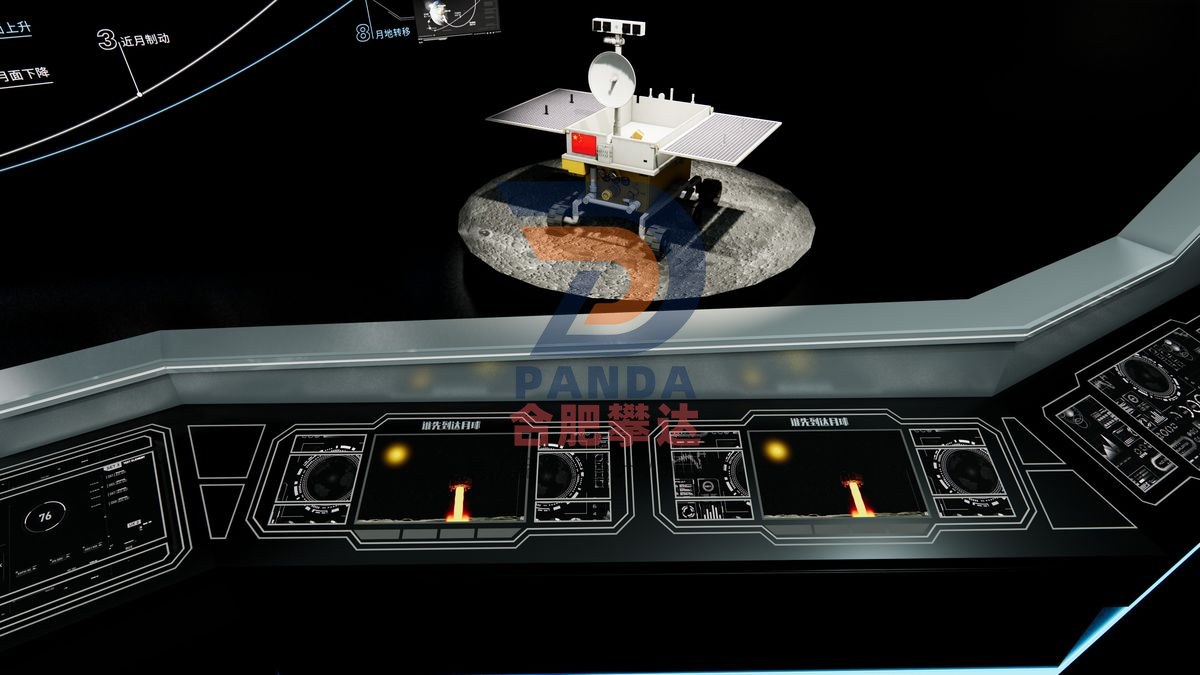
Who will reach the moon first
Aerospace · Interactive
- DimensionsSubject to on-site plan
- PresentationInteractive
- PricingQuoted by manufacture spec
Who will reach the moon first is a hands-on, mechanical & electromechanical interactive exhibit manufactured by Hefei Panda for science centers, children’s museums, discovery centers, STEM learning centers and family entertainment centers. Engineered for durable, robust, low-maintenance, high-traffic gallery installation, it turns abstract scientific concepts into direct, interactive visitor exploration. Hefei Panda is a global exhibit manufacturer exporting hands-on science displays to 50+ countries, with in-house engineering, fabrication, installation and commissioning.
Exhibit Summary
Who will reach the moon first is a Interactive interactive exhibit in the Aerospace category, designed for science centers, children’s museums, discovery centers, STEM learning centers and family entertainment centers. Built as a hands-on, mechanical & electromechanical display, it turns an abstract scientific concept into direct, interactive visitor exploration, and is engineered for durable, low-maintenance, high-traffic gallery use.
Scientific Principle
The displays provide an hands-on experience via multimedia inquiry, allowing the audience to grasp the relevant knowledge of lunar exploration from Chang'e 1 to Chang'e 5. At the same time, during the hands-on process, they can grasp the lunar landforms and China's lunar exploration footprints.
Operation
The lunar exploration project is my country's first close-range detection of stars other than the earth. It is the first step towards deep space exploration. Therefore, the orbit design of the lunar exploration satellite under the condition of three-body motion of the earth, moon, and satellite is more complicated than the previous design under the condition of relative motion of the earth and satellite. China's lunar exploration project is planned to be divided into three phases: "circling, landing and returning". The first phase of "orbiting" refers to the development and launch of my country's first lunar exploration satellite and the implementation of orbiting and lunar exploration; the second phase of "landing" refers to the first lunar soft landing and automatic patrol survey; the second phase of "landing" refers to the first lunar soft landing and automatic patrol survey. At present, my country has successfully launched Chang'e 1 to Chang'e 5 lunar probes. Among them, Chang'e 5 is responsible for one of the most complex and difficult tasks in China's aerospace field to date. The complete success of its mission also marks the successful completion of the three-step lunar exploration project. The displays use multimedia hands-on inquiry methods to set up Chang'e 1 to Chang'e 5 detectors for the audience to choose to inquire about knowledge.
Export-Ready Features
- Durable, robust construction for high-traffic gallery environments
- Low-maintenance electromechanical design with reliable, safe components
- Custom sizing, theming & multilingual labeling available
- OEM & turnkey exhibit solutions with full project management
- Overseas shipping, export documentation & on-site installation supported
- Shipped to science centers and museums in 50+ countries