
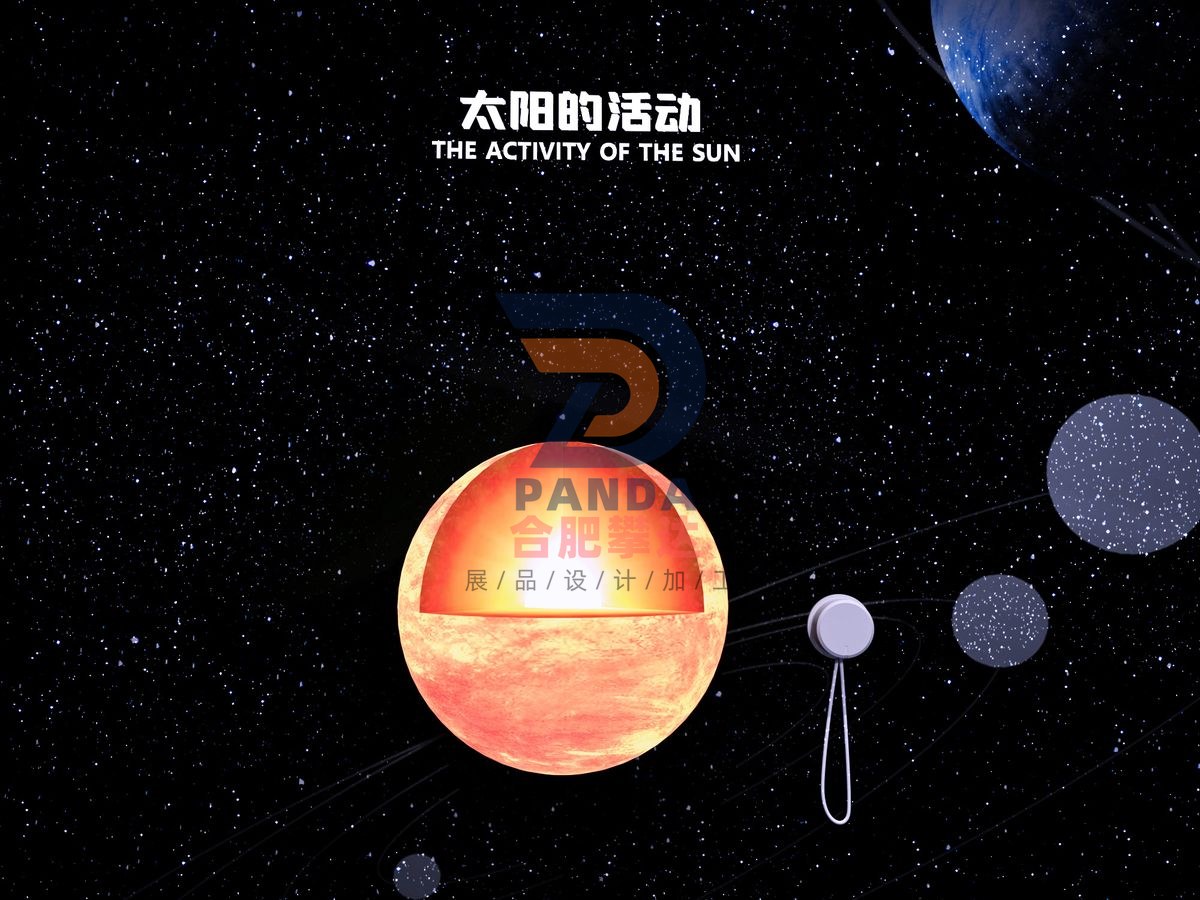
Activities of the Sun
Aerospace · Interactive
- DimensionsSubject to on-site plan
- PresentationInteractive
- PricingQuoted by manufacture spec
Activities of the Sun is a hands-on, mechanical & electromechanical interactive exhibit manufactured by Hefei Panda for science centers, children’s museums, discovery centers, STEM learning centers and family entertainment centers. Engineered for durable, robust, low-maintenance, high-traffic gallery installation, it turns abstract scientific concepts into direct, interactive visitor exploration. Hefei Panda is a global exhibit manufacturer exporting hands-on science displays to 50+ countries, with in-house engineering, fabrication, installation and commissioning.
Exhibit Summary
Activities of the Sun is a Interactive interactive exhibit in the Aerospace category, designed for science centers, children’s museums, discovery centers, STEM learning centers and family entertainment centers. Built as a hands-on, mechanical & electromechanical display, it turns an abstract scientific concept into direct, interactive visitor exploration, and is engineered for durable, low-maintenance, high-traffic gallery use.
Scientific Principle
The displays play the sounds of solar activities and model the internal structure of the sun, allowing the audience to hear and grasp solar activities and their impact on the earth.
Operation
Solar activity is the general term for all active phenomena in the solar atmosphere. Mainly include sunspots, spots, spectral spots, flares, prominences and coronal transient events. When the sun is in a period of intense activity, it radiates large amounts of ultraviolet, Solar activity: (1) Sunspots: Some dark spots sometimes appear on the surface of the sun’s photosphere, which are places where magnetic fields gather. These are sunspots; (2) Solar flare: A rapidly developing bright spot suddenly appears on the sun. Its lifespan is only between a few minutes and tens of minutes. The brightness rises rapidly and decreases slowly; (3) Light spots: Some are bright and some are dark on the surface of the photosphere. This kind of light and dark spots are formed due to the different temperatures here. The darker spots are called "sunspots" and the brighter spots are called "light spots". (4) Corona: During a total solar eclipse, the dark periphery of the sun is surrounded by silvery white light, which is buckled on the sun like a hat and is called the corona. (5) Solar prominence: During a total solar eclipse, the sun is surrounded by a red ring with bright red tongues of fire dancing on it. This tongue-shaped object is called a solar prominence. Comparison of sounds in the solar system: Although space is almost a vacuum and sound cannot propagate in space, this does not mean that there is no sound in space. Sound in space exists in the form of electromagnetic vibrations. Scientists capture the electromagnetic signals emitted by the planet via an "astronomical interferometer", and then convert these electromagnetic signals into sound frequencies that can be heard by human ears, so that the sounds of the planet can be heard. The displays mainly introduce the types, characteristics and impacts of solar activities. According to the structural form of the sun, the structure is perfectly displayed via the solar model, and the internal structure of the sun is displayed via sectioning.
Export-Ready Features
- Durable, robust construction for high-traffic gallery environments
- Low-maintenance electromechanical design with reliable, safe components
- Custom sizing, theming & multilingual labeling available
- OEM & turnkey exhibit solutions with full project management
- Overseas shipping, export documentation & on-site installation supported
- Shipped to science centers and museums in 50+ countries