
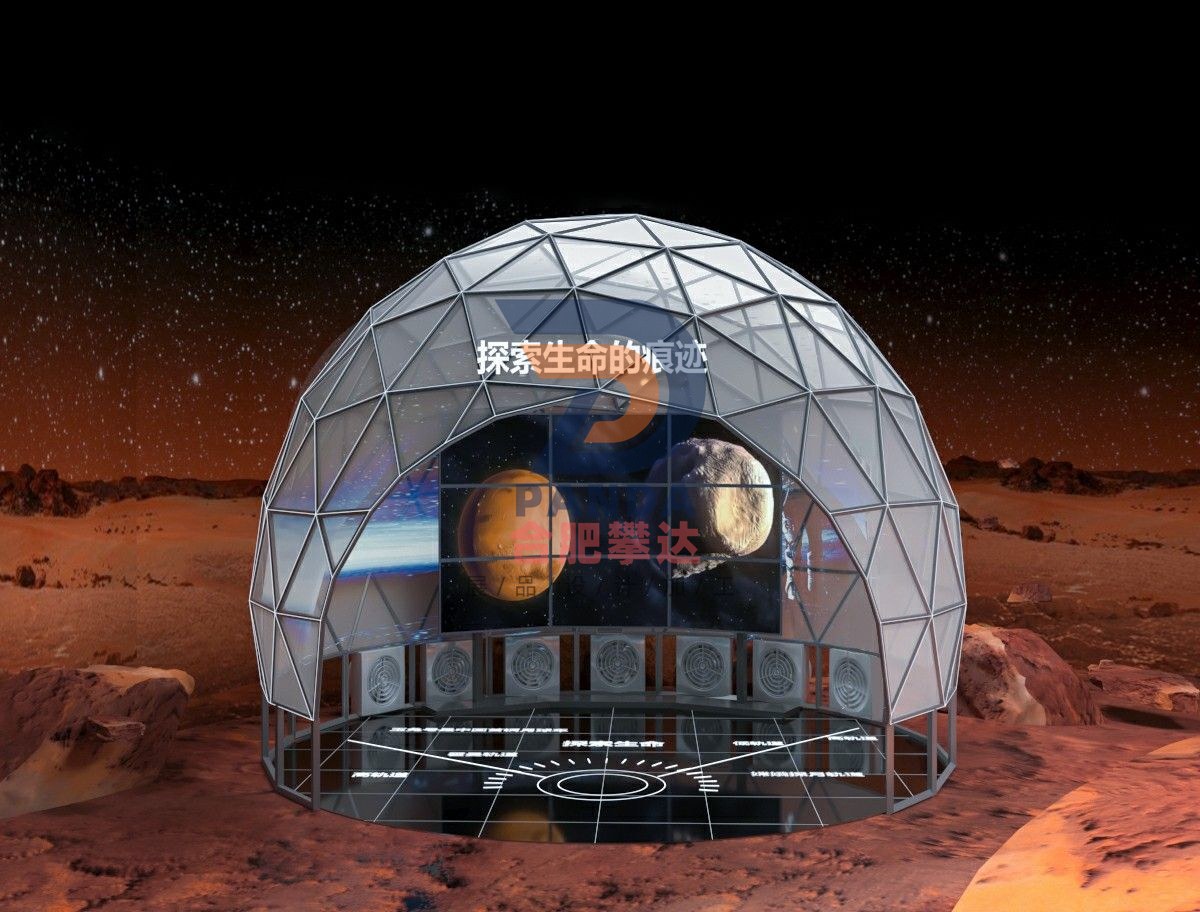
Exploring traces of life
Aerospace · Interactive
- DimensionsSubject to on-site plan
- PresentationInteractive
- PricingQuoted by manufacture spec
Exploring traces of life is a hands-on, mechanical & electromechanical interactive exhibit manufactured by Hefei Panda for science centers, children’s museums, discovery centers, STEM learning centers and family entertainment centers. Engineered for durable, robust, low-maintenance, high-traffic gallery installation, it turns abstract scientific concepts into direct, interactive visitor exploration. Hefei Panda is a global exhibit manufacturer exporting hands-on science displays to 50+ countries, with in-house engineering, fabrication, installation and commissioning.
Exhibit Summary
Exploring traces of life is a Interactive interactive exhibit in the Aerospace category, designed for science centers, children’s museums, discovery centers, STEM learning centers and family entertainment centers. Built as a hands-on, mechanical & electromechanical display, it turns an abstract scientific concept into direct, interactive visitor exploration, and is engineered for durable, low-maintenance, high-traffic gallery use.
Scientific Principle
This display hopes that the displays can simulate a Mars base, combined with hands-on games, so that the audience can grasp the physical detection tools and detection missions of Mars, and experience the status and pictures of humans walking on Mars.
Operation
Mars exploration refers to the science exploration activities of humans by launching space probes to Mars. Scientists believe there may be life on Mars, or at least there once was. First, there is water on Mars. In 2013, the Curiosity Mars rover also discovered water-containing minerals on Mars. In addition, via pictures taken by the Mars probe, scientists found that there are a large number of traces of erosion and erosion on the surface of Mars. Second, scientists discovered a meteorite containing "fossils of Martian life." In 1984, scientists discovered a meteorite in Antarctica and named it "Allen Hills 84001." After research, scientists believe that this is a Martian meteorite. Scientists have used high-resolution electron microscopes to conduct in-depth studies of Martian meteorites and believe that about 25% of the crystal structure inside them was formed by bacteria. It became strong evidence that life once existed on Mars. Third, the Mars probe found methane in the Martian atmosphere, which is considered evidence of life. There is a certain concentration of methane in the Martian atmosphere, indicating that methane gas is constantly being replenished into the atmosphere. Scientists believe there are three possible sources. One is the impact of asteroids and comets on Mars; the other is released by volcanic eruptions; and the third is produced by microorganisms on Mars. There are some microbial life activities such as bacteria on the earth that can produce methane gas. In 1984, the discovery of the "Allen Hills 84001" Martian meteorite became strong evidence that life once existed on Mars.
Export-Ready Features
- Durable, robust construction for high-traffic gallery environments
- Low-maintenance electromechanical design with reliable, safe components
- Custom sizing, theming & multilingual labeling available
- OEM & turnkey exhibit solutions with full project management
- Overseas shipping, export documentation & on-site installation supported
- Shipped to science centers and museums in 50+ countries