
The Earth's Internal Structure
Earth & Planet · Interactive
- DimensionsSubject to on-site plan
- PresentationInteractive
- PricingQuoted by manufacture spec
The Earth's Internal Structure is a hands-on, mechanical & electromechanical interactive exhibit manufactured by Hefei Panda for science centers, children’s museums, discovery centers, STEM learning centers and family entertainment centers. Engineered for durable, robust, low-maintenance, high-traffic gallery installation, it turns abstract scientific concepts into direct, interactive visitor exploration. Hefei Panda is a global exhibit manufacturer exporting hands-on science displays to 50+ countries, with in-house engineering, fabrication, installation and commissioning.
Exhibit Summary
The Earth's Internal Structure is a Interactive interactive exhibit in the Earth & Planet category, designed for science centers, children’s museums, discovery centers, STEM learning centers and family entertainment centers. Built as a hands-on, mechanical & electromechanical display, it turns an abstract scientific concept into direct, interactive visitor exploration, and is engineered for durable, low-maintenance, high-traffic gallery use.
Scientific Principle
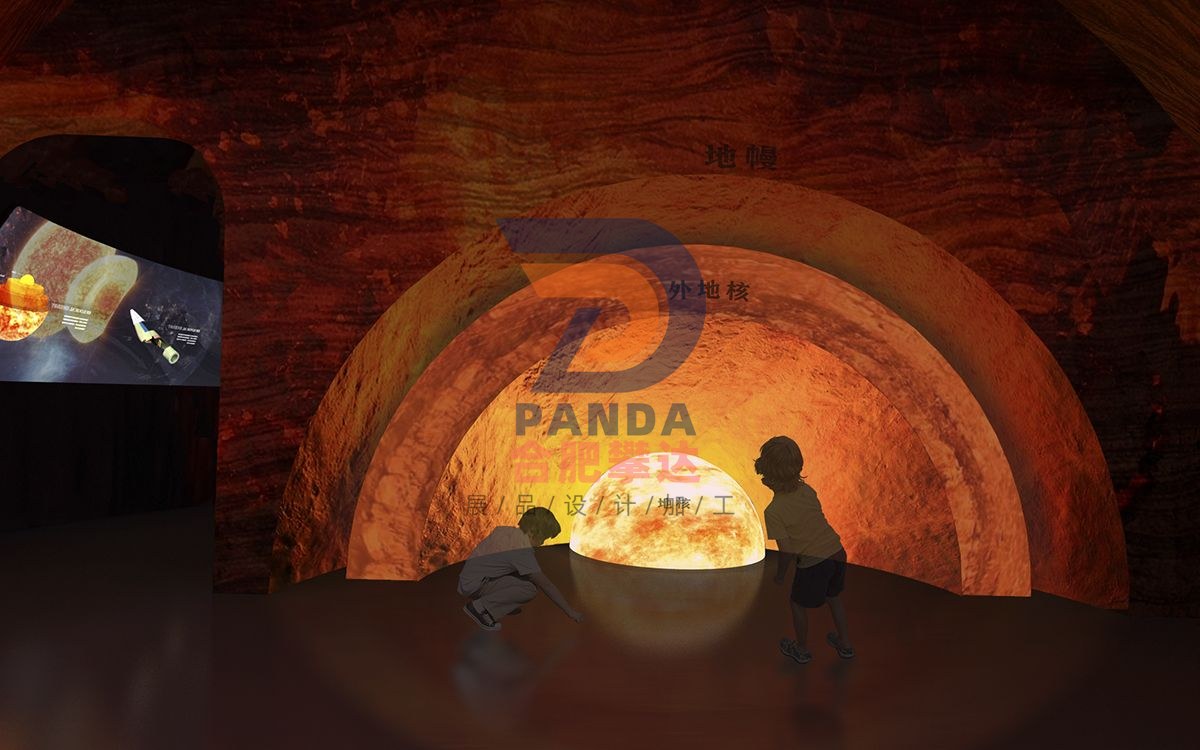
This display is located inside the "Earth's Outer Sphere". It creates an atmospheric scene inside the Earth via a relatively independent and closed spherical space, allowing the audience to immerse themselves in understanding the Earth's internal structure and feel the light and heat of the Earth's core. At the same time, independent multimedia hands-on displays are set up. Through hands-on operations, the audience can enter the exploration journey deep underground, thereby forming a complete understanding of the internal structure of the earth.
Operation
The earth’s inner sphere is divided into crust, mantle and core from outside to inside. The interface between the crust and the mantle is the Moho interface, and the interface between the mantle and the core is the Gutenberg interface. (1) Earth’s core: Mainly composed of iron and nickel elements. It is divided into an outer core and an inner core; the outer core is a molten metal substance, and its movement forms the earth's magnetic field; the inner core is a solid metal ball with extremely high pressure and strong pressure. (2) Mantle: It is divided into upper mantle and lower mantle. There is an asthenosphere (80 to 400 kilometers underground) in the upper part of the upper mantle. The temperature is very high, it displays partial melting and can flow slowly. The movement of the earth's plates is related to it. (3) Crust: A hard shell composed of solid rock on the surface of the earth; the thickness varies. The oceanic crust is thin, generally 5,000-10 kilometers, and the continental crust is thick, with an average thickness of about 39,000-41 kilometers. The crust is thicker in tall mountains, with a maximum thickness of 70 kilometers. This display is located inside the display "The Earth's Outer Sphere". It creates a scene-based atmosphere inside the Earth, forming a relatively independent and closed spherical space. At the same time, multimedia hands-on displays are set up to allow the audience to enter the earth's center of exploration. Through scene creation and media images, the composition of the Earth's interior is immersed, intuitive and hands-on.
Export-Ready Features
- Durable, robust construction for high-traffic gallery environments
- Low-maintenance electromechanical design with reliable, safe components
- Custom sizing, theming & multilingual labeling available
- OEM & turnkey exhibit solutions with full project management
- Overseas shipping, export documentation & on-site installation supported
- Shipped to science centers and museums in 50+ countries