
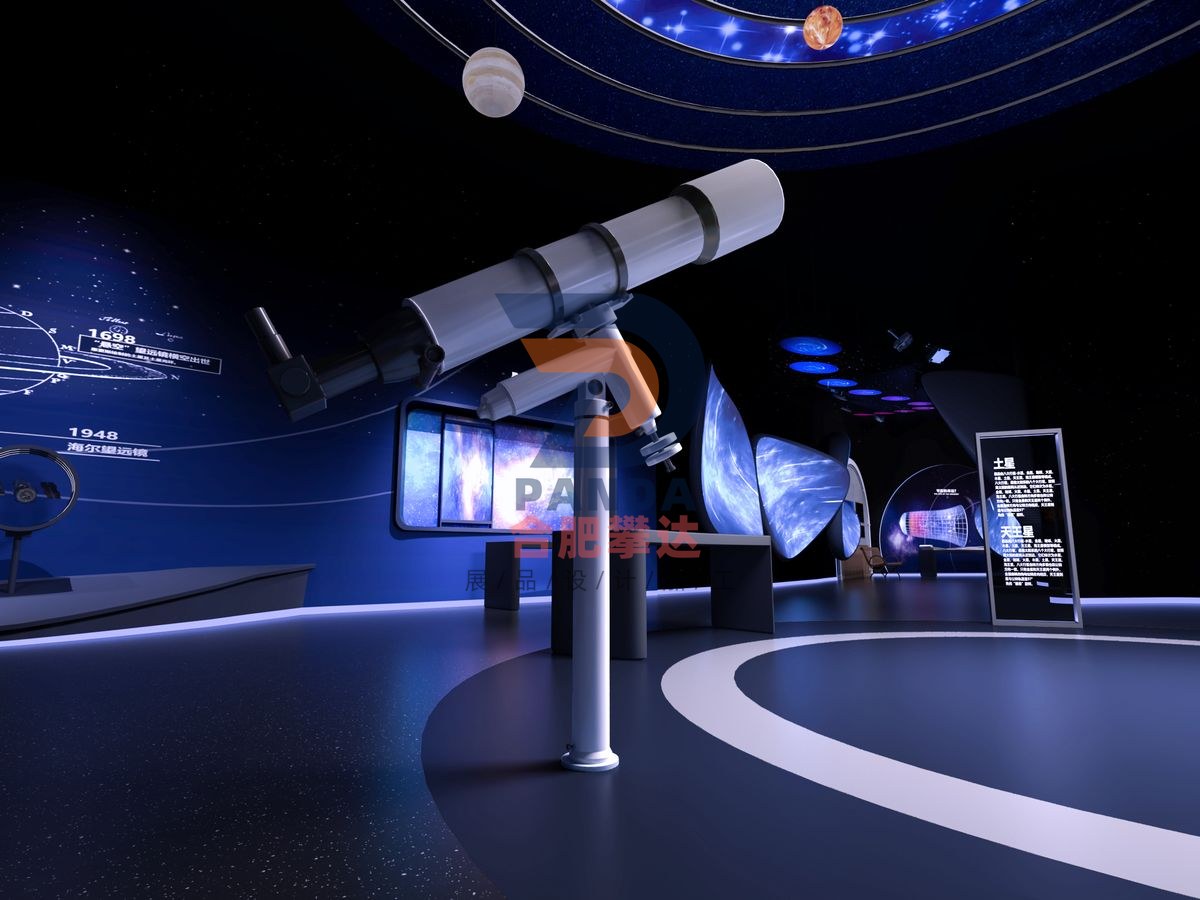
Searching for Planets with Life (VR Telescope)
Aerospace · Interactive
- DimensionsSubject to on-site plan
- PresentationInteractive
- PricingQuoted by manufacture spec
Searching for Planets with Life (VR Telescope) is a hands-on, mechanical & electromechanical interactive exhibit manufactured by Hefei Panda for science centers, children’s museums, discovery centers, STEM learning centers and family entertainment centers. Engineered for durable, robust, low-maintenance, high-traffic gallery installation, it turns abstract scientific concepts into direct, interactive visitor exploration. Hefei Panda is a global exhibit manufacturer exporting hands-on science displays to 50+ countries, with in-house engineering, fabrication, installation and commissioning.
Exhibit Summary
Searching for Planets with Life (VR Telescope) is a Interactive interactive exhibit in the Aerospace category, designed for science centers, children’s museums, discovery centers, STEM learning centers and family entertainment centers. Built as a hands-on, mechanical & electromechanical display, it turns an abstract scientific concept into direct, interactive visitor exploration, and is engineered for durable, low-maintenance, high-traffic gallery use.
Scientific Principle
The displays switch screens by rotating the knob of the telescope body, showing the appearance of various celestial bodies in the solar system (including the sun, planets, dwarf planets, asteroids, satellites, comets, etc.).
Operation
Definition of dwarf planet: or "dwarf planet", which is between a planet and an asteroid in size, orbits a star, has enough mass to overcome the gravity of solids to achieve a hydrostatic equilibrium (nearly spherical) shape, does not clear other celestial bodies in its orbit, and is not a planet. Among celestial bodies orbiting directly around the sun, Pluto ranks 9th in volume and 10th in mass. In 1930, Clyde Tombaugh discovered Pluto and regarded it as the ninth planet. After 1992, some objects with a mass similar to Pluto were discovered in the Kuiper Belt, which began to challenge its planetary status. Eris, which was discovered in 2005, is even 27% more massive than Pluto. Therefore, the International Astronomical Union (IAU) officially defined the concept of a planet in 2006, excluding Pluto from the ranks of planets and reclassifying it as a dwarf planet. Representative dwarf planets: Pluto, Charon, Eris, Ceres, Makemake, Haumea, and Gonggong. The displays have the same content as "02-11 Understanding Planets", but the heights of the two telescopes are different, meeting the needs of different groups of people.
Export-Ready Features
- Durable, robust construction for high-traffic gallery environments
- Low-maintenance electromechanical design with reliable, safe components
- Custom sizing, theming & multilingual labeling available
- OEM & turnkey exhibit solutions with full project management
- Overseas shipping, export documentation & on-site installation supported
- Shipped to science centers and museums in 50+ countries