
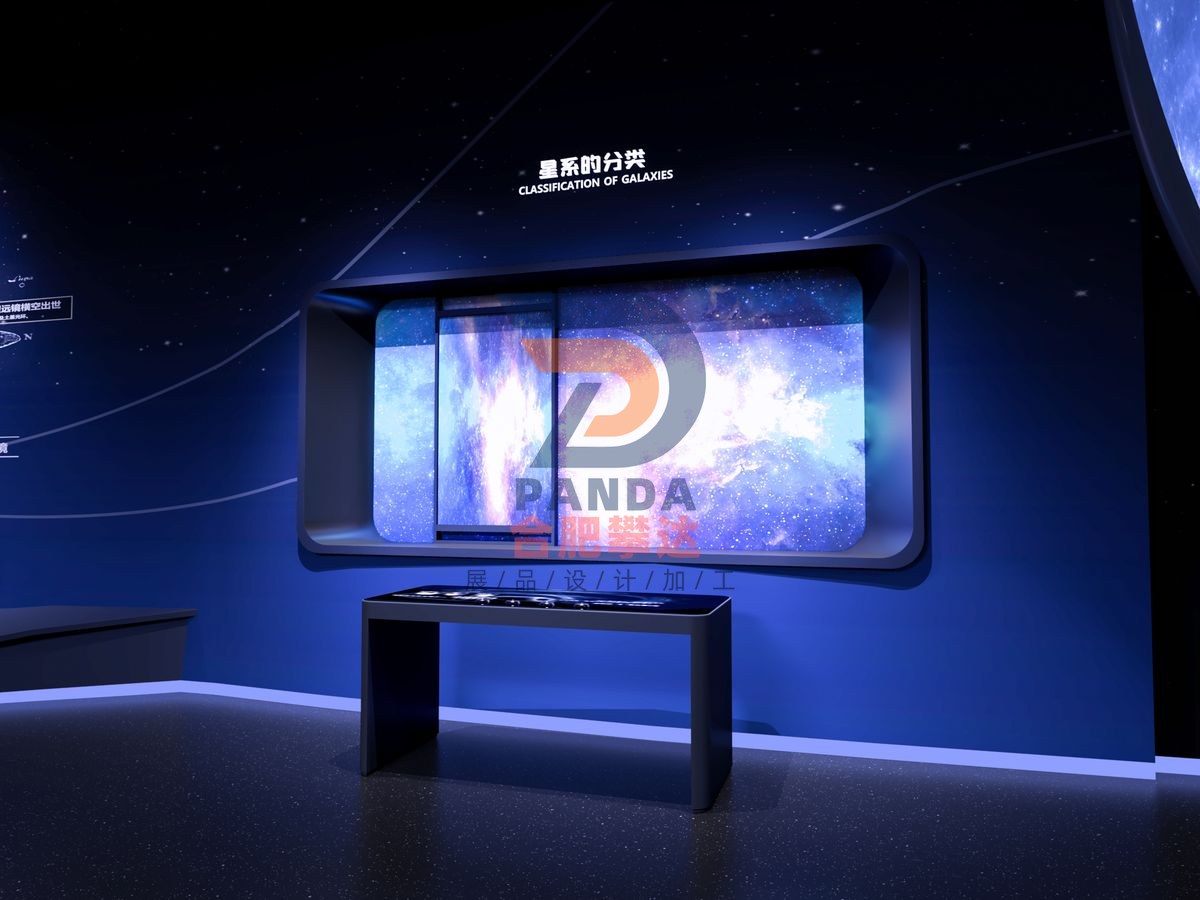
Classification of galaxies
Aerospace · Interactive
- DimensionsSubject to on-site plan
- PresentationInteractive
- PricingQuoted by manufacture spec
Classification of galaxies is a hands-on, mechanical & electromechanical interactive exhibit manufactured by Hefei Panda for science centers, children’s museums, discovery centers, STEM learning centers and family entertainment centers. Engineered for durable, robust, low-maintenance, high-traffic gallery installation, it turns abstract scientific concepts into direct, interactive visitor exploration. Hefei Panda is a global exhibit manufacturer exporting hands-on science displays to 50+ countries, with in-house engineering, fabrication, installation and commissioning.
Exhibit Summary
Classification of galaxies is a Interactive interactive exhibit in the Aerospace category, designed for science centers, children’s museums, discovery centers, STEM learning centers and family entertainment centers. Built as a hands-on, mechanical & electromechanical display, it turns an abstract scientific concept into direct, interactive visitor exploration, and is engineered for durable, low-maintenance, high-traffic gallery use.
Scientific Principle
The Hubble galaxy classification method is a galaxy classification method widely used by astronomers. The displays allow the audience to grasp the types of galaxies by collecting games of the same type of galaxies.
Operation
According to Hubble’s galaxy classification, galaxies can be roughly divided into three categories: elliptical galaxies, spiral galaxies and irregular galaxies. Spiral galaxies are further divided into spiral galaxies and barred spiral galaxies according to whether the core of the galaxy is spherical or bar-shaped. Later, due to the continuity problem of the classification of elliptical galaxies and spiral galaxies, lenticular galaxies were defined as being between the two. (1) Whirlpool galaxy: About 25% to 30% of the galaxies in the universe adjacent to the Milky Way are spiral galaxies. Each spiral galaxy has a flat disk-like structure rich in gas and dust that rotates around a spherical core or bar-shaped axis. The centers of spiral galaxies are usually old red or yellow stars, often twisted into bar-like structures. The disk of a spiral galaxy is evenly dotted with stars, but the young, bright blue-white stars are found only in the spiral arms. Surrounding the disk is a spherical "halo" in which globular star clusters and stray stars orbit. (2) Elliptical galaxy: Elliptical galaxies are those galaxies that are spherical in appearance. They cover a wide range of scales, from the largest galaxies to the smallest galaxies. Elliptical galaxies exist. Some of them are shaped like eggs or even cigarettes. It is worth mentioning that the largest elliptical galaxies are often very close to perfect spheres. (3) Lenticular galaxies: Lenticular galaxies look similar to elliptical galaxies because they are dominated by bulges of old red and yellow stars. Lenticular galaxies are similar in size and overall appearance to spiral galaxies, except that their bulges are much larger than those of similarly sized spiral galaxies. They are shaped like lenses and are therefore called "lensed galaxies". (4) Irregular galaxies: Some galaxies are deformed due to collisions with companion galaxies or the gravitational influence of neighboring galaxies. These galaxies are usually classified as "special galaxies." Many of these are true irregular galaxies, which often contain large amounts of gas, dust, and hot blue stars. The famous Small Magellanic Cloud is an irregular galaxy. There are countless galaxies of different sizes and shapes in the universe. According to Hubble's classification, they can be roughly divided into three categories: elliptical galaxies, spiral galaxies and irregular galaxies.
Export-Ready Features
- Durable, robust construction for high-traffic gallery environments
- Low-maintenance electromechanical design with reliable, safe components
- Custom sizing, theming & multilingual labeling available
- OEM & turnkey exhibit solutions with full project management
- Overseas shipping, export documentation & on-site installation supported
- Shipped to science centers and museums in 50+ countries