
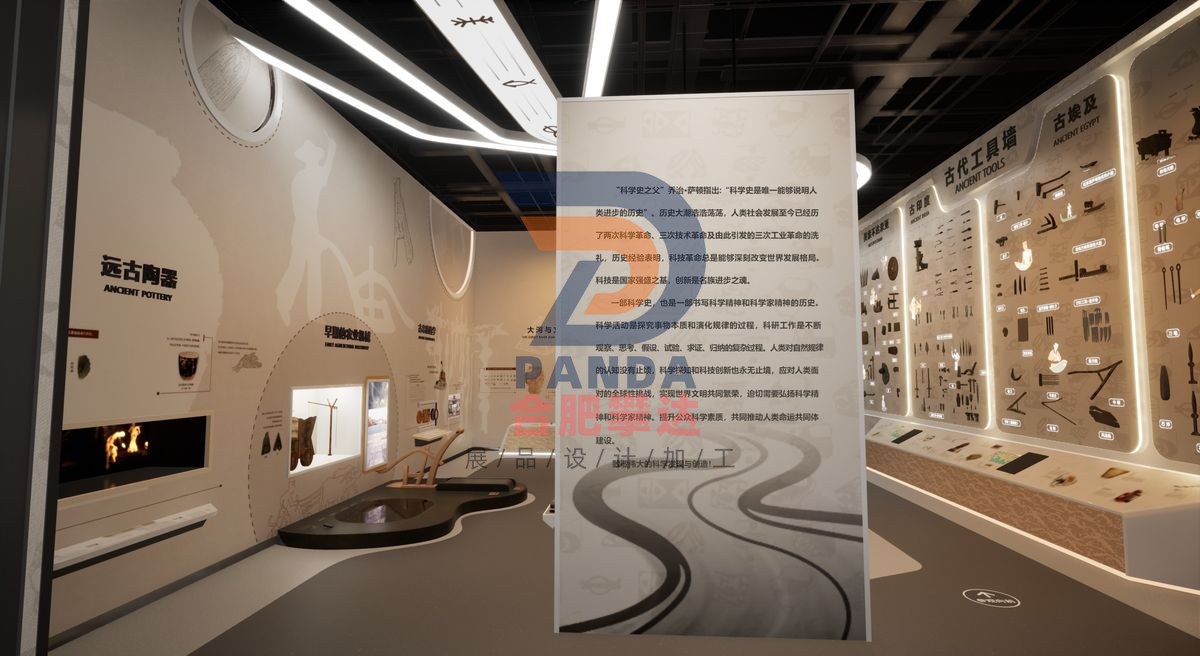
The Footprint of Science
Smart Technology · Interactive
- DimensionsSubject to on-site plan
- PresentationInteractive
- PricingQuoted by manufacture spec
The Footprint of Science is a hands-on, mechanical & electromechanical interactive exhibit manufactured by Hefei Panda for science centers, children’s museums, discovery centers, STEM learning centers and family entertainment centers. Engineered for durable, robust, low-maintenance, high-traffic gallery installation, it turns abstract scientific concepts into direct, interactive visitor exploration. Hefei Panda is a global exhibit manufacturer exporting hands-on science displays to 50+ countries, with in-house engineering, fabrication, installation and commissioning.
Exhibit Summary
The Footprint of Science is a Interactive interactive exhibit in the Smart Technology category, designed for science centers, children’s museums, discovery centers, STEM learning centers and family entertainment centers. Built as a hands-on, mechanical & electromechanical display, it turns an abstract scientific concept into direct, interactive visitor exploration, and is engineered for durable, low-maintenance, high-traffic gallery use.
Scientific Principle
As the first display with a leading role, "The Footprint of Science" leads the audience back to the development of science and technology, and feels the magnificent journey of science. As an emotional foreshadowing, it guides the audience into the first exhibition area - the prologue of civilization, and begins the journey of science exploration.
Operation
The footprints of science can be traced back to ancient times, which was the starting point of technology and civilization for human survival. Subsequently, several large river basins gradually gave birth to the fertile soil for mankind's earliest civilization. Tools and technology, mathematics, astronomy and calendars continued to advance. Human beings gradually learned how to explore, grasp and control their environment. In Greece, the place where the science spirit originated, natural science achievements that influenced the world were created during the classical era and the Hellenistic period. When the glory of European science dimmed in the Middle Ages, China and Arabia suddenly emerged and reached a highly developed level of science and technology. In the 16th and 17th centuries, a science revolution broke out, prefaced by the astronomical revolution. Galileo pioneered science experimental methods, and Newton unified the forces in the sky and the forces on the earth. Modern science was born, and people's worldview and the way they acquired natural knowledge underwent fundamental changes. From the 18th century to the early 20th century, two industrial revolutions broke out one after another. Steam brought about a surge in speed, the internal combustion engine revolutionized transportation, and electromagnetism brought mankind into the electric age. Science gradually began to have a profound impact on society and increasingly became a social force driving history. At the rotate of the century, the theory of relativity founded by Einstein overturned the edifice of classical mechanics established by Newton and ushered in a new era of modern science; the research on nuclear energy opened the atomic energy age and changed the world structure; and the electronic age created by the electron tube and the wave of information technology set off by computers swept the world and created a new social landscape. The display is located at the entrance of the exhibition hall, in the form of an inverted cone trumpet, and uses a P2 full-color anti-collision LED screen to play video. The multimedia film adopts a flashback method, taking the current society we live in as the starting point of the scene. As time reverses, tens of thousands of years of science and technological achievements of human beings quietly emerge, and milestone moments in the course of science development appear before their eyes. The audience is led to trace the course of human science exploration, which serves as the beginning of the science journey exhibition hall.
Export-Ready Features
- Durable, robust construction for high-traffic gallery environments
- Low-maintenance electromechanical design with reliable, safe components
- Custom sizing, theming & multilingual labeling available
- OEM & turnkey exhibit solutions with full project management
- Overseas shipping, export documentation & on-site installation supported
- Shipped to science centers and museums in 50+ countries