
Ancient Pottery
Smart Technology · Interactive
- DimensionsSubject to on-site plan
- PresentationInteractive
- PricingQuoted by manufacture spec
Ancient Pottery is a hands-on, mechanical & electromechanical interactive exhibit manufactured by Hefei Panda for science centers, children’s museums, discovery centers, STEM learning centers and family entertainment centers. Engineered for durable, robust, low-maintenance, high-traffic gallery installation, it turns abstract scientific concepts into direct, interactive visitor exploration. Hefei Panda is a global exhibit manufacturer exporting hands-on science displays to 50+ countries, with in-house engineering, fabrication, installation and commissioning.
Exhibit Summary
Ancient Pottery is a Interactive interactive exhibit in the Smart Technology category, designed for science centers, children’s museums, discovery centers, STEM learning centers and family entertainment centers. Built as a hands-on, mechanical & electromechanical display, it turns an abstract scientific concept into direct, interactive visitor exploration, and is engineered for durable, low-maintenance, high-traffic gallery use.
Scientific Principle
Pottery is the first daily necessities invented by humans that changed the material properties of nature. It achieves the wonderful combination of fire, water, and earth and is an important milestone in the evolution of human civilization. The exhibition aims to let the audience grasp the invention of pottery, ancient pottery-making methods and pottery-making techniques via hands-on experiences, while also understanding the important archaeological remains related to pottery in my country and Anhui, and understanding the significance of this important milestone in the evolution of human civilization.
Operation
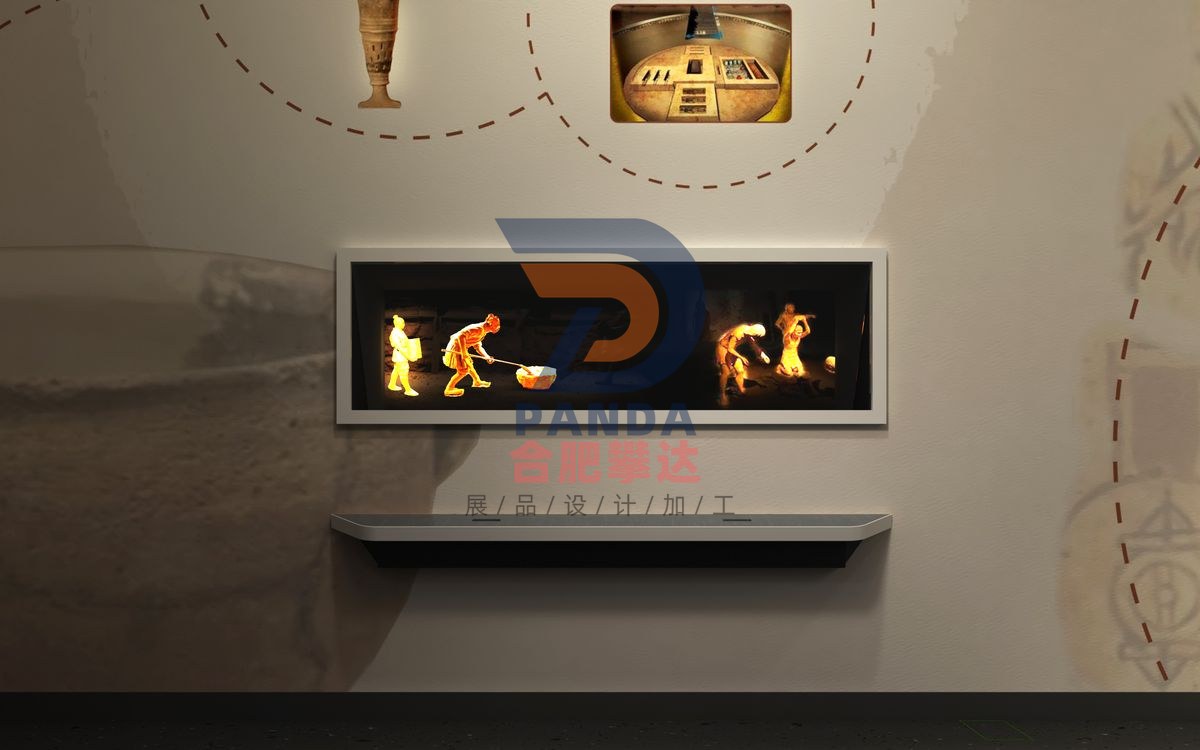
In addition to the use of ground stone tools, a more important sign of the Neolithic Age is the settled life and the use of pottery accompanying the settled life. About 20,000 to 10,000 years ago, humans invented pottery. Engels once pointed out that the lower stage of human barbarism "began from learning the art of pottery". The "barbaric age" that Engels called is equivalent to what we call the "Neolithic Age" today. The earliest known pottery in the world is a straight-mouthed, round-bottomed sand-filled pottery jar unearthed from the Xianren Cave site in China around 18,000 BC. The earliest pottery was produced by applying clay to rattan or wooden containers to make them fire-resistant. When people did this, they soon discovered that shaped clay could achieve this purpose without an internal container, and pottery was officially produced. The prehistoric pottery making process can be roughly divided into five steps: selecting raw materials, making pottery blanks, trimming, decorating and firing. The firing of pottery has gone via a process from open-air firing to kiln firing. In 1962, a straight-mouthed round-bottomed pottery pot with a diameter of 20 cm and a height of 18 cm was unearthed from the Xianrendong site in Shanxi Province. It is the earliest shaped pottery discovered in the world so far, and is known as "the first pot in the world." The Shuangdun Cultural Site in Anhui is about 7,000 years old and is the earliest Neolithic cultural relic found in the middle reaches of the Huaihe River. The Yuchi Temple site in Anhui is a settlement relic from the late Neolithic period of primitive society, dating from 4500 to 5000 years ago. It is the largest, most complete, and unique architectural style and pattern of settlement relics in China that are characterized by barbecue houses. It is known as the "No. 1 Primitive Village in China." Pottery is the first daily necessities invented by humans that changed the material properties of nature. It achieves the wonderful combination of fire, water and earth and is an important milestone in the evolution of human civilization.
Export-Ready Features
- Durable, robust construction for high-traffic gallery environments
- Low-maintenance electromechanical design with reliable, safe components
- Custom sizing, theming & multilingual labeling available
- OEM & turnkey exhibit solutions with full project management
- Overseas shipping, export documentation & on-site installation supported
- Shipped to science centers and museums in 50+ countries