
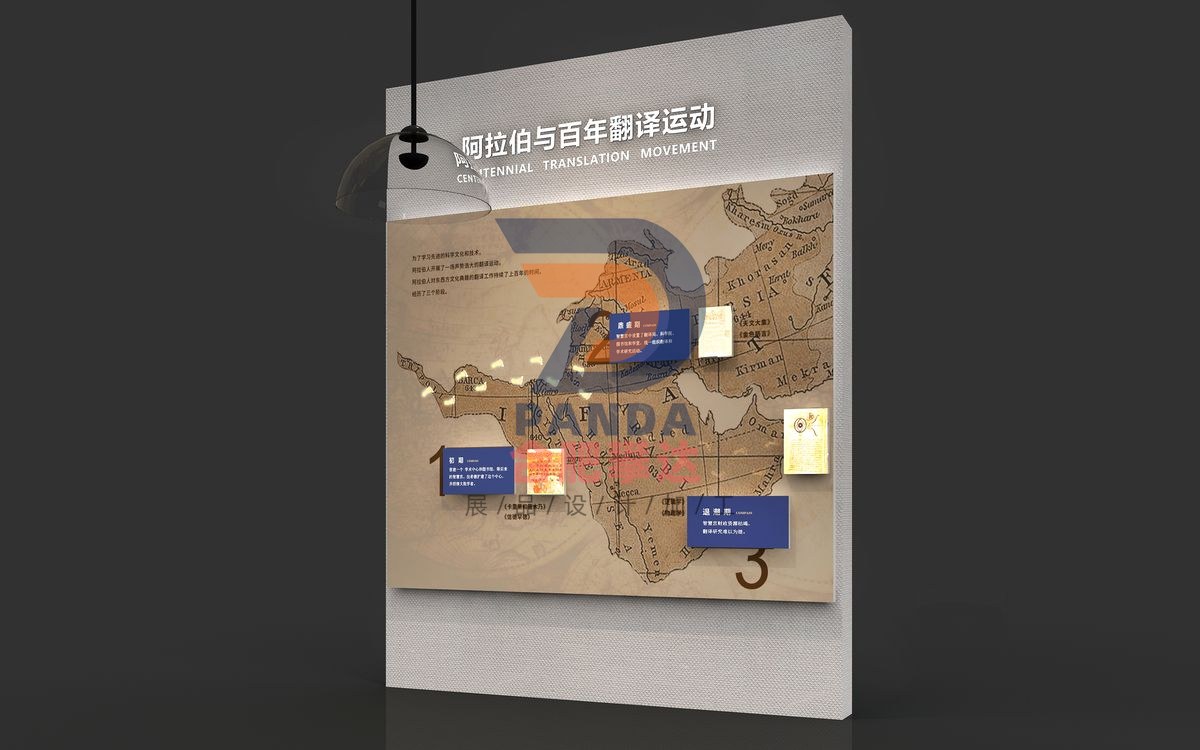
Arabia and the Centennial Translation Movement
Smart Technology · Interactive
- DimensionsSubject to on-site plan
- PresentationInteractive
- PricingQuoted by manufacture spec
Arabia and the Centennial Translation Movement is a hands-on, mechanical & electromechanical interactive exhibit manufactured by Hefei Panda for science centers, children’s museums, discovery centers, STEM learning centers and family entertainment centers. Engineered for durable, robust, low-maintenance, high-traffic gallery installation, it turns abstract scientific concepts into direct, interactive visitor exploration. Hefei Panda is a global exhibit manufacturer exporting hands-on science displays to 50+ countries, with in-house engineering, fabrication, installation and commissioning.
Exhibit Summary
Arabia and the Centennial Translation Movement is a Interactive interactive exhibit in the Smart Technology category, designed for science centers, children’s museums, discovery centers, STEM learning centers and family entertainment centers. Built as a hands-on, mechanical & electromechanical display, it turns an abstract scientific concept into direct, interactive visitor exploration, and is engineered for durable, low-maintenance, high-traffic gallery use.
Scientific Principle
Shows the science and technological achievements of Arabia in the Middle Ages and the importance of the Great Translation Movement to the inheritance and development of science.
Operation
The science achievements of medieval Arabia: (1) Mathematics: Arab mathematicians introduced Indian arithmetic and algebra to the West, making it the common cultural wealth of all mankind today. We are accustomed to calling the numbers 1, 2, 3, 4, 5, 6, 7, 8, 9, and 0 Arabic numerals. In fact, they are Indian numerals. It's just that Westerners know it from Arabic books, so they mistakenly think it is Arabic numerals. (2) Astronomy: Arab astronomers carefully studied Ptolemy's works and tested Ptolemy's astronomical theory with quite sophisticated instruments and detailed observations. (3) Physics: The Arabs studied the imaging concept of the lens and found that the curved surface of the lens is the cause of the refraction of light, not that the material making up the lens has any special magic power. Kepler later directly inherited the research work of Arab scientists in optics. The Arab Centennial Translation Movement: In order to discover advanced science, culture and technology, the Arabs launched a massive translation movement. Most of the wisdom of Greek civilization, Persian civilization and Indian civilization that preceded Islamic civilization was translated into Arabic. Through this translation movement, Arabia created a prosperous Arab Islamic civilization on the basis of absorbing and learning from the achievements of Eastern and Western civilizations. The Arabs' translation of Eastern and Western cultural classics lasted for hundreds of years and went via three stages. The first stage (early period) started with the Mansur Caliphate and ended with the Rashid era. The works translated during this period include: "Kalilai and Dimunai" in Persian, "Sindhhand" in Indian, Aristotle's "Logic", Ptolemy's "Collection of Astronomy", etc. The second stage (the heyday) started from the Maimun era, about 830 to 930 AD. Maimon founded the "Wisdom Museum", a comprehensive academic institution set up by the state in the capital Baghdad, which consists of the Translation Bureau, the Academy of Sciences and the Library, and uniformly organizes and centrally leads the country's translation and academic research activities. During this period, Pythagos's "Golden Maxim" and all the works of Hippocrates and Green were translated, as well as Plato's "Republic" and "Laws" and Aristotle's "Categories". The third stage (end), from about the end of the 10th century to the middle of the 11th century AD. The main works translated include Aristotle's "Logic" and "Physics" and their annotations.
Export-Ready Features
- Durable, robust construction for high-traffic gallery environments
- Low-maintenance electromechanical design with reliable, safe components
- Custom sizing, theming & multilingual labeling available
- OEM & turnkey exhibit solutions with full project management
- Overseas shipping, export documentation & on-site installation supported
- Shipped to science centers and museums in 50+ countries