
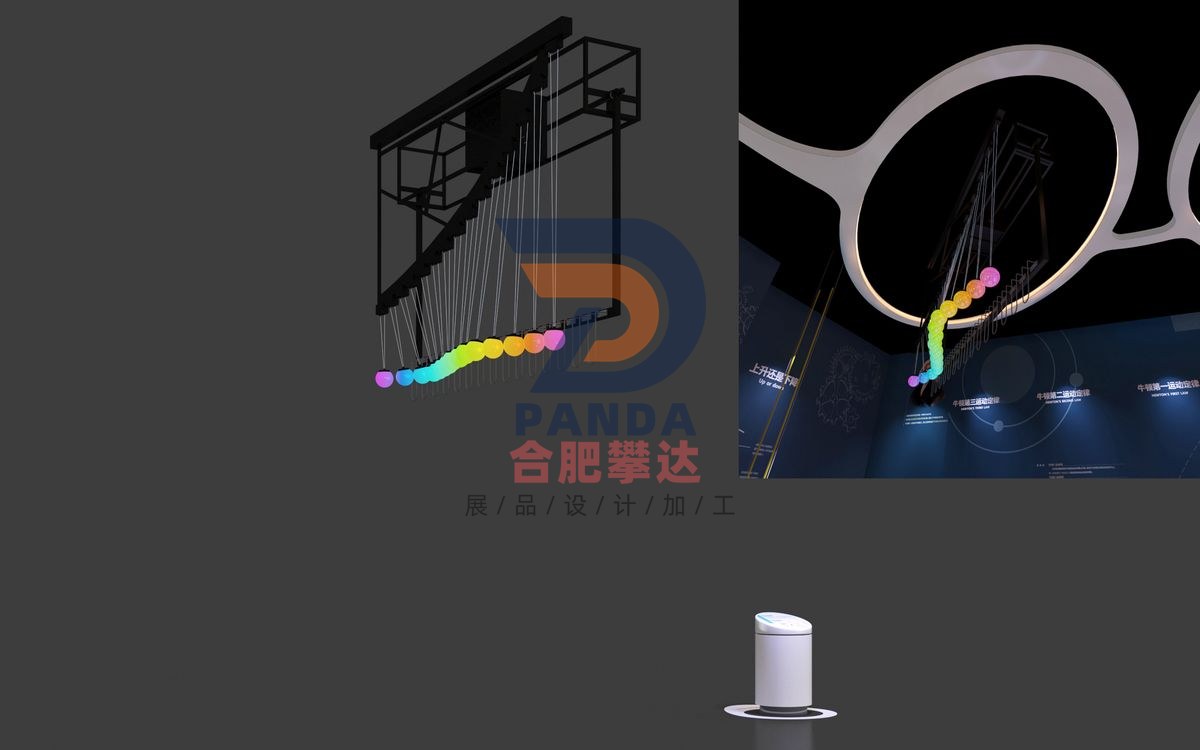
Serpentine Pendulum
Mechanics in Motion · Interactive
- DimensionsSubject to on-site plan
- PresentationInteractive
- PricingQuoted by manufacture spec
Serpentine Pendulum is a hands-on, mechanical & electromechanical interactive exhibit manufactured by Hefei Panda for science centers, children’s museums, discovery centers, STEM learning centers and family entertainment centers. Engineered for durable, robust, low-maintenance, high-traffic gallery installation, it turns abstract scientific concepts into direct, interactive visitor exploration. Hefei Panda is a global exhibit manufacturer exporting hands-on science displays to 50+ countries, with in-house engineering, fabrication, installation and commissioning.
Exhibit Summary
Serpentine Pendulum is a Interactive interactive exhibit in the Mechanics in Motion category, designed for science centers, children’s museums, discovery centers, STEM learning centers and family entertainment centers. Built as a hands-on, mechanical & electromechanical display, it turns an abstract scientific concept into direct, interactive visitor exploration, and is engineered for durable, low-maintenance, high-traffic gallery use.
Scientific Principle
The law of isochrony of a simple pendulum is the first dynamic law discovered by mankind. The exhibition item demonstrates the periodic change relationship of the pendulum via the swing of a simple pendulum with different pendulum lengths.
Operation
In 1595, Galileo Galilei discovered a pattern of object swings from the back and forth swing of the chandelier in the Pisa church. He discovered that when a long rope hangs a heavy object and swings freely at a small angle, the period (the time it takes to swing once) has nothing to do with the amplitude of the swing or the mass of the object, and is inversely proportional to the square root of the length of the pendulum. The greater the gravity, the faster the swing. A swing system that obeys this law is called a "simple pendulum." The exhibition item extends Galileo's isochronic concept of a simple pendulum and designs pendulum balls of different lengths. The length of the cycloid increases from left to right. When each pendulum ball is swung at the same time, the swing frequency of each pendulum ball will decrease in sequence, and each pendulum ball will swing in sequence, forming a harmonious pattern change. A pendulum is a unit that can produce reciprocating swings. One end of a weightless thin rod or an inextensible thin flexible rope is suspended at a certain point in the gravity field, and a heavy ball is fixed at the other end to form a pendulum. If the ball is limited to swinging in the vertical plane, it is a planar pendulum. If the ball is not limited to the vertical plane, it is a spherical pendulum. The approximate periodic formula of the pendulum motion is: T=2π√(L/g). Among them, L is the pendulum length, and g is the local gravity acceleration. The displays are equipped with pendulums of different lengths. Due to the different pendulum lengths and different periods, an S-shaped serpentine curve is ultimately formed.
Export-Ready Features
- Durable, robust construction for high-traffic gallery environments
- Low-maintenance electromechanical design with reliable, safe components
- Custom sizing, theming & multilingual labeling available
- OEM & turnkey exhibit solutions with full project management
- Overseas shipping, export documentation & on-site installation supported
- Shipped to science centers and museums in 50+ countries