
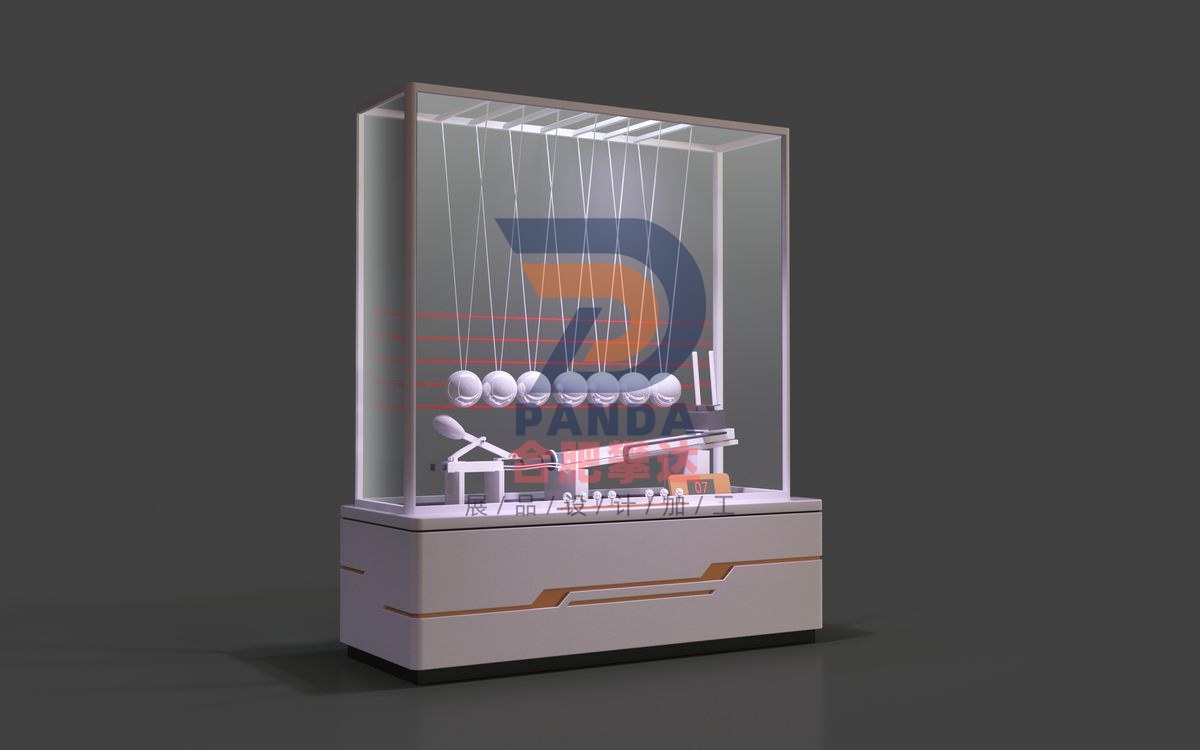
Collision
Mechanics in Motion · Interactive
- DimensionsSubject to on-site plan
- PresentationInteractive
- PricingQuoted by manufacture spec
Collision is a hands-on, mechanical & electromechanical interactive exhibit manufactured by Hefei Panda for science centers, children’s museums, discovery centers, STEM learning centers and family entertainment centers. Engineered for durable, robust, low-maintenance, high-traffic gallery installation, it turns abstract scientific concepts into direct, interactive visitor exploration. Hefei Panda is a global exhibit manufacturer exporting hands-on science displays to 50+ countries, with in-house engineering, fabrication, installation and commissioning.
Exhibit Summary
Collision is a Interactive interactive exhibit in the Mechanics in Motion category, designed for science centers, children’s museums, discovery centers, STEM learning centers and family entertainment centers. Built as a hands-on, mechanical & electromechanical display, it turns an abstract scientific concept into direct, interactive visitor exploration, and is engineered for durable, low-maintenance, high-traffic gallery use.
Scientific Principle
The exhibition item demonstrates the concept of energy conservation and the conversion of kinetic energy and potential energy via the transfer of kinetic and potential energy of the ball.
Operation
The exhibition item is a demonstration unit consisting of several spheres of the same mass and volume fixed closely to each other via hanging ropes. The leftmost ball gains momentum and is transferred to the balls hanging side by side on the right via collision. The momentum is transferred to the right among the four balls in rotate. When the rightmost ball cannot continue to transfer momentum, it is ejected. The "force" generated by the leftmost ball is transmitted most directly and losslessly to the rightmost ball via the extremely small contact surface, tightly arranged and non-deformed spheres (close to a closed system), knocking it away. Collision was actually first proposed by French physicist Edme Marriott in 1676 to prove Newtonian mechanics. The concept of conservation of energy tells us that energy will neither be created nor disappear out of thin air. It can only be transferred from one object to another. Moreover, the forms of energy can also be converted into each other, and they can be transmitted losslessly in a closed environment.
Export-Ready Features
- Durable, robust construction for high-traffic gallery environments
- Low-maintenance electromechanical design with reliable, safe components
- Custom sizing, theming & multilingual labeling available
- OEM & turnkey exhibit solutions with full project management
- Overseas shipping, export documentation & on-site installation supported
- Shipped to science centers and museums in 50+ countries