
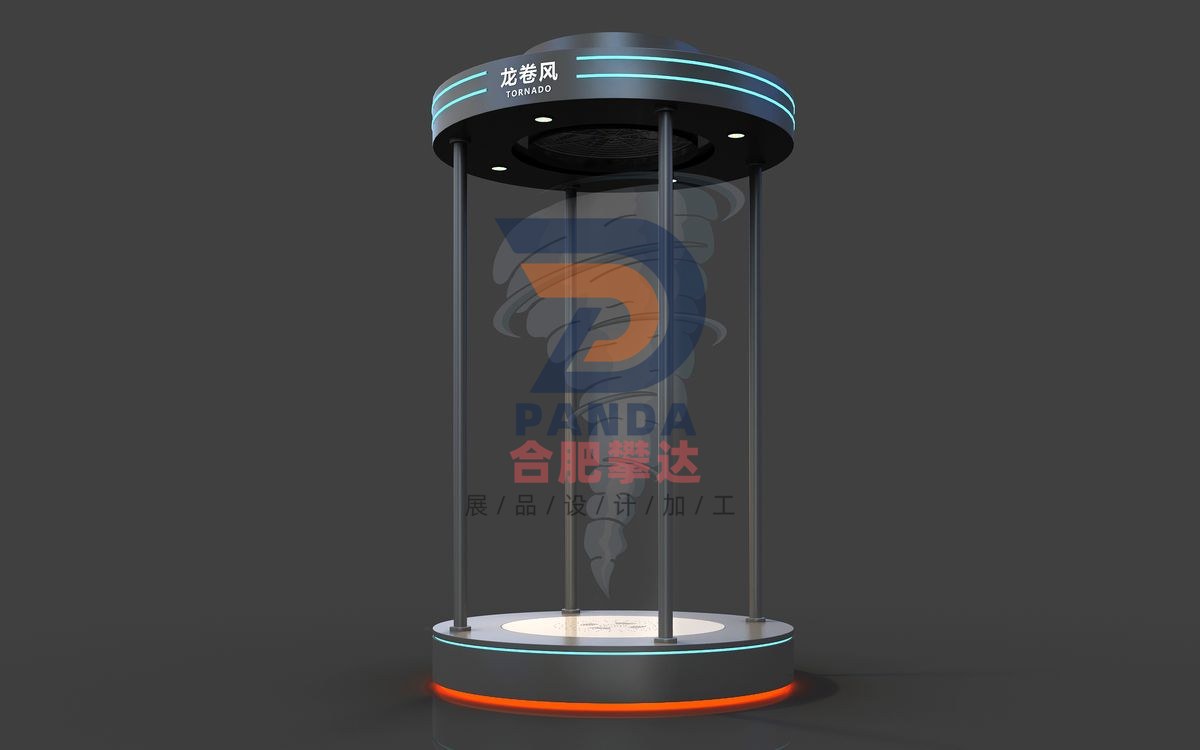
Tornado
Mechanics in Motion · Interactive
- DimensionsSubject to on-site plan
- PresentationInteractive
- PricingQuoted by manufacture spec
Tornado is a hands-on, mechanical & electromechanical interactive exhibit manufactured by Hefei Panda for science centers, children’s museums, discovery centers, STEM learning centers and family entertainment centers. Engineered for durable, robust, low-maintenance, high-traffic gallery installation, it turns abstract scientific concepts into direct, interactive visitor exploration. Hefei Panda is a global exhibit manufacturer exporting hands-on science displays to 50+ countries, with in-house engineering, fabrication, installation and commissioning.
Exhibit Summary
Tornado is a Interactive interactive exhibit in the Mechanics in Motion category, designed for science centers, children’s museums, discovery centers, STEM learning centers and family entertainment centers. Built as a hands-on, mechanical & electromechanical display, it turns an abstract scientific concept into direct, interactive visitor exploration, and is engineered for durable, low-maintenance, high-traffic gallery use.
Scientific Principle
Through the natural weather phenomenon of "tornado", the audience can more closely grasp the relationship between the causes of tornado formation and pressure difference, and further grasp the subject knowledge point of fluid mechanics in the actual phenomena in life.
Operation
Tornadoes and Physical Fluid Pressure: The conditions required to form a tornado are essentially the same as those required for severe thunderstorms, namely large vertical instability of the air near the surface, high humidity, and the subsequent horizontal gathering of winds at low levels immediately following the rise in the storm, related to fluid pressure. The formation of a tornado can be divided into four stages: (1) Atmospheric instability produces strong updrafts, which are further strengthened due to the influence of the maximum passing airflow in the jet stream. (2) Due to the interaction with the wind with shear in both speed and direction in the vertical direction, the updraft begins to rotate in the middle of the troposphere, forming a mesoscale cyclone. (3) As the mesoscale cyclone develops toward the surface and extends upward, it itself thins and intensifies. At the same time, a small area of enhancement is consistent with the formation of a nascent tornado inside the cyclone. The same process that creates a cyclone forms the core of the tornado. (4) The rotation in the core of a tornado is different from that in a cyclone. It is strong enough to make the tornado stretch all the way to the ground. When the developed vortex reaches the height of the ground, the surface air pressure drops sharply and the surface wind speed rises sharply, forming a tornado. Introduction to tornado: Tornado is a rare local, small-scale, sudden strong convective weather. It is a strong, small-scale air vortex caused by air convection movement under strong and unstable weather conditions. The structure of a tornado consists of the funnel cloud as the main part and the convective system that maintains its existence, usually the cumulonimbus clouds brought by thunderstorms.
Export-Ready Features
- Durable, robust construction for high-traffic gallery environments
- Low-maintenance electromechanical design with reliable, safe components
- Custom sizing, theming & multilingual labeling available
- OEM & turnkey exhibit solutions with full project management
- Overseas shipping, export documentation & on-site installation supported
- Shipped to science centers and museums in 50+ countries