
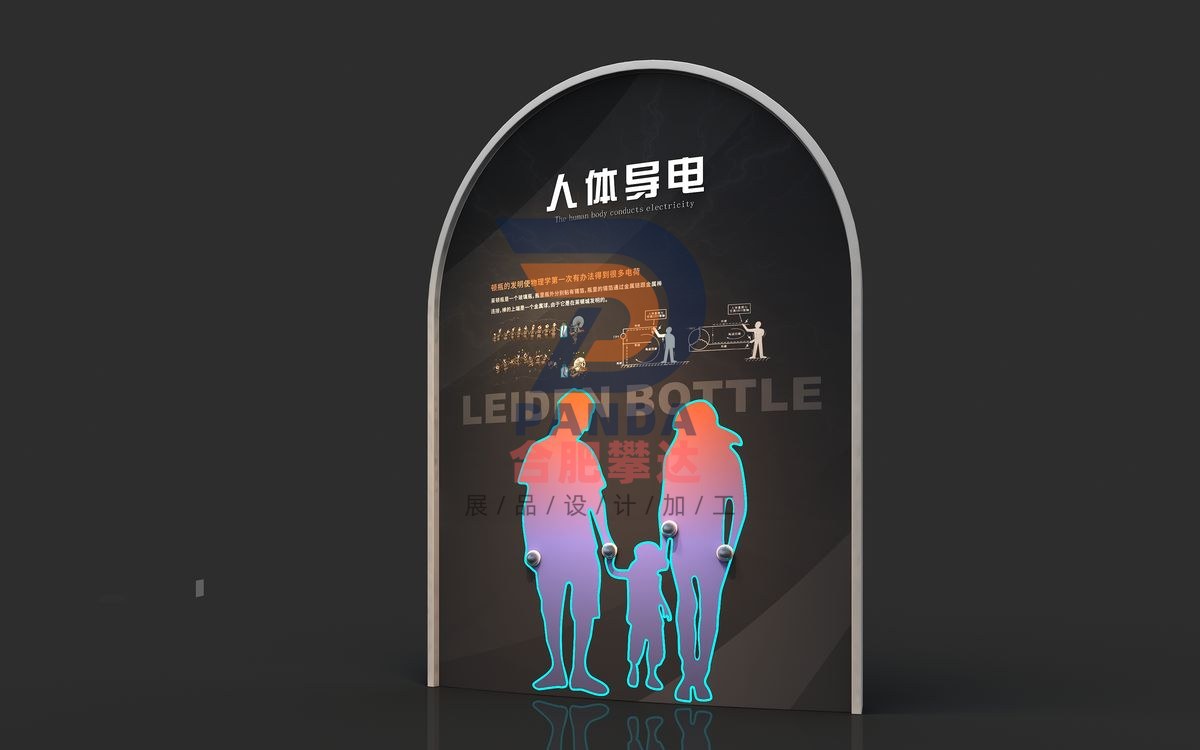
Human body conductivity
Electromagnetism · Interactive
- DimensionsSubject to on-site plan
- PresentationInteractive
- PricingQuoted by manufacture spec
Human body conductivity is a hands-on, mechanical & electromechanical interactive exhibit manufactured by Hefei Panda for science centers, children’s museums, discovery centers, STEM learning centers and family entertainment centers. Engineered for durable, robust, low-maintenance, high-traffic gallery installation, it turns abstract scientific concepts into direct, interactive visitor exploration. Hefei Panda is a global exhibit manufacturer exporting hands-on science displays to 50+ countries, with in-house engineering, fabrication, installation and commissioning.
Exhibit Summary
Human body conductivity is a Interactive interactive exhibit in the Electromagnetism category, designed for science centers, children’s museums, discovery centers, STEM learning centers and family entertainment centers. Built as a hands-on, mechanical & electromechanical display, it turns an abstract scientific concept into direct, interactive visitor exploration, and is engineered for durable, low-maintenance, high-traffic gallery use.
Scientific Principle
This exhibition allows the audience to grasp the role of the Leyden bottle by allowing the audience to hold hands and connect to form a closed circuit. The invention of the Leyden bottle made it possible for physics to obtain a lot of charges for the first time, and interact with other audiences to perceive the current that is rapidly formed due to the movement of charges.
Operation
The Leyden bottle is a glass bottle with tin foil attached to the inside and outside of the bottle. The tin foil in the bottle is connected to a metal rod via a metal chain. The upper end of the rod is a metal ball because it was invented in the city of Leiden. So it's called a Leyden jar, and it was the original capacitor. Leyden jars soon aroused strong repercussions in Europe. Electricians not only used them to conduct a large number of experiments, but also performed a large number of demonstration performances. Some people used them to ignite alcohol and gunpowder. One of the most spectacular was the performance performed by Frenchman Nolet in front of a cathedral in Paris. Nolet invited the royal family of Louis XV to watch the performance of the Leyden bottle. He asked 700 monks to line up hand in hand, and the line was 900 feet (about 275 meters) long. Then, Nolet asked the monk at the front of the row to hold the Leyden bottle with his hand, and asked the monk at the end of the row to hold the lead of the bottle. In an instant, seven hundred monks jumped up almost at the same time due to the electric shock. Everyone present was stunned. Nolet showed people the huge power of electricity with convincing evidence. The Leyden bottle is a glass bottle with tin foil on the inside and outside. The tin foil in the bottle is connected to a metal rod via a metal chain. The upper end of the rod is a metal ball because it was invented in the city of Leiden. So it's called a Leyden jar, and it was the original capacitor. Leyden jars soon aroused strong repercussions in Europe. Electricians not only used them to conduct a large number of experiments, but also performed a large number of demonstration performances. Some people used them to ignite alcohol and gunpowder.
Export-Ready Features
- Durable, robust construction for high-traffic gallery environments
- Low-maintenance electromechanical design with reliable, safe components
- Custom sizing, theming & multilingual labeling available
- OEM & turnkey exhibit solutions with full project management
- Overseas shipping, export documentation & on-site installation supported
- Shipped to science centers and museums in 50+ countries