
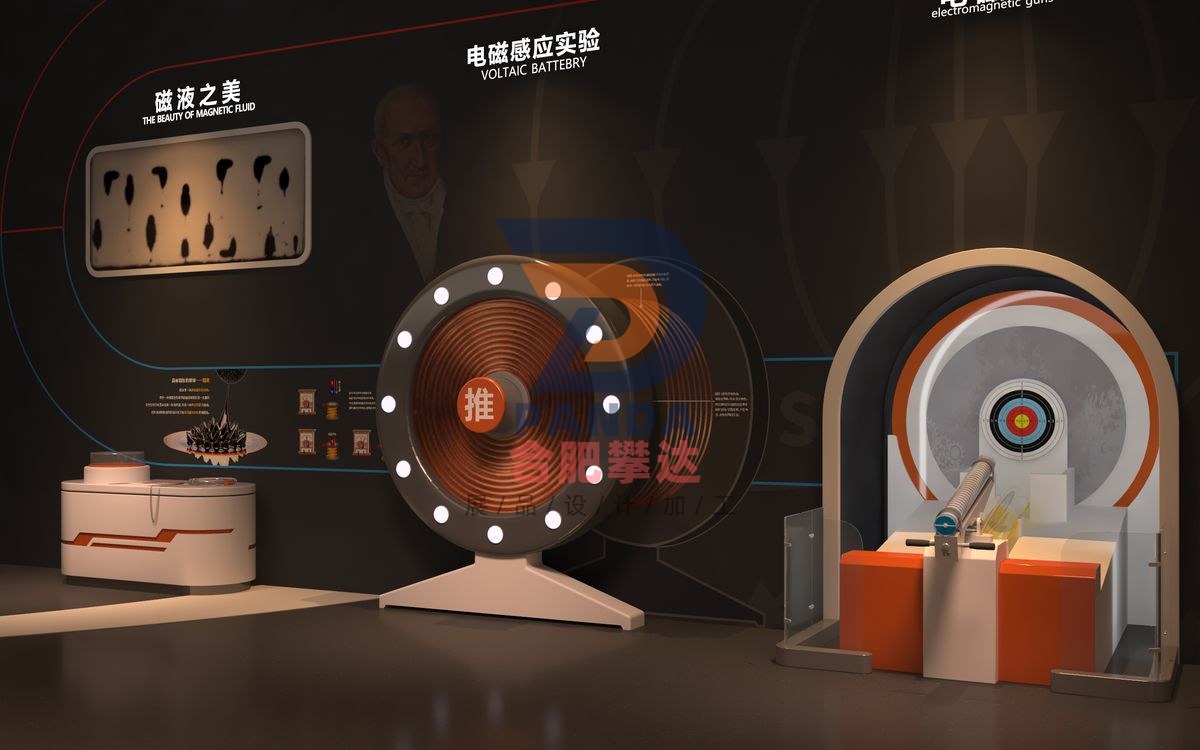
Electromagnetic Induction Test
Electromagnetism · Interactive
- DimensionsSubject to on-site plan
- PresentationInteractive
- PricingQuoted by manufacture spec
Electromagnetic Induction Test is a hands-on, mechanical & electromechanical interactive exhibit manufactured by Hefei Panda for science centers, children’s museums, discovery centers, STEM learning centers and family entertainment centers. Engineered for durable, robust, low-maintenance, high-traffic gallery installation, it turns abstract scientific concepts into direct, interactive visitor exploration. Hefei Panda is a global exhibit manufacturer exporting hands-on science displays to 50+ countries, with in-house engineering, fabrication, installation and commissioning.
Exhibit Summary
Electromagnetic Induction Test is a Interactive interactive exhibit in the Electromagnetism category, designed for science centers, children’s museums, discovery centers, STEM learning centers and family entertainment centers. Built as a hands-on, mechanical & electromechanical display, it turns an abstract scientific concept into direct, interactive visitor exploration, and is engineered for durable, low-maintenance, high-traffic gallery use.
Scientific Principle
By interacting with the unit, the audience watches the generation of induced current and grasps the principles of electromagnetic induction.
Operation
The concept of electromagnetic induction is to use changes in magnetic flux to generate induced electromotive force, which can be converted into electrical energy via other forms. The direction of the induced current is related to the direction of the object's cutting magnetic field lines or the direction of the magnetic field; the deflection direction of the ammeter pointer depends on the direction of the induced current. A change in the deflection direction of the pointer indicates a change in the direction of the induced current. The concept of electromagnetic induction is widely used, such as generators, induction motors and transformers. In electronic technology, inductive components are widely used to control the distribution of voltage or current and to emit, receive and transmit electromagnetic signals. In electromagnetic measurement, in addition to the direct application of the electromagnetic induction concept in the measurement of many important electromagnetic quantities, some non-electromagnetic quantities can also be measured by converting them into electromagnetic quantities, thus developing a variety of automated instruments. The concept of electromagnetic induction is to use changes in magnetic flux to generate induced electromotive force, which can be converted into electrical energy via other forms.
Export-Ready Features
- Durable, robust construction for high-traffic gallery environments
- Low-maintenance electromechanical design with reliable, safe components
- Custom sizing, theming & multilingual labeling available
- OEM & turnkey exhibit solutions with full project management
- Overseas shipping, export documentation & on-site installation supported
- Shipped to science centers and museums in 50+ countries