
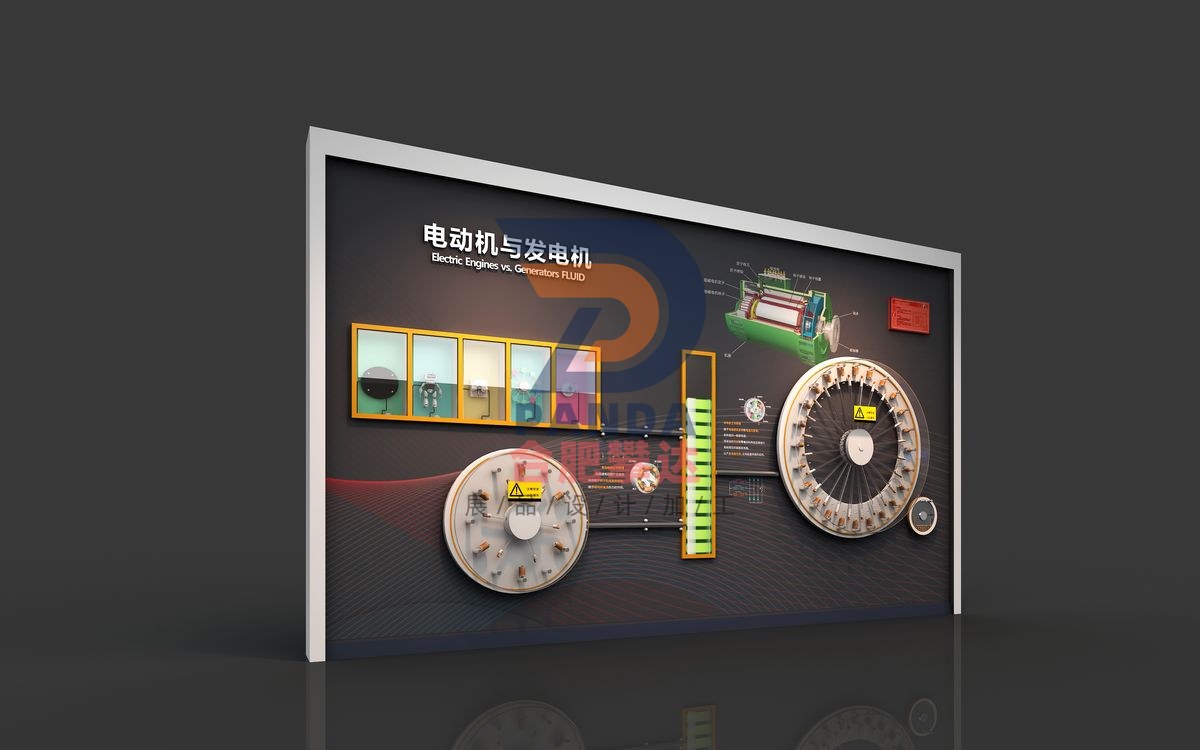
Electric Motors and Generators
Electromagnetism · Interactive
- DimensionsSubject to on-site plan
- PresentationInteractive
- PricingQuoted by manufacture spec
Electric Motors and Generators is a hands-on, mechanical & electromechanical interactive exhibit manufactured by Hefei Panda for science centers, children’s museums, discovery centers, STEM learning centers and family entertainment centers. Engineered for durable, robust, low-maintenance, high-traffic gallery installation, it turns abstract scientific concepts into direct, interactive visitor exploration. Hefei Panda is a global exhibit manufacturer exporting hands-on science displays to 50+ countries, with in-house engineering, fabrication, installation and commissioning.
Exhibit Summary
Electric Motors and Generators is a Interactive interactive exhibit in the Electromagnetism category, designed for science centers, children’s museums, discovery centers, STEM learning centers and family entertainment centers. Built as a hands-on, mechanical & electromechanical display, it turns an abstract scientific concept into direct, interactive visitor exploration, and is engineered for durable, low-maintenance, high-traffic gallery use.
Scientific Principle
Demonstrates the conversion between mechanical energy-electrical energy-mechanical energy via the combination of generators and electric motors. The audience is also allowed to rotate the generator themselves, and the current generated drives the motor and various electrical appliances above. By speeding up the speed, the audience can view the electrical appliances working at the same time after being powered on. To grasp the working principles of generators and electric motors.
Operation
1. Working principles of generators and electric motors: The working concept of an electric motor is to use an energized coil to generate a magnetic field and act on the rotor to form a rotating torque, demonstrating the effect of the magnetic field on the force of the current. The working concept of the generator is based on the law of electromagnetic induction and the law of electromagnetic force. The general concept of its construction is: use appropriate magnetic and conductive materials to form magnetic circuits and circuits that perform electromagnetic induction with each other to generate electromagnetic power and achieve the purpose of energy conversion. 2. The invention of the electric motor: Logically, there must be a generator first and then an electric motor. However, historically, the generator did not come first, but the electric motor appeared first. In 1821, Faraday fixed the north end of the magnetic rod at the bottom of a glass, poured mercury into the cup, and then hung a freely rotating wire into the mercury. After energizing it with a voltaic battery, the wire began to rotate around the magnetic rod. Through this experiment, it was found that when electricity is applied, the wire will rotate around the magnetic bar when the magnetic bar is fixed; and when the wire is fixed, the magnet will rotate around the wire. This unit was actually the earliest electric motor. In 1834, German scientist Jacobi used electromagnets as rotors and made the first practical electric motor. In 1838, he made a more powerful electric motor and successfully propelled the boat. However, although this kind of electric motor has been very practical, its promotion has been limited because its current comes from a voltaic battery, which is not powerful enough and expensive. It was not until 1873 that Belgian electrical engineer Gram accidentally connected two generators and gained inspiration to invent an electric motor for industrial production. Since then, the development of generators and electric motors have merged into one. 3. Faraday copper disc generator: After Faraday discovered the phenomenon of electromagnetic induction, he continued to conduct many experiments. He placed a rotatable metal disk in the magnetic field of a magnet and used an ammeter to measure the current between the edge of the disk and the center of the axis. Experiments showed that when the disk rotated, the ammeter deflected, confirming that current appeared in the loop, which meant that mechanical energy was converted into electrical energy. This was the first generator in history. The working concept of an electric motor is to use an energized coil to generate a magnetic field and act on the rotor to form a rotating torque, demonstrating the effect of the magnetic field on the force of the current. The working concept of the generator is based on the law of electromagnetic induction and the law of electromagnetic force. The general concept of its construction is: use appropriate magnetic and conductive materials to form magnetic circuits and circuits that perform electromagnetic induction with each other to generate electromagnetic power and achieve the purpose of energy conversion.
Export-Ready Features
- Durable, robust construction for high-traffic gallery environments
- Low-maintenance electromechanical design with reliable, safe components
- Custom sizing, theming & multilingual labeling available
- OEM & turnkey exhibit solutions with full project management
- Overseas shipping, export documentation & on-site installation supported
- Shipped to science centers and museums in 50+ countries