
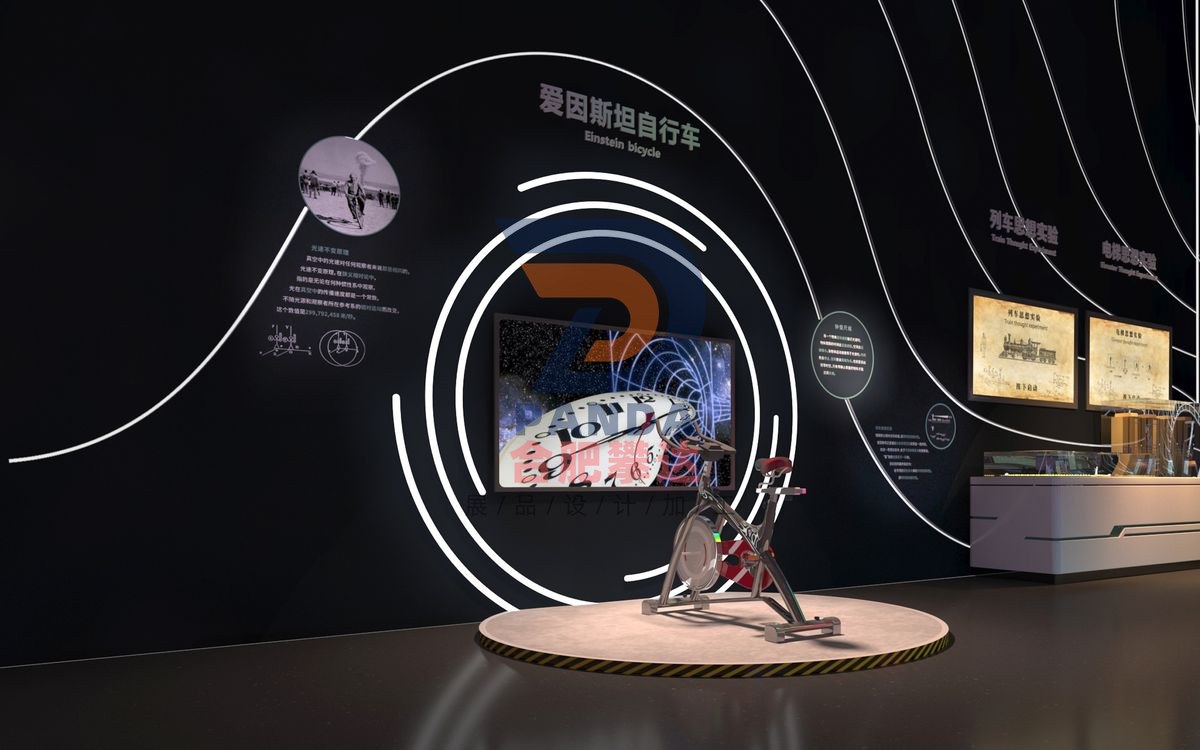
Einstein's Bicycle
Aerospace · Interactive
- DimensionsSubject to on-site plan
- PresentationInteractive
- PricingQuoted by manufacture spec
Einstein's Bicycle is a hands-on, mechanical & electromechanical interactive exhibit manufactured by Hefei Panda for science centers, children’s museums, discovery centers, STEM learning centers and family entertainment centers. Engineered for durable, robust, low-maintenance, high-traffic gallery installation, it turns abstract scientific concepts into direct, interactive visitor exploration. Hefei Panda is a global exhibit manufacturer exporting hands-on science displays to 50+ countries, with in-house engineering, fabrication, installation and commissioning.
Exhibit Summary
Einstein's Bicycle is a Interactive interactive exhibit in the Aerospace category, designed for science centers, children’s museums, discovery centers, STEM learning centers and family entertainment centers. Built as a hands-on, mechanical & electromechanical display, it turns an abstract scientific concept into direct, interactive visitor exploration, and is engineered for durable, low-maintenance, high-traffic gallery use.
Scientific Principle
Demonstrates the concept of constant speed of light in the special theory of relativity, and the resulting slow clock effect.
Operation
The concept of constant speed of light is one of the basic starting points for Einstein to create the special theory of relativity. No matter what inertial frame (inertial reference frame) it is observed in, the propagation speed of light in a vacuum is a constant and does not change with the relative motion of the light source and the observer's reference frame. This value is 299,792,458 meters/second. The speed of light in any reference system is the speed of light itself, that is, "the speed of light remains unchanged in any reference system." In layman's terms: the speed of light will change according to the motion state of the observer, thus making the observer feel that its speed is unchanged. For the "same beam of light", it becomes faster as you go faster, and slower as you go slower - the speed of light "automatically adapts to the observer". The concept of constant speed of light derives the slow effect of shrinking clocks. The atomic clock experiment in 1971 confirmed the slow clock effect. The constant speed of light leads to the slow clock effect. The faster the speed, the slower the time. When an object moves close to the speed of light, time around the object will rapidly slow down and space will shrink rapidly. When the speed of an object is equal to the speed of light, time will stop and space will shrink to a point. The speed of light changes depending on the motion of the observer, making it appear to the observer that its speed is constant. For the "same beam of light", it becomes faster as you go faster, and slower as you go slower - the speed of light "automatically adapts to the observer".
Export-Ready Features
- Durable, robust construction for high-traffic gallery environments
- Low-maintenance electromechanical design with reliable, safe components
- Custom sizing, theming & multilingual labeling available
- OEM & turnkey exhibit solutions with full project management
- Overseas shipping, export documentation & on-site installation supported
- Shipped to science centers and museums in 50+ countries