
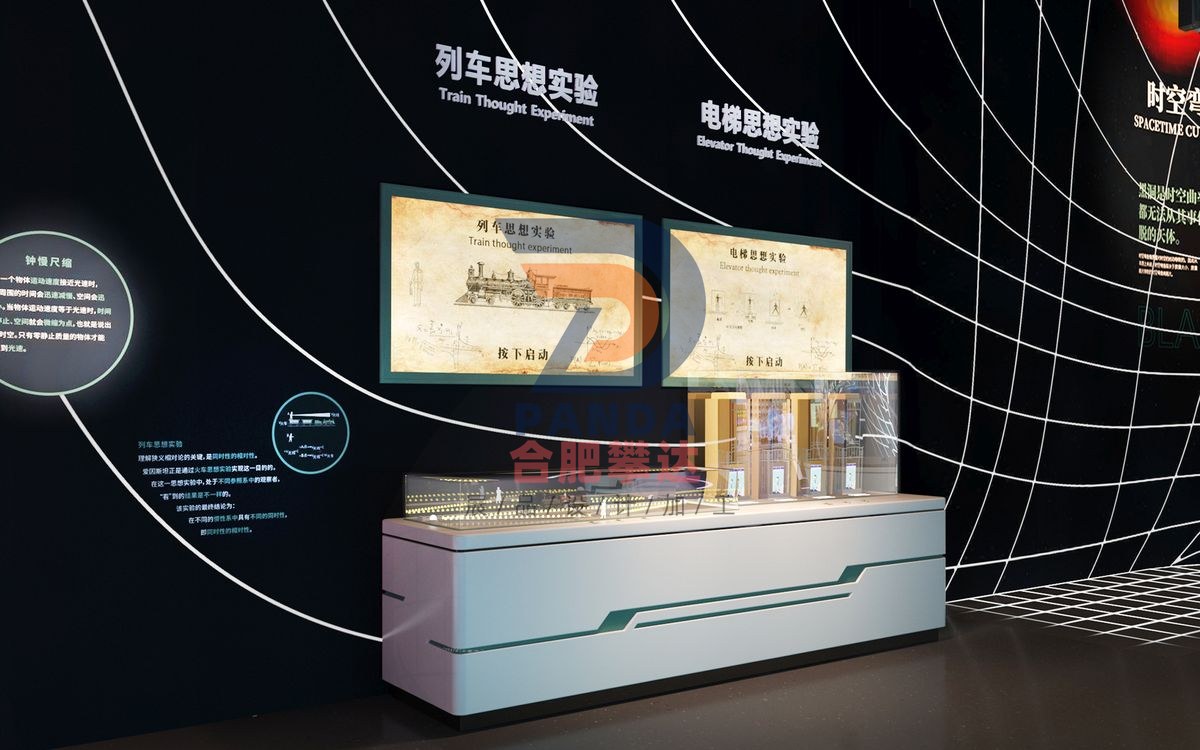
Train Thought Experiment
Mechanics in Motion · Interactive
- DimensionsSubject to on-site plan
- PresentationInteractive
- PricingQuoted by manufacture spec
Train Thought Experiment is a hands-on, mechanical & electromechanical interactive exhibit manufactured by Hefei Panda for science centers, children’s museums, discovery centers, STEM learning centers and family entertainment centers. Engineered for durable, robust, low-maintenance, high-traffic gallery installation, it turns abstract scientific concepts into direct, interactive visitor exploration. Hefei Panda is a global exhibit manufacturer exporting hands-on science displays to 50+ countries, with in-house engineering, fabrication, installation and commissioning.
Exhibit Summary
Train Thought Experiment is a Interactive interactive exhibit in the Mechanics in Motion category, designed for science centers, children’s museums, discovery centers, STEM learning centers and family entertainment centers. Built as a hands-on, mechanical & electromechanical display, it turns an abstract scientific concept into direct, interactive visitor exploration, and is engineered for durable, low-maintenance, high-traffic gallery use.
Scientific Principle
Shows Einstein's train thought experiment and explains the basic concept of special relativity - the concept of relativity.
Operation
Basic principles of special relativity: For observers in different reference frames, events occur at different times. Einstein achieved this via his train thought experiment. According to Einstein, an observer in motion and an observer in a stationary state perceive the passage of time differently. In the train thought experiment, Einstein imagined a very long train traveling along a straight track at a constant speed v. The two ends of the train are A and B, and its midpoint is M. The train travels from A to B (that is, A is the rear of the train and B is the front). At the same time, it is assumed that at a certain time t, there are three points A’, B’ and M’ on the railway track at the same position as the train (the three points correspond to A, B and M respectively). There are lights L1 and L2 at A’ and B’ respectively, and L1 and L2 are turned on at the same time at time t. So, which time does the light ray of L1 and L2 arrive at the middle point M of the train (assuming that point M and point M’ coincide at time t)? Or do they arrive at the same time? In this thought experiment, observers in different frames of reference "view" different results. In the coordinate system with the railway track as the reference object, the result “seen” by the observer standing at point M’ is obvious: because the distances from L1 and L2 to point M’ are equal and the light propagation speeds are the same, the light rays from L1 and L2 will reach point M’ at the same time. But in the coordinate system with the train as the reference object, people will view a completely different scene: because the train is moving forward at speed v, that is, when the light rays L1 and L2 are emitted, the three points A, B, and M on the train coincide with the three points A’, B’, and M’ on the railway track. When the light is emitted and propagates forward, the middle point M of the train is moving away from A’ at the speed v and toward point B’. Therefore, the speed of the light emitted by L1 reaching point M should be c-v, and the speed of the light emitted by L2 reaching point M is c+v. Then, the result is obviously that the light emitted from L2 at point B’ will reach point M before the light emitted from L1 at point A’. For observers in different reference frames, events occur at different times. Einstein achieved this via his train thought experiment. According to Einstein, an observer in motion and an observer in a stationary state perceive the passage of time differently.
Export-Ready Features
- Durable, robust construction for high-traffic gallery environments
- Low-maintenance electromechanical design with reliable, safe components
- Custom sizing, theming & multilingual labeling available
- OEM & turnkey exhibit solutions with full project management
- Overseas shipping, export documentation & on-site installation supported
- Shipped to science centers and museums in 50+ countries