
Opening the door to the microscopic world
Smart Technology · Interactive
- DimensionsSubject to on-site plan
- PresentationInteractive
- PricingQuoted by manufacture spec
Opening the door to the microscopic world is a hands-on, mechanical & electromechanical interactive exhibit manufactured by Hefei Panda for science centers, children’s museums, discovery centers, STEM learning centers and family entertainment centers. Engineered for durable, robust, low-maintenance, high-traffic gallery installation, it turns abstract scientific concepts into direct, interactive visitor exploration. Hefei Panda is a global exhibit manufacturer exporting hands-on science displays to 50+ countries, with in-house engineering, fabrication, installation and commissioning.
Exhibit Summary
Opening the door to the microscopic world is a Interactive interactive exhibit in the Smart Technology category, designed for science centers, children’s museums, discovery centers, STEM learning centers and family entertainment centers. Built as a hands-on, mechanical & electromechanical display, it turns an abstract scientific concept into direct, interactive visitor exploration, and is engineered for durable, low-maintenance, high-traffic gallery use.
Scientific Principle
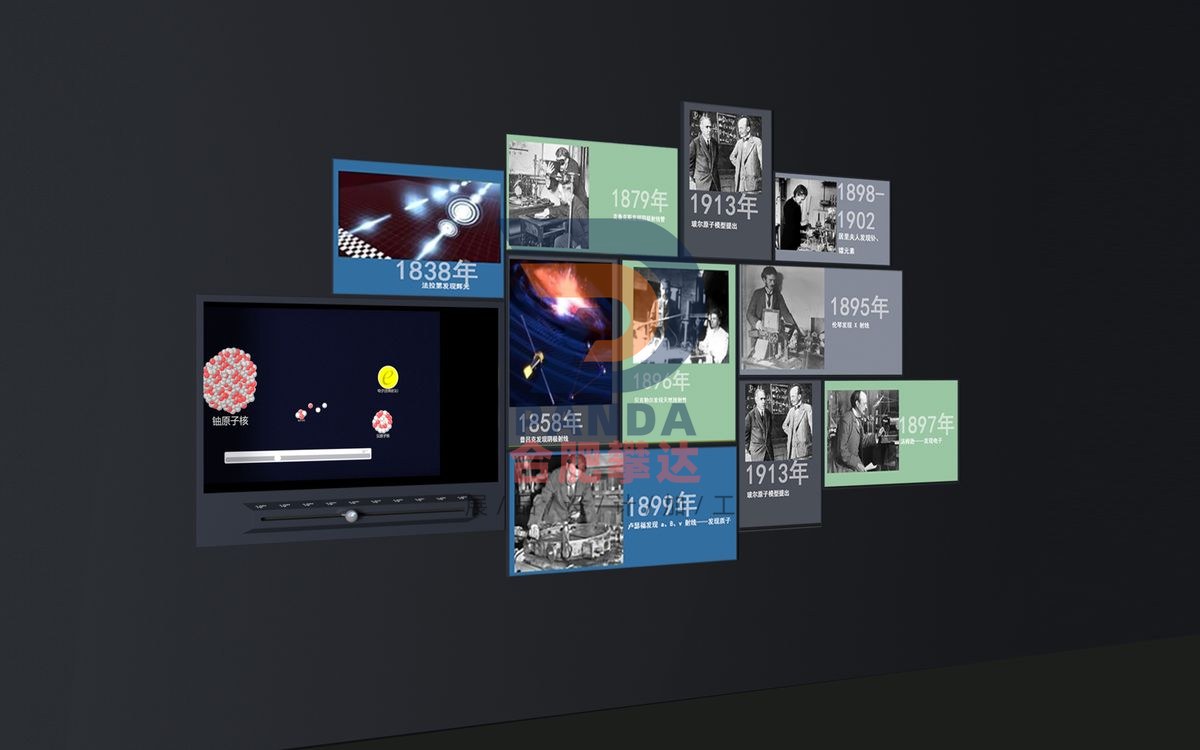
Through a set of picture and text light boxes, scientists in the process of discovering the microscopic world and their discovery process are displayed, leading the audience to enter the exploration of the microscopic world.
Operation
The discovery process of the microscopic world: Faraday discovered glow in 1838; Plucker discovered cathode rays in 1858; Crooks invented the cathode ray tube in 1879; Roentgen discovered X-rays in 1895; Becquerel discovered natural radioactivity in 1896; Thomson discovered electrons in 1897; In 1899, Rutherford discovered alpha, beta, and gamma rays—discovered protons; from 1898 to 1902, Marie Curie discovered polonium and radium elements; Bohr's atomic model was proposed in 1913; Chadwick discovered the neutron in 1932. A set of picture and text light boxes show scientists in the process of discovering the microscopic world and their discovery process.
Export-Ready Features
- Durable, robust construction for high-traffic gallery environments
- Low-maintenance electromechanical design with reliable, safe components
- Custom sizing, theming & multilingual labeling available
- OEM & turnkey exhibit solutions with full project management
- Overseas shipping, export documentation & on-site installation supported
- Shipped to science centers and museums in 50+ countries