
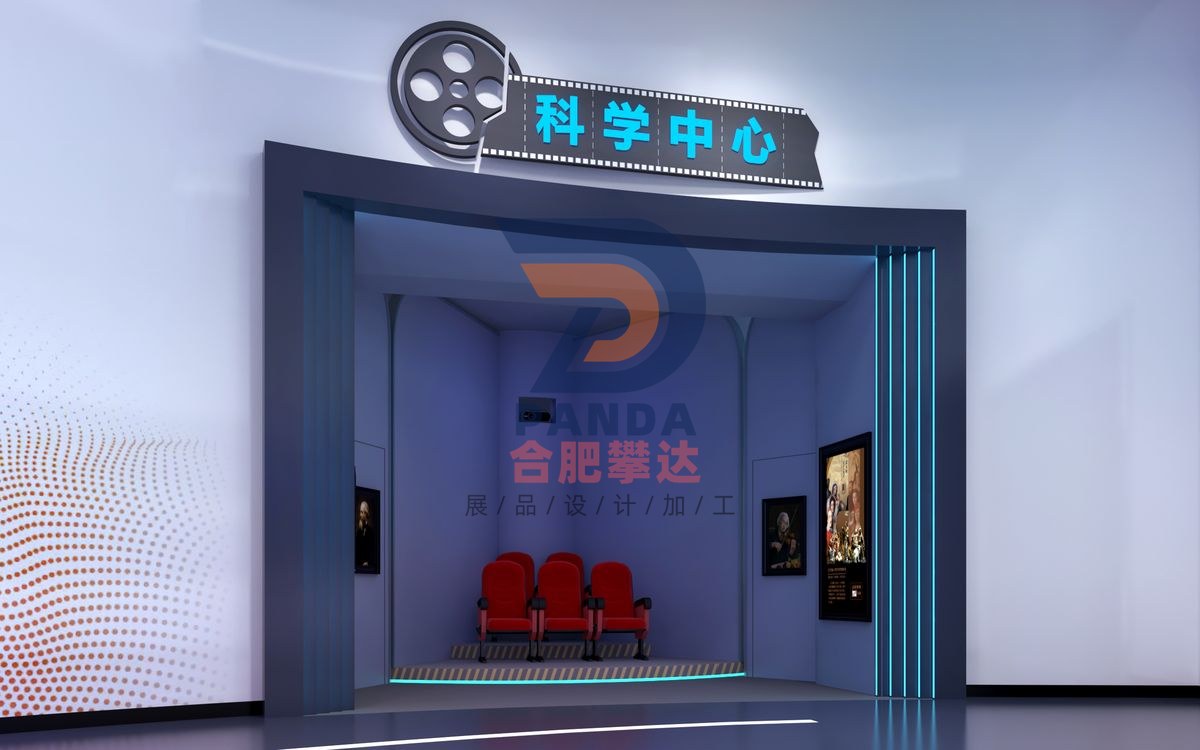
Science Center
Smart Technology · Interactive
- DimensionsSubject to on-site plan
- PresentationInteractive
- PricingQuoted by manufacture spec
Science Center is a hands-on, mechanical & electromechanical interactive exhibit manufactured by Hefei Panda for science centers, children’s museums, discovery centers, STEM learning centers and family entertainment centers. Engineered for durable, robust, low-maintenance, high-traffic gallery installation, it turns abstract scientific concepts into direct, interactive visitor exploration. Hefei Panda is a global exhibit manufacturer exporting hands-on science displays to 50+ countries, with in-house engineering, fabrication, installation and commissioning.
Exhibit Summary
Science Center is a Interactive interactive exhibit in the Smart Technology category, designed for science centers, children’s museums, discovery centers, STEM learning centers and family entertainment centers. Built as a hands-on, mechanical & electromechanical display, it turns an abstract scientific concept into direct, interactive visitor exploration, and is engineered for durable, low-maintenance, high-traffic gallery use.
Scientific Principle
Shows the five transfers of science centers in the world and their impacts, allowing the audience to imagine whether the next transfer of science centers will occur in China.
Operation
A science center refers to a country or region where the number of major science and technological achievements achieved in a certain period exceeds one quarter of the total major achievements achieved in the same period. When the science ideas and achievements of a certain country are superior to those of the actual science center and thus lead the trend of science and culture, it is the so-called transfer of the science center. The first time: Italy (1540-1610) Renaissance brought ideological emancipation The Renaissance movement - an extremely important historical period in European history, "is the greatest progress and change that mankind has ever experienced", "an era that requires giants and produces giants", and is also the second golden age in the history of European culture after ancient Greek culture. It provides a spiritual environment and economic soil for the birth and development of modern science. The second time: Britain (1660-1730), the science society prospered, and science research exchanges and cooperation were free. Between 1660 and 1730, Britain had more than 60 outstanding scientists, accounting for more than 36% of the world's outstanding scientists at that time, and their major science achievements accounted for more than 40% of the world's. From 1660 to 1730, Britain became the world's science center. The third time: France (1770-1830) The Enlightenment promoted reason and created the "Golden Age" of science In the mid-18th century, the French bourgeoisie launched the Enlightenment Movement, criticizing theocracy, advocating science and democracy, and launching a large-scale science experiment. In 1789, the French bourgeois revolution broke out, causing most scientists, engineers, doctors, printers and a large number of intellectuals to devote themselves to it regardless of their own safety. The Enlightenment and the French Revolution brought about the "golden age" of science, with the emergence of famous scientists and their science achievements such as mathematicians Lagrange and Laplace, physicists Coulomb and Ampere, and chemist Lavoisier. According to incomplete statistics, from 1789 to 1800, France had 23 of the 58 major science research achievements in the world, accounting for 40% of the total. In almost every important science field, French scientists made outstanding contributions. The fourth time: Germany (1810-1920) combined teaching and research, leading science and technology for a hundred years and ruling the roost Modern German science benefited from the promotion of the industrial revolution and drew sufficient social nutrients from the German revolution. The symbol of ideological emancipation during the German revolutionary period was Kant's rational criticism. Dampier, the famous historian of science and technology, pointed out: "Germany's science center is in its universities." German universities have transformed from scholastic to modern. Germany was also the first country in the world to establish the "tutor system." In addition, Germany has many models of this new type of science research and education system. Germany pays special attention to the combination of theory and practice of science and technology. Due to the application of science and technology in industry, agriculture, transportation and other sectors, Germany became the world's industrialized country in the 1870s. The fifth time: The United States (1920-) draws on the strengths of others and takes advantage of diversity, leading the era of "big science" The rise of American science was mainly due to the tradition of British science and the German science system. This made the take-off of American science stand on the "shoulders of giants" from the beginning. The newly born United States, relying on its pioneering spirit and sense of innovation, quickly greatly improved the application level of Western European science and technology. It turned electric power technology into the energy industry of the whole society, turned steam technology and metallurgical technology into the transportation, steel and machinery industries, and thus invented the radio technology and communication industry. The development of big science in the United States not only drives stronger industrial technology inventions, but also effectively promotes basic science achievements. It is still the center of world science. A science center refers to a country or region where the number of major science and technological achievements achieved in a certain period exceeds a quarter of the total number of major achievements achieved in the same period. When the science ideas and achievements of a certain country are superior to those of the actual science center and thus lead the trend of science and culture, it is the so-called transfer of the science center.
Export-Ready Features
- Durable, robust construction for high-traffic gallery environments
- Low-maintenance electromechanical design with reliable, safe components
- Custom sizing, theming & multilingual labeling available
- OEM & turnkey exhibit solutions with full project management
- Overseas shipping, export documentation & on-site installation supported
- Shipped to science centers and museums in 50+ countries