
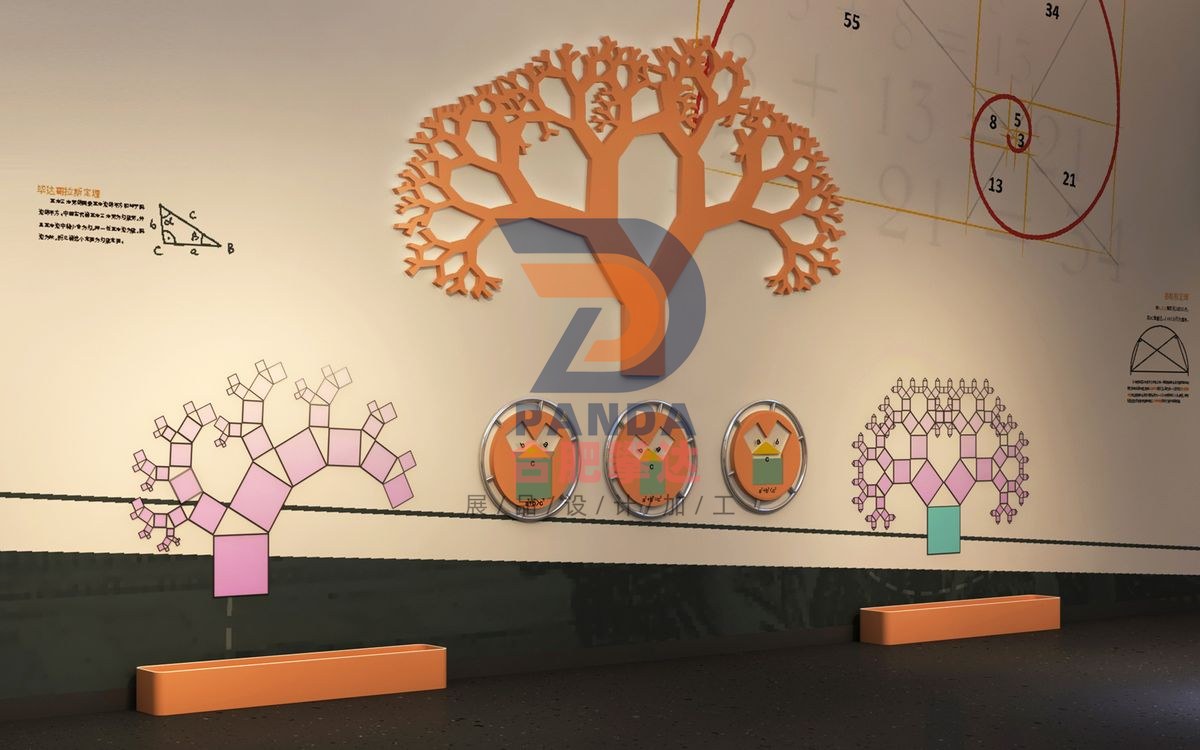
The Pythagoras Theorem
Mathematics · Interactive
- DimensionsSubject to on-site plan
- PresentationInteractive
- PricingQuoted by manufacture spec
The Pythagoras Theorem is a hands-on, mechanical & electromechanical interactive exhibit manufactured by Hefei Panda for science centers, children’s museums, discovery centers, STEM learning centers and family entertainment centers. Engineered for durable, robust, low-maintenance, high-traffic gallery installation, it turns abstract scientific concepts into direct, interactive visitor exploration. Hefei Panda is a global exhibit manufacturer exporting hands-on science displays to 50+ countries, with in-house engineering, fabrication, installation and commissioning.
Exhibit Summary
The Pythagoras Theorem is a Interactive interactive exhibit in the Mathematics category, designed for science centers, children’s museums, discovery centers, STEM learning centers and family entertainment centers. Built as a hands-on, mechanical & electromechanical display, it turns an abstract scientific concept into direct, interactive visitor exploration, and is engineered for durable, low-maintenance, high-traffic gallery use.
Scientific Principle
The exhibition aims to showcase Pythagoras’ most representative achievement in mathematics, which is the proposing of the Pythagoras Theorem, and uses fun interactions to allow the audience to explore the verification of the Pythagoras Theorem and experience the process of science theoretical research and proof.
Operation
Pythagoras Theorem: The basic relationship between the three sides of a right triangle in Euclidean geometry. That is, the area of a square with a hypotenuse side (the side opposite the right angle) is equal to the sum of the areas of the other two squares. Proofs of theorems are diverse, including geometric and algebraic, and some date back thousands of years. The root diagram of the "Pythagoras tree": The root diagram of the "Pythagoras tree" is an infinitely repeatable tree shape drawn by Pythagoras based on the Pythagoras theorem. The construction of the Pythagoras tree starts with a large square, and two congruent smaller squares are built above the square. An isosceles right triangle appears between the three squares, so the side length of the smaller square is √2/2 of the side length of the large square. Repeat this process with the two smaller squares, resulting in four smaller squares, and so on. The exhibition aims to showcase Pythagoras' most representative achievement in mathematics, which is the proposing of the Pythagoras theorem, and uses fun interactions to allow the audience to explore the verification of the Pythagoras theorem and experience the process of research and proof of science theories.
Export-Ready Features
- Durable, robust construction for high-traffic gallery environments
- Low-maintenance electromechanical design with reliable, safe components
- Custom sizing, theming & multilingual labeling available
- OEM & turnkey exhibit solutions with full project management
- Overseas shipping, export documentation & on-site installation supported
- Shipped to science centers and museums in 50+ countries