
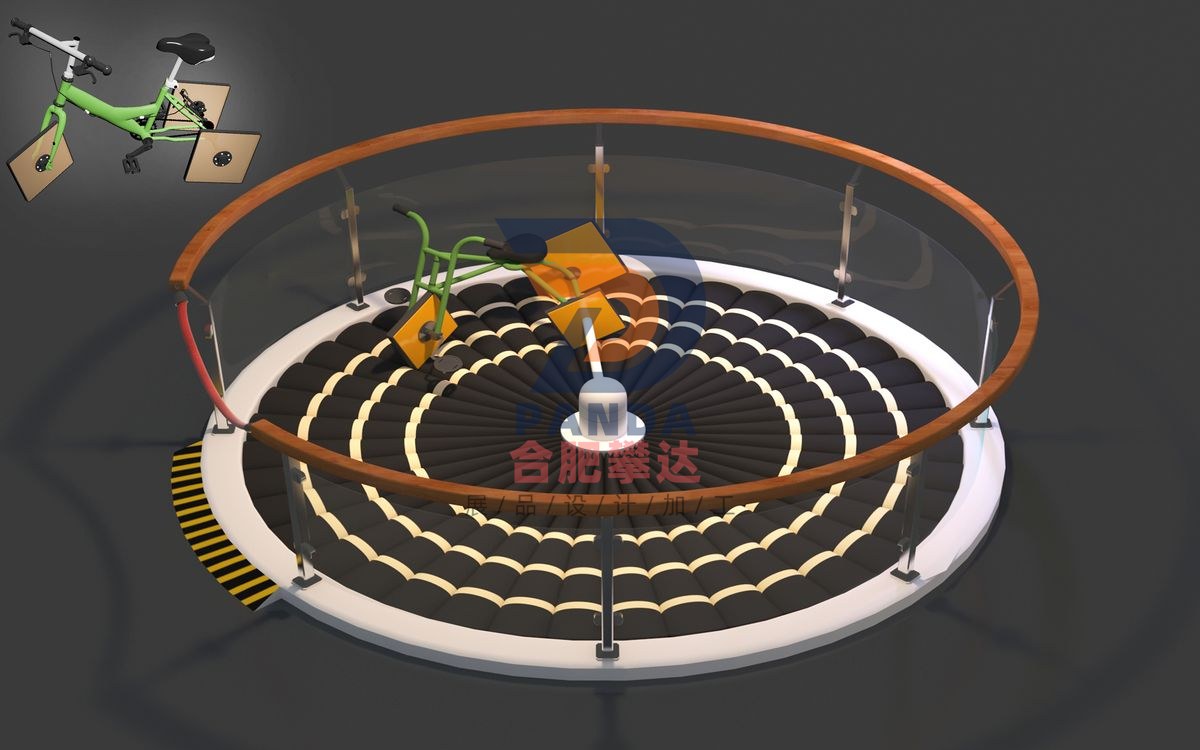
Square Wheel Car
Mechanics in Motion · Interactive
- DimensionsSubject to on-site plan
- PresentationInteractive
- PricingQuoted by manufacture spec
Square Wheel Car is a hands-on, mechanical & electromechanical interactive exhibit manufactured by Hefei Panda for science centers, children’s museums, discovery centers, STEM learning centers and family entertainment centers. Engineered for durable, robust, low-maintenance, high-traffic gallery installation, it turns abstract scientific concepts into direct, interactive visitor exploration. Hefei Panda is a global exhibit manufacturer exporting hands-on science displays to 50+ countries, with in-house engineering, fabrication, installation and commissioning.
Exhibit Summary
Square Wheel Car is a Interactive interactive exhibit in the Mechanics in Motion category, designed for science centers, children’s museums, discovery centers, STEM learning centers and family entertainment centers. Built as a hands-on, mechanical & electromechanical display, it turns an abstract scientific concept into direct, interactive visitor exploration, and is engineered for durable, low-maintenance, high-traffic gallery use.
Scientific Principle
The exhibition allows the audience to ride a square wheel car, watch its curved trajectory, and grasp the concept of the catenary.
Operation
A catenary is a curve, which refers to a uniform (thickness and mass distribution), soft (inextensible) chain fixed at both ends. It has a curved shape under the action of gravity, such as a suspension bridge. It is named because it is similar to a rope fixed at both ends drooping under the action of uniform gravity. With an appropriate choice of coordinate system, the equation of the catenary is a hyperbolic cosine function whose standard equation is: Among them, a is a constant, which is the distance from the curve vertex to the abscissa axis. Bicycles with square wheels can drive smoothly because the running track is a carefully designed catenary line. The distance between the wheel's center of gravity and the ground can remain unchanged during driving, thus achieving a smooth driving effect. In 1690, Jacobi Bernoulli, Johann Bernoulli's brother, raised the catenary problem to seek answers from the mathematical community, that is: fix the two ends of the necklace, let it hang naturally in the gravity field, and find the curve equation of the necklace. Galileo was the first to notice the catenary and speculated that the catenary was a parabola. In 1691, Leibniz, Huygens and Johann Bernoulli each obtained the correct answer, using the recently born calculus. Undoubtedly, the "catenary" has reached an equilibrium state, and at this time we can think that its gravitational potential energy has reached a minimum. Because the equilibrium axiom tells us that the minimum potential energy must be balanced, and the catenary can only have one equilibrium state. Since its gravitational potential energy is considered to have reached the minimum, the problem becomes to find the one with the smallest gravitational potential energy among the curves with a fixed circumference. This is the same as the previous "steepest descent line" problem and belongs to the category of variation (finding small changes and extreme values for the path). Therefore, the steepest descent line and catenary line problems are essentially the same.
Export-Ready Features
- Durable, robust construction for high-traffic gallery environments
- Low-maintenance electromechanical design with reliable, safe components
- Custom sizing, theming & multilingual labeling available
- OEM & turnkey exhibit solutions with full project management
- Overseas shipping, export documentation & on-site installation supported
- Shipped to science centers and museums in 50+ countries