
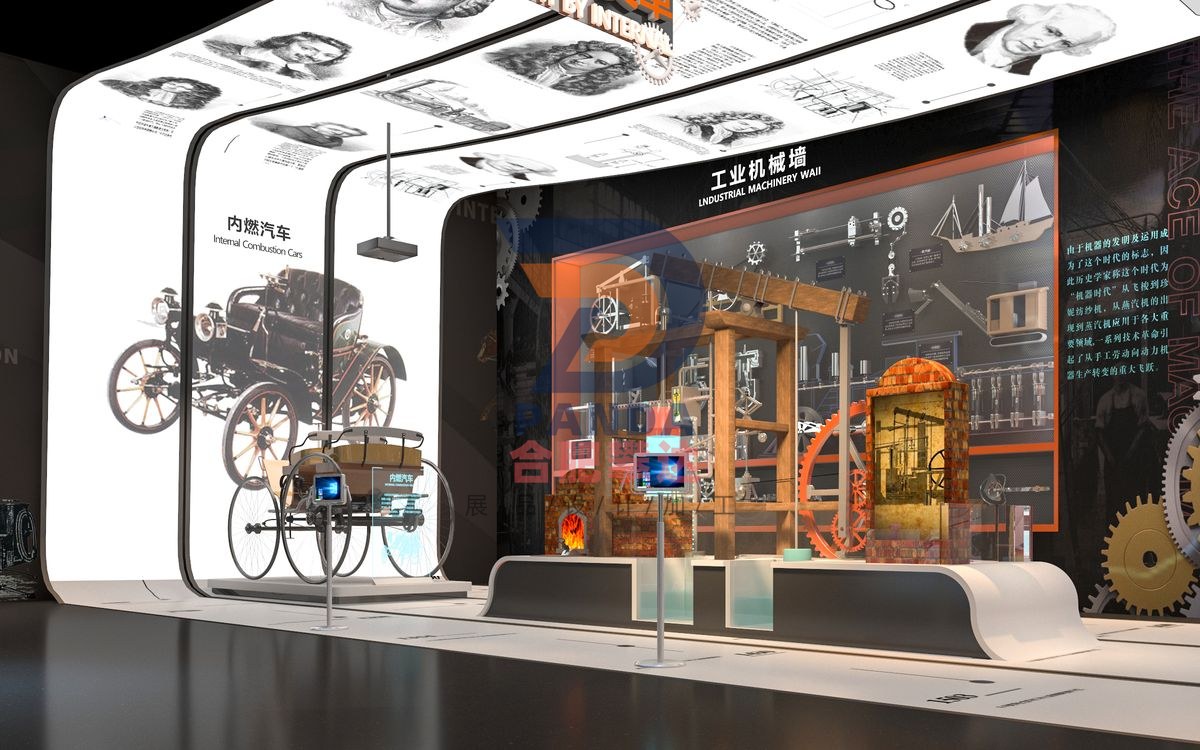
Traveling Through the Industrial Age
Smart Technology · Interactive
- DimensionsSubject to on-site plan
- PresentationInteractive
- PricingQuoted by manufacture spec
Traveling Through the Industrial Age is a hands-on, mechanical & electromechanical interactive exhibit manufactured by Hefei Panda for science centers, children’s museums, discovery centers, STEM learning centers and family entertainment centers. Engineered for durable, robust, low-maintenance, high-traffic gallery installation, it turns abstract scientific concepts into direct, interactive visitor exploration. Hefei Panda is a global exhibit manufacturer exporting hands-on science displays to 50+ countries, with in-house engineering, fabrication, installation and commissioning.
Exhibit Summary
Traveling Through the Industrial Age is a Interactive interactive exhibit in the Smart Technology category, designed for science centers, children’s museums, discovery centers, STEM learning centers and family entertainment centers. Built as a hands-on, mechanical & electromechanical display, it turns an abstract scientific concept into direct, interactive visitor exploration, and is engineered for durable, low-maintenance, high-traffic gallery use.
Scientific Principle
Through AR experience, the audience can experience the factory atmosphere of the first industrial revolution immersively, as if traveling via time and space, achieving overall atmosphere rendering and interesting interaction.
Operation
The audience watches by operating the viewfinder, as if they are in different scenes of the industrial era, and truly feels the industrial atmosphere under the background of the era. Spinning Factory: Scenes of the spinning jenny driving mass production in the factory; Steam engine: The scene of the first factory whose entire production process was driven by steam power; Steam locomotive: A picture of a steam locomotive running; Steamship: A picture of a steamship sailing on the sea; Steam shovel: A picture of using a steam shovel to carry out large-scale construction projects. Beginning in the 1860s, a series of important inventions appeared in Britain's emerging industry, the cotton textile industry. Machine production gradually replaced manual labor and later expanded to other industries. This major change in industry, science, technology, etc. is called the Industrial Revolution. The invention and application of a new power machine, the steam engine, brought mankind into the steam age. The rise of the industrial revolution greatly promoted social and economic development and technological progress. In the second half of the 19th century, under the guidance of science theories, technological inventions emerged one after another, and the industrial revolution entered a new stage of development. The most prominent feature of this period was the widespread use of electricity in production and life. With the advent of generators, electricity gradually replaced steam power and became an important power source. In order to use electricity to drive machines, the Belgian Gram invented the electric motor in 1870. Compared with steam engines, electric motors have high efficiency, less pollution, wide application range, and convenient use, and are gradually popularized in industrial production.
Export-Ready Features
- Durable, robust construction for high-traffic gallery environments
- Low-maintenance electromechanical design with reliable, safe components
- Custom sizing, theming & multilingual labeling available
- OEM & turnkey exhibit solutions with full project management
- Overseas shipping, export documentation & on-site installation supported
- Shipped to science centers and museums in 50+ countries