
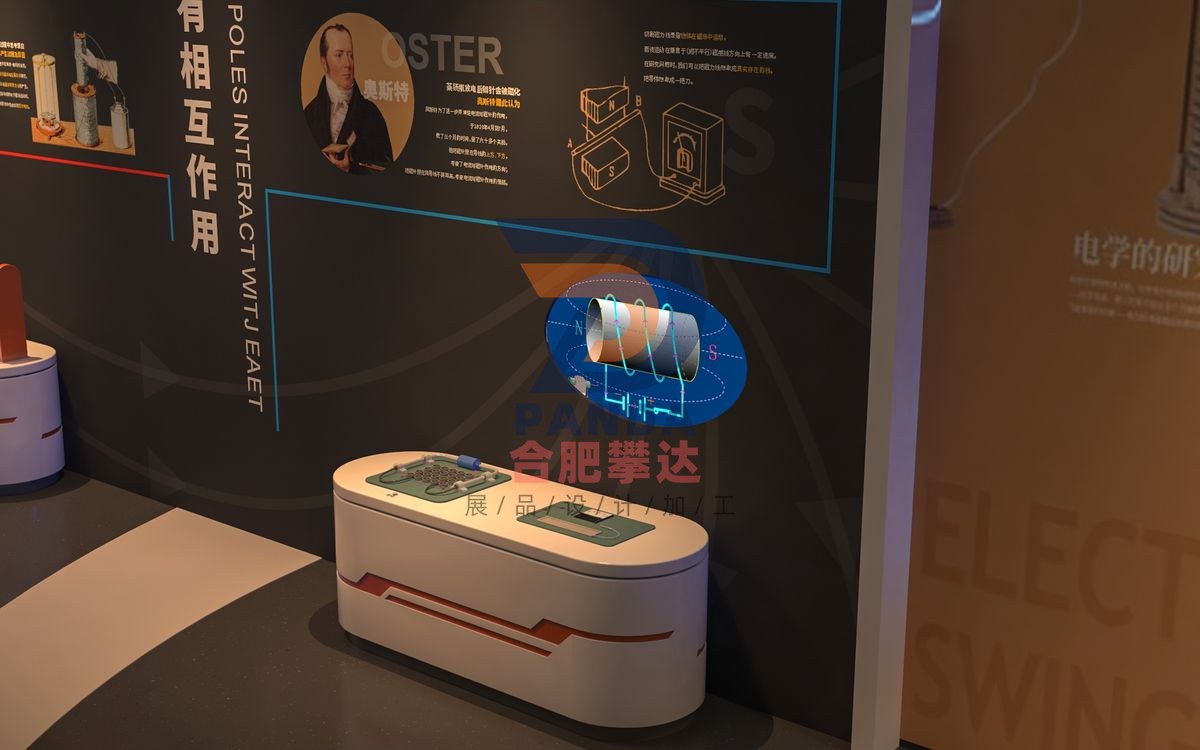
Oersted's Experiment
Electromagnetism · Interactive
- DimensionsSubject to on-site plan
- PresentationInteractive
- PricingQuoted by manufacture spec
Oersted's Experiment is a hands-on, mechanical & electromechanical interactive exhibit manufactured by Hefei Panda for science centers, children’s museums, discovery centers, STEM learning centers and family entertainment centers. Engineered for durable, robust, low-maintenance, high-traffic gallery installation, it turns abstract scientific concepts into direct, interactive visitor exploration. Hefei Panda is a global exhibit manufacturer exporting hands-on science displays to 50+ countries, with in-house engineering, fabrication, installation and commissioning.
Exhibit Summary
Oersted's Experiment is a Interactive interactive exhibit in the Electromagnetism category, designed for science centers, children’s museums, discovery centers, STEM learning centers and family entertainment centers. Built as a hands-on, mechanical & electromechanical display, it turns an abstract scientific concept into direct, interactive visitor exploration, and is engineered for durable, low-maintenance, high-traffic gallery use.
Scientific Principle
Restore Oersted's unexpected discovery, aiming to let the audience grasp the process of Oersted's discovery of the current and magnetic effects, and feel the scientist's curiosity, hard exploration, continuous research, and the science spirit of finally achieving extraordinary results.
Operation
The steel needle will be magnetized after the Leyden jar is discharged. Based on this, Oersted believed that under appropriate conditions, electricity can be converted into magnetism. One day in April 1820, Oersted inadvertently brought an electrified wire close to the compass during class. When the wire was energized, the magnetic needle deflected. He was very excited, and he firmly grasped this phenomenon, conducted in-depth research for three months, and repeated dozens of experiments. An experiment showing the existence of a magnetic field around a current-carrying wire: If a small magnetic needle is placed near a straight wire (the wire needs to be placed north and south), the magnetic needle will deflect when a current flows via the wire. In order to further clarify the effect of electric current on the magnetic needle, Oersted spent three months from April to July 1820 and conducted more than 60 experiments. He placed the magnetic needle above and below the wire to examine the direction of the current's effect on the magnetic needle; On July 21, 1820, Oersted announced the magnetic effect of electric current to the science community, unveiling the prelude to electromagnetism and marking the arrival of the electromagnetic era. The steel needle will be magnetized after the Leyden jar is discharged. Under appropriate conditions, electricity can be converted into magnetism.
Export-Ready Features
- Durable, robust construction for high-traffic gallery environments
- Low-maintenance electromechanical design with reliable, safe components
- Custom sizing, theming & multilingual labeling available
- OEM & turnkey exhibit solutions with full project management
- Overseas shipping, export documentation & on-site installation supported
- Shipped to science centers and museums in 50+ countries