
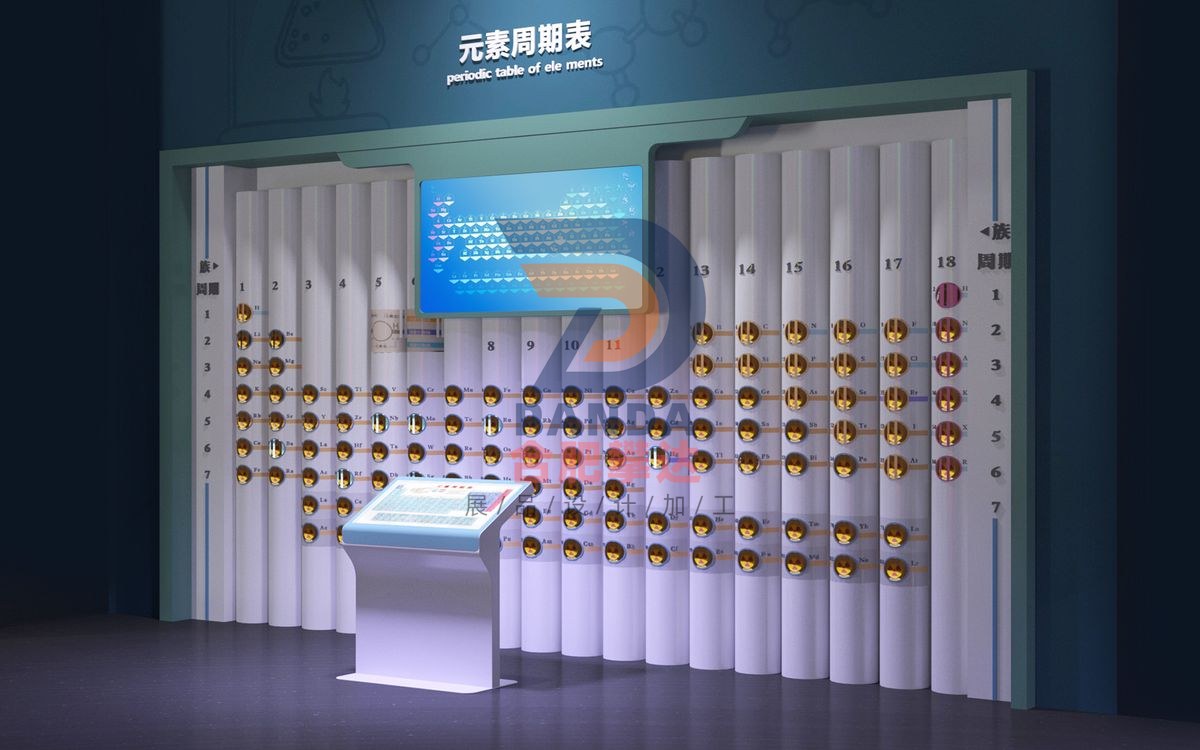
Periodic Table of Elements
Smart Technology · Interactive
- DimensionsSubject to on-site plan
- PresentationInteractive
- PricingQuoted by manufacture spec
Periodic Table of Elements is a hands-on, mechanical & electromechanical interactive exhibit manufactured by Hefei Panda for science centers, children’s museums, discovery centers, STEM learning centers and family entertainment centers. Engineered for durable, robust, low-maintenance, high-traffic gallery installation, it turns abstract scientific concepts into direct, interactive visitor exploration. Hefei Panda is a global exhibit manufacturer exporting hands-on science displays to 50+ countries, with in-house engineering, fabrication, installation and commissioning.
Exhibit Summary
Periodic Table of Elements is a Interactive interactive exhibit in the Smart Technology category, designed for science centers, children’s museums, discovery centers, STEM learning centers and family entertainment centers. Built as a hands-on, mechanical & electromechanical display, it turns an abstract scientific concept into direct, interactive visitor exploration, and is engineered for durable, low-maintenance, high-traffic gallery use.
Scientific Principle
The periodic table of elements reveals the differences and connections between various chemical elements, realizes a leap from perceptual to rational understanding of inorganic chemistry, and provides humans with the key to exploring the cyclical development of nature. The exhibition will create a large-scale photoelectric hands-on wall of the periodic table of elements. Through the hands-on form of media games, the audience can explore the rules and hidden meanings in the periodic table of elements, and grasp the process of the invention and gradual improvement of the periodic table of elements.
Operation
From the mid-18th century to the mid-19th century, a series of new elements were discovered one after another with the great development of production and science experiments. People began to wonder how many elements there are on the earth? How to find new elements? Are there certain intrinsic connections between various elements? Against this background, scientists began to classify existing elements. It was not until 1869 that the German chemist Mendeleev proposed the periodic law of elements, that is, "elements arranged according to their atomic weights show obvious periodicity in their properties" and published his first periodic table. Mendeleev also predicted undiscovered elements with great accuracy via periodicity. The periodic table is a list of chemical elements ordered from smallest to largest atomic number. The list is generally rectangular, with spaces left in the periods of some elements so that elements with similar properties can be grouped into the same group, such as halogens, alkali metal elements, rare gases (noble gases or noble gases), radioactive elements, etc. This makes the elements in the periodic table divided into seven main groups, seven sub-groups, zero groups, and eight groups. The periodic table of elements reveals the differences and connections between various chemical elements, realizes a leap from perceptual to rational understanding of inorganic chemistry, and provides humans with the key to exploring the cyclical development of nature.
Export-Ready Features
- Durable, robust construction for high-traffic gallery environments
- Low-maintenance electromechanical design with reliable, safe components
- Custom sizing, theming & multilingual labeling available
- OEM & turnkey exhibit solutions with full project management
- Overseas shipping, export documentation & on-site installation supported
- Shipped to science centers and museums in 50+ countries