
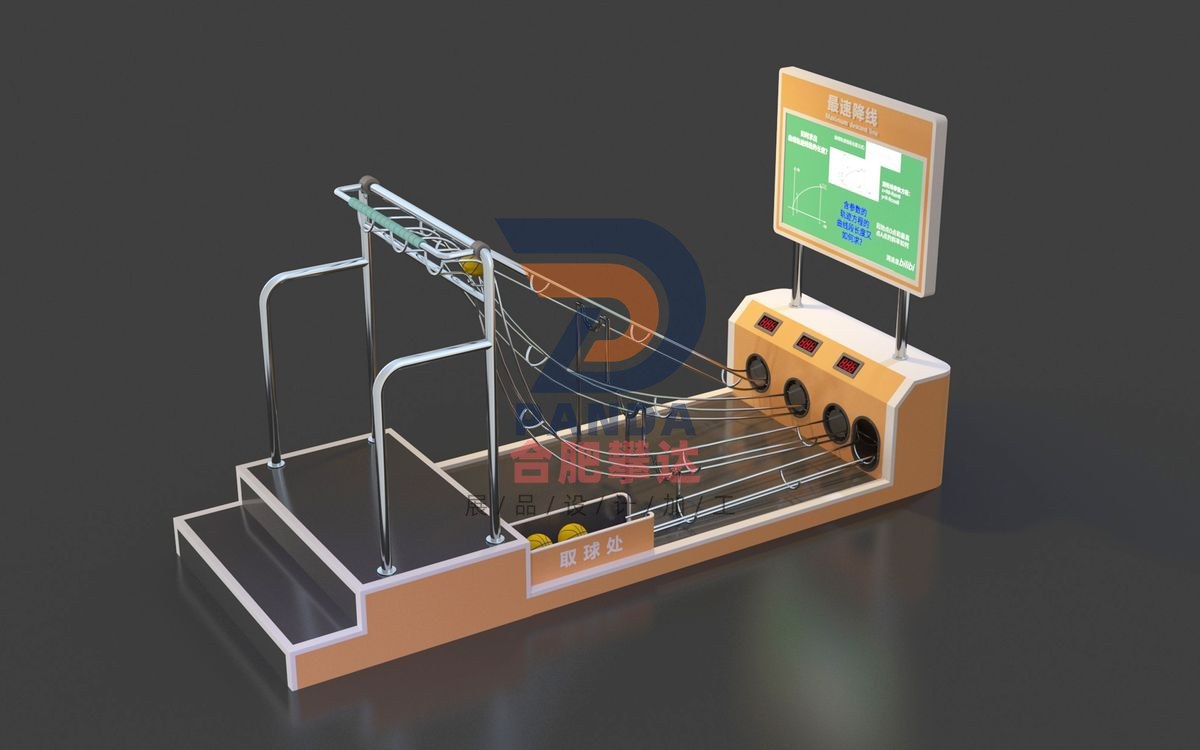
The steepest descent line
Mechanics in Motion · Interactive
- DimensionsSubject to on-site plan
- PresentationInteractive
- PricingQuoted by manufacture spec
The steepest descent line is a hands-on, mechanical & electromechanical interactive exhibit manufactured by Hefei Panda for science centers, children’s museums, discovery centers, STEM learning centers and family entertainment centers. Engineered for durable, robust, low-maintenance, high-traffic gallery installation, it turns abstract scientific concepts into direct, interactive visitor exploration. Hefei Panda is a global exhibit manufacturer exporting hands-on science displays to 50+ countries, with in-house engineering, fabrication, installation and commissioning.
Exhibit Summary
The steepest descent line is a Interactive interactive exhibit in the Mechanics in Motion category, designed for science centers, children’s museums, discovery centers, STEM learning centers and family entertainment centers. Built as a hands-on, mechanical & electromechanical display, it turns an abstract scientific concept into direct, interactive visitor exploration, and is engineered for durable, low-maintenance, high-traffic gallery use.
Scientific Principle
The exhibition allows the audience to draw conclusions via experiments, answer the question of the steepest descent line raised by Galileo, and grasp the science experimental methods created by Galileo.
Operation
In 1630, Galileo asked this question: "When a small ball slides from a given point to another point that is not vertically below it under the action of gravity, what route will the ball take to slide along in the shortest time, excluding friction?" In 1638, Galileo gave the answer in "On Two New Sciences" that it was an arc, but did not provide a proof. Of course, based on the knowledge we have now, this is undoubtedly wrong. In June 1696, after successfully solving this problem, Johann Bernoulli issued a challenge to mathematicians across Europe: Given two points A and B on a vertical plane, if a point moves from A to B in the least time under the influence of gravity only, what does the path it traces look like? In 1697, the "Learned Bulletin" published four solutions by Newton, Jacob, Leibniz, and Kirnhaus. The final answer was a cycloid, not an arc as envisioned by Galileo. The steepest descent line or shortest line problem is the first calculus of variation problem in history, and it is also a symbol of the development of calculus of variations. This question was raised by Johann Bernoulli in an open letter to his brother Jacob Bernoulli in 1696. The formulation of the problem is: Suppose A and B are two points on the vertical plane that are not on the same vertical line. Among all the plane curves connecting A and B, find a curve that makes the particle that is only affected by gravity and has an initial velocity of zero move along this curve from point A to point B in the shortest time. That is the fastest descent line.
Export-Ready Features
- Durable, robust construction for high-traffic gallery environments
- Low-maintenance electromechanical design with reliable, safe components
- Custom sizing, theming & multilingual labeling available
- OEM & turnkey exhibit solutions with full project management
- Overseas shipping, export documentation & on-site installation supported
- Shipped to science centers and museums in 50+ countries