
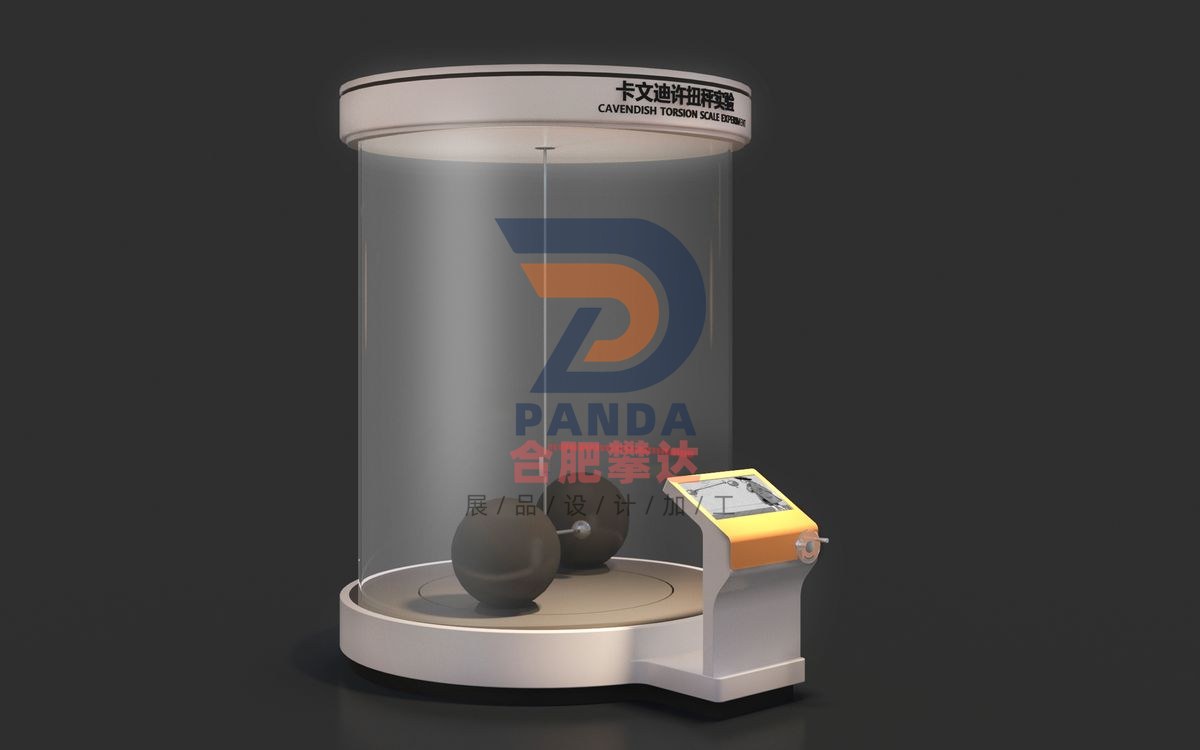
Cavendish torsion scale experiment
Mechanics in Motion · Interactive
- DimensionsSubject to on-site plan
- PresentationInteractive
- PricingQuoted by manufacture spec
Cavendish torsion scale experiment is a hands-on, mechanical & electromechanical interactive exhibit manufactured by Hefei Panda for science centers, children’s museums, discovery centers, STEM learning centers and family entertainment centers. Engineered for durable, robust, low-maintenance, high-traffic gallery installation, it turns abstract scientific concepts into direct, interactive visitor exploration. Hefei Panda is a global exhibit manufacturer exporting hands-on science displays to 50+ countries, with in-house engineering, fabrication, installation and commissioning.
Exhibit Summary
Cavendish torsion scale experiment is a Interactive interactive exhibit in the Mechanics in Motion category, designed for science centers, children’s museums, discovery centers, STEM learning centers and family entertainment centers. Built as a hands-on, mechanical & electromechanical display, it turns an abstract scientific concept into direct, interactive visitor exploration, and is engineered for durable, low-maintenance, high-traffic gallery use.
Scientific Principle
Restore the process of Cavendish torsion scale experiment and introduce Cavendish's method of testing the weight of the earth.
Operation
Cavendish installed a small lead ball on each end of a long wooden stick, like a dumbbell, and then used a quartz wire to hang the "dumbbell" horizontally. During the experiment, as long as the two large shot balls are brought close to the small shot balls at both ends of the wooden stick, due to the effect of "gravity", the "dumbbell" will definitely swing and the quartz wire will also twist. As long as you measure how much the quartz wire twists, you can know the gravity between the big and small lead balls. At the same time, he fixed a small mirror on the quartz wire and illuminated the small mirror with a beam of light. A small mirror reflects light onto a scale. In this way, as long as the quartz wire twists slightly, the reflected light will move significantly on the scale, thus improving the sensitivity of the experiment. He measured the parameters of the gravitational constant. The gravitational constant is approximately G=6.67259x10⁻¹¹ (N·m2/kg2). G=6.67×10⁻¹¹ (N·m2/kg2) is usually taken. On this basis, Cavendish calculated the density and mass of the earth. Cavendish's calculation result is that the mass of the earth is 6.0x1024kg. This result has an error of less than 1% compared with the results measured by modern instruments. Judging from the experimental conditions at the time, it was quite an achievement. The formula of universal gravitation F=Gm1m2/r2 (G is the gravitational constant, m1 and m2 are the masses of the two objects, and r is the distance between the two objects). But Newton himself did not know what the value of the gravitational constant G was. It was not until 1798 that Cavendish verified the law of universal gravitation via the torsion balance experiment and determined the gravitational constant and the average density of the earth. He is known as "the first person to weigh the earth." The display describes Cavendish's experimental process in the form of scene restoration.
Export-Ready Features
- Durable, robust construction for high-traffic gallery environments
- Low-maintenance electromechanical design with reliable, safe components
- Custom sizing, theming & multilingual labeling available
- OEM & turnkey exhibit solutions with full project management
- Overseas shipping, export documentation & on-site installation supported
- Shipped to science centers and museums in 50+ countries