
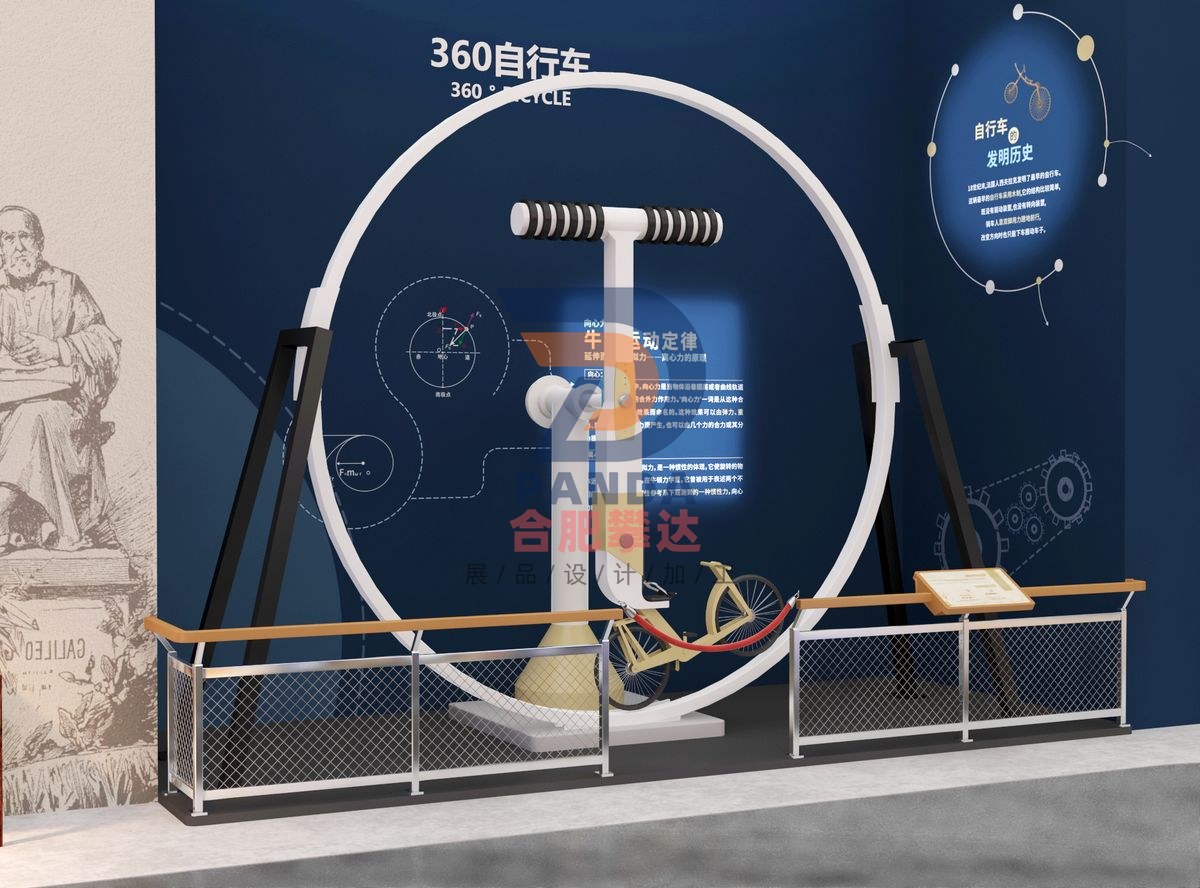
360° Bicycle
Mechanics in Motion · Interactive
- DimensionsSubject to on-site plan
- PresentationInteractive
- PricingQuoted by manufacture spec
360° Bicycle is a hands-on, mechanical & electromechanical interactive exhibit manufactured by Hefei Panda for science centers, children’s museums, discovery centers, STEM learning centers and family entertainment centers. Engineered for durable, robust, low-maintenance, high-traffic gallery installation, it turns abstract scientific concepts into direct, interactive visitor exploration. Hefei Panda is a global exhibit manufacturer exporting hands-on science displays to 50+ countries, with in-house engineering, fabrication, installation and commissioning.
Exhibit Summary
360° Bicycle is a Interactive interactive exhibit in the Mechanics in Motion category, designed for science centers, children’s museums, discovery centers, STEM learning centers and family entertainment centers. Built as a hands-on, mechanical & electromechanical display, it turns an abstract scientific concept into direct, interactive visitor exploration, and is engineered for durable, low-maintenance, high-traffic gallery use.
Scientific Principle
The displays allow the audience to participate in the ride and experience the concept of centripetal force and the virtual force extended from Newton's law of motion - centrifugal force.
Operation
Centripetal force only changes the direction of motion of the controlled object, but does not change the rate of motion, even in non-uniform circular motion. In non-uniform circular motion, the tangential acceleration that changes the speed of motion is not produced by centripetal force. The size of the centripetal force is closely related to the mass of the object (m), the length of the circumferential radius of the object's movement (r) and the angular velocity (ω). The property of an object remaining at rest or moving in a straight line at a uniform speed is called inertia. Newton's third law states that for every force, there is an equal and opposite force. Centrifugal force is a virtual force, a manifestation of inertia, that moves a rotating object away from its center of rotation. In a rotating system, centripetal force pulls the object inward to maintain a curved path, while the inertia of the object due to its mass forces the object to continue moving in the tangent direction of the motion trajectory (the straight line direction it originally advanced at that moment). In each case, only one real force is exerted, and the other is simply a reaction force. Centripetal force refers to the total external force directed toward the center of the circle (center of curvature) when an object moves along a circle or curved track in classical mechanics. This effect can be produced by any force such as elasticity, gravity, friction, etc., or it can be provided by the resultant force or components of several forces. Because circular motion is a curved motion, an object in circular motion will also be acted upon by a combined external force in a direction different from its speed. For an object in circular motion, centripetal force is a pulling force whose direction changes as the object moves in a circular orbit. This pulling force is directed along the radius of the circle toward the center of the circle, hence the name "centripetal force." The centripetal force points to the center of the circle, and the object controlled by the centripetal force moves in a tangential direction, so the centripetal force must be perpendicular to the direction of motion of the controlled object, and only produces acceleration in the direction of the normal line of the velocity.
Export-Ready Features
- Durable, robust construction for high-traffic gallery environments
- Low-maintenance electromechanical design with reliable, safe components
- Custom sizing, theming & multilingual labeling available
- OEM & turnkey exhibit solutions with full project management
- Overseas shipping, export documentation & on-site installation supported
- Shipped to science centers and museums in 50+ countries