
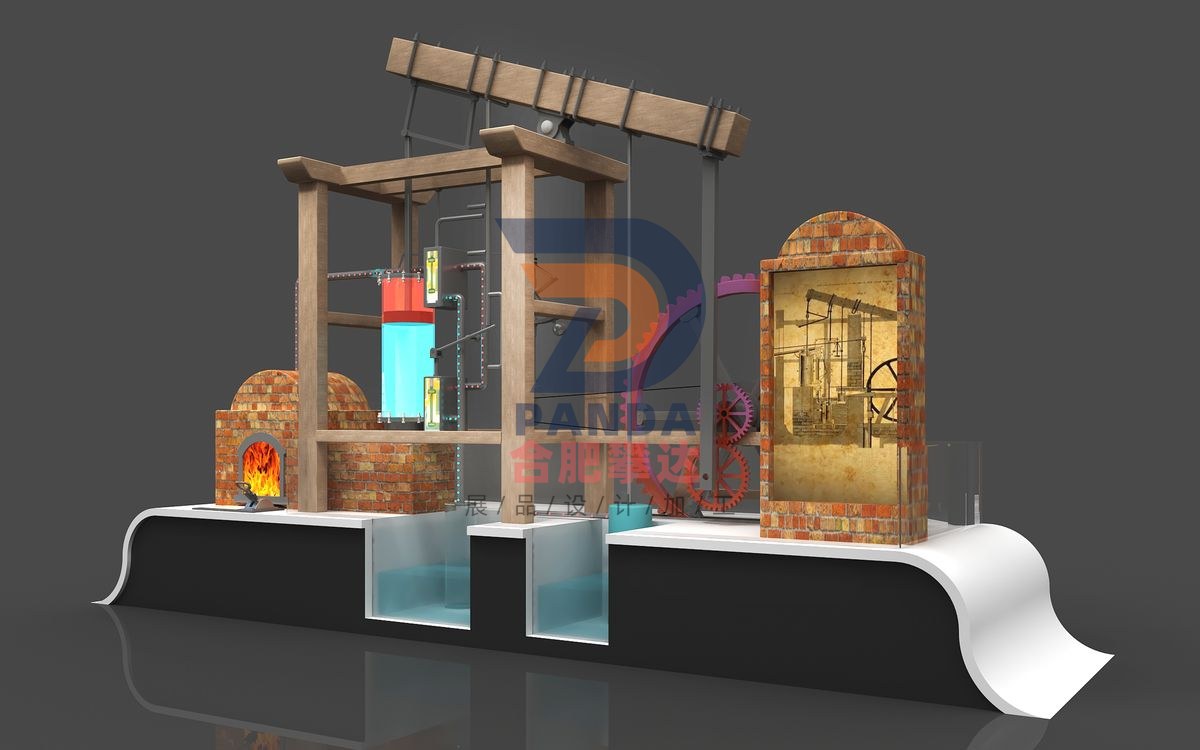
Watt's Improved Steam Engine
Smart Technology · Interactive
- DimensionsSubject to on-site plan
- PresentationInteractive
- PricingQuoted by manufacture spec
Watt's Improved Steam Engine is a hands-on, mechanical & electromechanical interactive exhibit manufactured by Hefei Panda for science centers, children’s museums, discovery centers, STEM learning centers and family entertainment centers. Engineered for durable, robust, low-maintenance, high-traffic gallery installation, it turns abstract scientific concepts into direct, interactive visitor exploration. Hefei Panda is a global exhibit manufacturer exporting hands-on science displays to 50+ countries, with in-house engineering, fabrication, installation and commissioning.
Exhibit Summary
Watt's Improved Steam Engine is a Interactive interactive exhibit in the Smart Technology category, designed for science centers, children’s museums, discovery centers, STEM learning centers and family entertainment centers. Built as a hands-on, mechanical & electromechanical display, it turns an abstract scientific concept into direct, interactive visitor exploration, and is engineered for durable, low-maintenance, high-traffic gallery use.
Scientific Principle
Let the audience fully grasp Watt's improvement of the Newcomen steam engine, grasp the operating concept of Watt's steam engine via practical experience, and further grasp its importance to the industrial revolution, allowing mankind to enter the "steam age".
Operation
1. Operating concept: A steam engine is a reciprocating power machine that converts the energy of steam into mechanical work. A steam engine requires a boiler that boils water to produce high-pressure steam. This boiler can use wood, coal, oil or natural gas, or even combustible garbage as a heat source. The expansion of the steam pushes the piston to do work. 2. History and significance: ① Start - Between 1679 and 1695, Denis Papen published several papers or research communications based on the research of Boyle and others, proposed the operating concept of the steam engine, and created a laboratory model. ② Prototype - Under the guidance of Paburn's theory, two British engineers, Thomas Seville and Thomas Newcomen, independently manufactured early industrial steam engines in 1698 and 1712 respectively based on Paburn's steam engine theory and model. ③Improvement - In 1776, Watt improved the Newcomen steam engine, which was widely used in industry. ④ Significance - Watt's improved steam engine opened up a new era of energy utilization for mankind and brought mankind into the "steam age". Its emergence caused the industrial revolution in the 18th century. Until the early 20th century, it remained the world's most important prime mover. 3. Watt's improvements: The biggest drawback of the Newcomen steam engine is that it can only work up and down. In order to improve efficiency, Watt improved its components - ① parallel four-bar linkage assembly; ② centrifugal speed regulator; ③ hot and cold separation condenser. Watt steam engine, a high-efficiency steam engine successfully developed by British inventor James Watt (1736-1819). Watt improved the Newcomen steam engine in 1769, greatly improving its efficiency and making it feasible for commercial use. In 1782, Watt made a double-action steam engine and applied it in the cotton textile industry. Watt's steam engine liberated more manpower and greatly improved production efficiency. It is recognized as the most important invention of the British Industrial Revolution.
Export-Ready Features
- Durable, robust construction for high-traffic gallery environments
- Low-maintenance electromechanical design with reliable, safe components
- Custom sizing, theming & multilingual labeling available
- OEM & turnkey exhibit solutions with full project management
- Overseas shipping, export documentation & on-site installation supported
- Shipped to science centers and museums in 50+ countries