
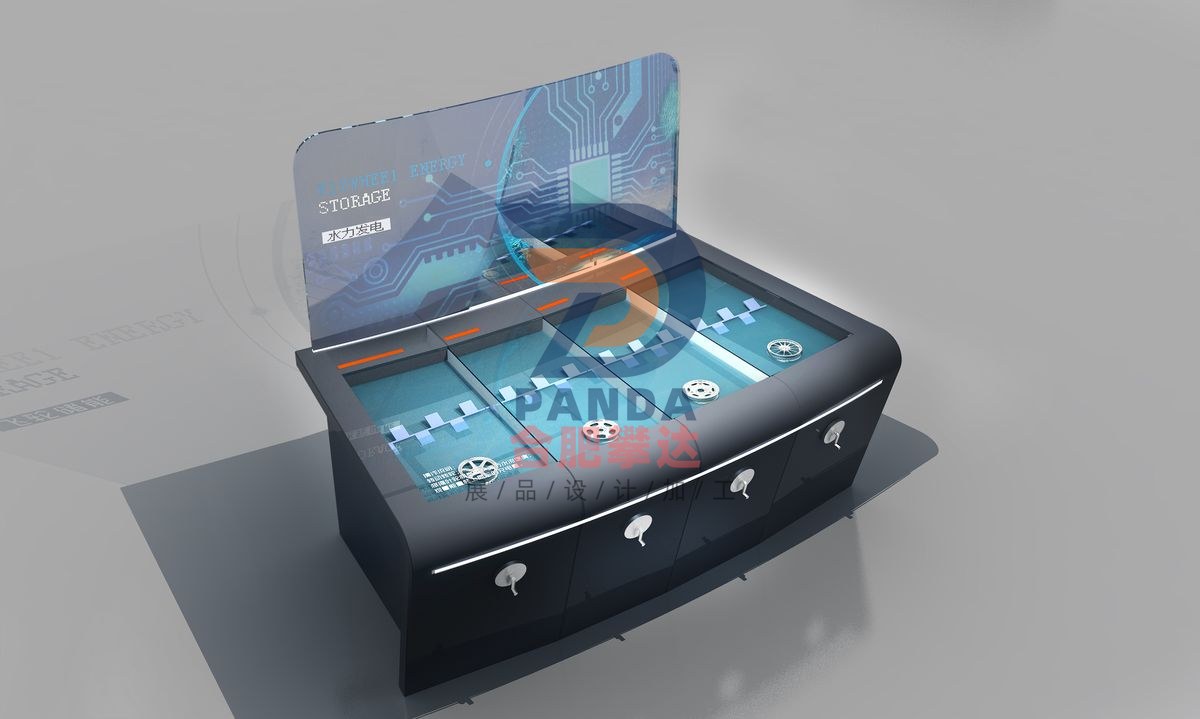
Hydropower
Earth & Planet · Interactive
- DimensionsSubject to on-site plan
- PresentationInteractive
- PricingQuoted by manufacture spec
Hydropower is a hands-on, mechanical & electromechanical interactive exhibit manufactured by Hefei Panda for science centers, children’s museums, discovery centers, STEM learning centers and family entertainment centers. Engineered for durable, robust, low-maintenance, high-traffic gallery installation, it turns abstract scientific concepts into direct, interactive visitor exploration. Hefei Panda is a global exhibit manufacturer exporting hands-on science displays to 50+ countries, with in-house engineering, fabrication, installation and commissioning.
Exhibit Summary
Hydropower is a Interactive interactive exhibit in the Earth & Planet category, designed for science centers, children’s museums, discovery centers, STEM learning centers and family entertainment centers. Built as a hands-on, mechanical & electromechanical display, it turns an abstract scientific concept into direct, interactive visitor exploration, and is engineered for durable, low-maintenance, high-traffic gallery use.
Scientific Principle
The display has four sets of water tanks and a hydropower simulation unit. The audience can control the water flow speed by turning the runner. Different impeller types match the appropriate water flow speed to obtain the maximum power generation. The audience learned about the principles of hydropower generation and factors affecting hydropower generation during the interaction.
Operation
Hydropower uses the potential energy of water to convert water turbine mechanical energy, and then uses the mechanical energy to drive a generator to generate electricity. Hydropower has the characteristics of high power generation efficiency, low cost, quick start-up, and easy adjustment. It does not consume fuel, does not undergo chemical changes, and does not discharge harmful substances during operation. It also has the advantages of controlling floods, providing irrigation water, and improving river navigation. According to the size of the water head used by hydropower stations, they can be divided into high head (above 70 meters), medium head (15 to 70 meters) and low head (less than 15 meters) hydropower stations. The power generation of a hydropower station is comprehensively affected by water flow, water head size and generator unit capacity. Four types of turbines: 1. Impact turbine: It is suitable for power stations with high water head and small flow. It converts water from the pressure pipe into a high-speed jet after passing via the nozzle, which tangentially impacts the runner, pushing the runner to rotate, thereby driving the generator rotor to rotate and generate electricity. 2. Axial-flow fixed-paddle turbine: suitable for hydropower stations with low water head and small water head changes. The blades are fixed on the runner body, and the blade placement angle cannot be changed during operation. 3. Axial flow paddle turbine: It has double adjustment performance, that is, both the water guide vane and the runner blade can be adjusted to maintain the operational stability and high efficiency of the turbine within a wide range of water head and load changes. 4. Francis turbine: It has a compact structure, high efficiency, and can adapt to water heads from 20 meters to 700 meters. It is one of the types of hydraulic turbines widely used in countries around the world. When water passes via the working wheel of this turbine, it enters in the radial direction and flows out in the axial direction, so it is also called a radial axial flow turbine. The displays are designed to simulate and show the principles and processes of hydropower generation. There are four sets of water tanks on the platform, and four sets of turbines with different shapes are installed in the water tanks. The audience turns the hand wheel, and the sensor detects the signal and drives the water pump to release the water flow at the corresponding speed to impact the turbine. The rotation of the turbine generates electric energy to charge the energy bar. The process of hydropower generation is revealed in the form of electromechanical hands-on demonstration, and the audience is guided to think about the factors that affect hydropower generation.
Export-Ready Features
- Durable, robust construction for high-traffic gallery environments
- Low-maintenance electromechanical design with reliable, safe components
- Custom sizing, theming & multilingual labeling available
- OEM & turnkey exhibit solutions with full project management
- Overseas shipping, export documentation & on-site installation supported
- Shipped to science centers and museums in 50+ countries