
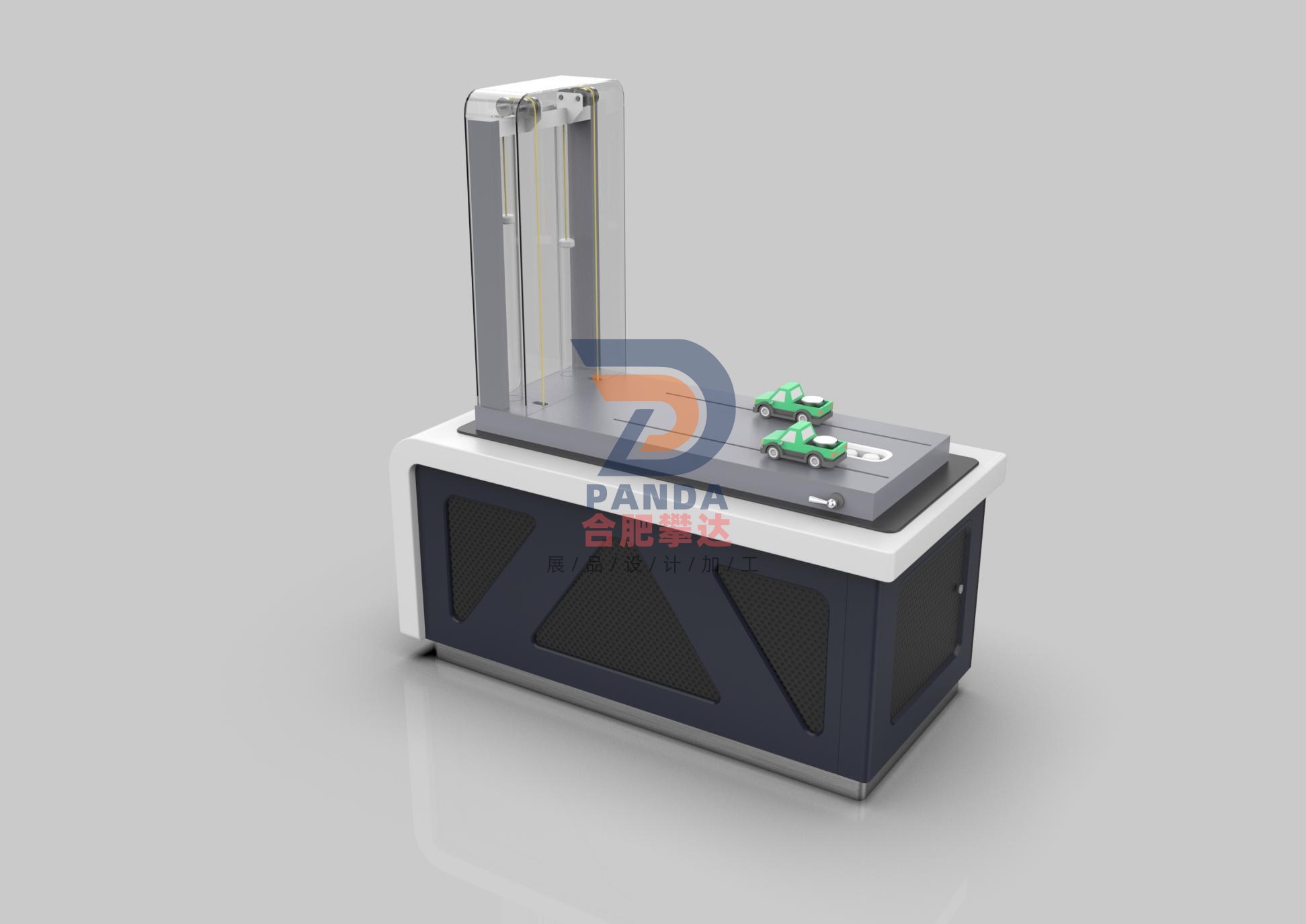
Newton's Second Law
Mechanics in Motion · Mechanical Interaction
- Dimensions1600×800×1720mm
- PresentationMechanical Interaction
- PricingQuoted by manufacture spec
Newton's Second Law is a hands-on, mechanical & electromechanical interactive exhibit manufactured by Hefei Panda for science centers, children’s museums, discovery centers, STEM learning centers and family entertainment centers. Engineered for durable, robust, low-maintenance, high-traffic gallery installation, it turns abstract scientific concepts into direct, interactive visitor exploration. Hefei Panda is a global exhibit manufacturer exporting hands-on science displays to 50+ countries, with in-house engineering, fabrication, installation and commissioning.
Exhibit Summary
Newton's Second Law is a Mechanical Interaction interactive exhibit in the Mechanics in Motion category, designed for science centers, children’s museums, discovery centers, STEM learning centers and family entertainment centers. Built as a hands-on, mechanical & electromechanical display, it turns an abstract scientific concept into direct, interactive visitor exploration, and is engineered for durable, low-maintenance, high-traffic gallery use.
Scientific Principle
The common expression of Newton's second law of motion is: the acceleration of an object is directly proportional to the force, inversely proportional to the mass of the object, and proportional to the reciprocal of the mass of the object; the direction of acceleration is the same as the direction of the force.
Operation
There are two identical car models on the table, both on the same sliding track. The weight box next to them has weights of the same mass, which can add weight to the car. Without changing the mass and pulling force of the trolley, the running speed of each trolley is the same. Participants add weights of different masses to one trolley, while the other remains unchanged. They increase the pulling force of the rope on the trolley. They will find that the movement speed of the trolley is different. The greater the pulling force, the faster the speed. 1. Rotate the handle and watch the speed of the car without changing anything; 2. Add different amounts of weights to one car, keep one unchanged, and watch the speed of the car.
Export-Ready Features
- Durable, robust construction for high-traffic gallery environments
- Low-maintenance electromechanical design with reliable, safe components
- Custom sizing, theming & multilingual labeling available
- OEM & turnkey exhibit solutions with full project management
- Overseas shipping, export documentation & on-site installation supported
- Shipped to science centers and museums in 50+ countries