
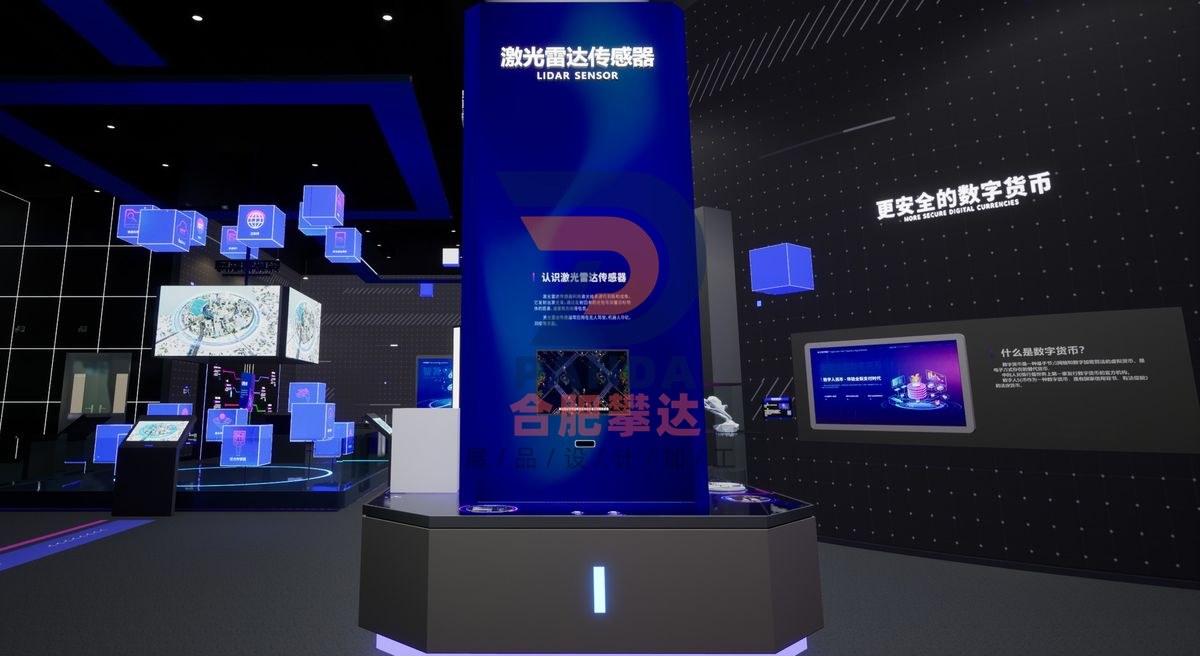
LiDAR
Smart Technology · Interactive
- DimensionsSubject to on-site plan
- PresentationInteractive
- PricingQuoted by manufacture spec
LiDAR is a hands-on, mechanical & electromechanical interactive exhibit manufactured by Hefei Panda for science centers, children’s museums, discovery centers, STEM learning centers and family entertainment centers. Engineered for durable, robust, low-maintenance, high-traffic gallery installation, it turns abstract scientific concepts into direct, interactive visitor exploration. Hefei Panda is a global exhibit manufacturer exporting hands-on science displays to 50+ countries, with in-house engineering, fabrication, installation and commissioning.
Exhibit Summary
LiDAR is a Interactive interactive exhibit in the Smart Technology category, designed for science centers, children’s museums, discovery centers, STEM learning centers and family entertainment centers. Built as a hands-on, mechanical & electromechanical display, it turns an abstract scientific concept into direct, interactive visitor exploration, and is engineered for durable, low-maintenance, high-traffic gallery use.
Scientific Principle
Through hands-on games, the principles and applications of LiDAR sensors are demonstrated. Let guests have a vivid and intuitive understanding of the application of lidar sensors.
Operation
Lidar sensors can accurately measure the target's position (distance and angle), shape (size) and status (speed, attitude), thereby achieving the purpose of detecting, identifying, and tracking targets. 1. What is lidar? Lidar, also known as optical radar (Light Detection And Ranging), is the abbreviation of laser detection and ranging system. It measures the propagation distance between the sensor transmitter and the target object, analyzes the reflected energy on the surface of the target object, and the amplitude, frequency and phase of the reflected wave spectrum to present accurate three-dimensional structural information of the target object. 2. Applications of lidar: topographic survey; construction quality survey; underwater topographic survey; precision agriculture; forestry mapping; driverless vehicles; flood warning; determination of land use; accident scene restoration; slope monitoring; atmospheric measurement; asset management; frozen area mapping; augmented reality; power inspection. 3. Classification of lidar According to the structure, lidar is divided into mechanical lidar, solid-state lidar and hybrid solid-state lidar. Mechanical lidar: Mechanical lidar refers to the rotation of its transmitting system and receiving system in a macro sense. That is, by continuously rotating the transmitting head, the faster and more accurate laser is changed from a "line" to a "surface", and multiple laser beams are arranged in the vertical direction to form multiple surfaces to achieve the purpose of dynamic scanning and dynamic reception of information. Hybrid solid-state lidar: When the mechanical lidar is working, the transmitting system and the receiving system will always rotate 360 degrees, while when the hybrid solid-state lidar is working, it cannot be seen from the appearance alone. Solid-state lidar: Compared with mechanical lidar, the biggest structural feature of solid-state lidar is that it has no rotating parts and is relatively small.
Export-Ready Features
- Durable, robust construction for high-traffic gallery environments
- Low-maintenance electromechanical design with reliable, safe components
- Custom sizing, theming & multilingual labeling available
- OEM & turnkey exhibit solutions with full project management
- Overseas shipping, export documentation & on-site installation supported
- Shipped to science centers and museums in 50+ countries