
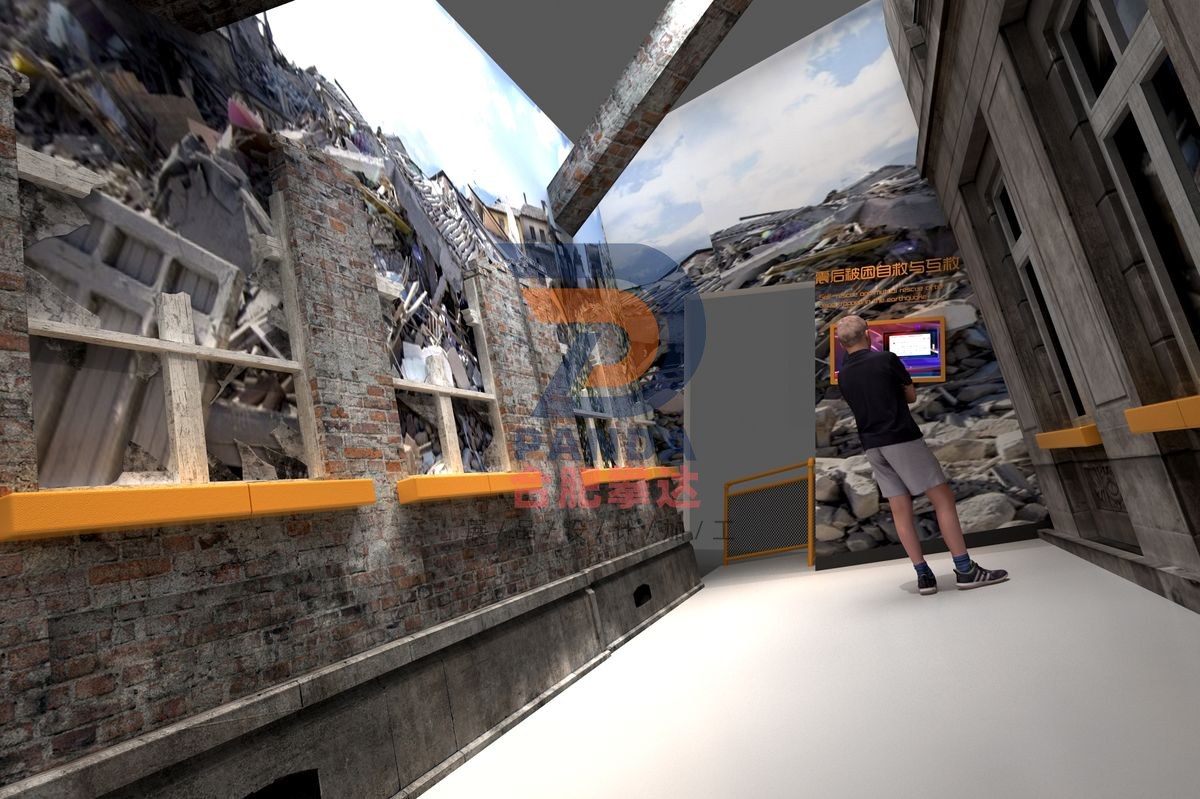
Self-rescue and mutual rescue after the earthquake
Safety & Emergency · Interactive
- DimensionsSubject to on-site plan
- PresentationInteractive
- PricingQuoted by manufacture spec
Self-rescue and mutual rescue after the earthquake is a hands-on, mechanical & electromechanical interactive exhibit manufactured by Hefei Panda for science centers, children’s museums, discovery centers, STEM learning centers and family entertainment centers. Engineered for durable, robust, low-maintenance, high-traffic gallery installation, it turns abstract scientific concepts into direct, interactive visitor exploration. Hefei Panda is a global exhibit manufacturer exporting hands-on science displays to 50+ countries, with in-house engineering, fabrication, installation and commissioning.
Exhibit Summary
Self-rescue and mutual rescue after the earthquake is a Interactive interactive exhibit in the Safety & Emergency category, designed for science centers, children’s museums, discovery centers, STEM learning centers and family entertainment centers. Built as a hands-on, mechanical & electromechanical display, it turns an abstract scientific concept into direct, interactive visitor exploration, and is engineered for durable, low-maintenance, high-traffic gallery use.
Scientific Principle
Through hands-on experience, the audience can grasp the effective ways to seek help in a narrow space after the earthquake, thereby enhancing the audience's self-rescue ability.
Operation
This exhibition item consists of wall modeling, touch screen, etc. In the multimedia hands-on part, via game question and answer interaction, the main perspective is used to simulate how to carry out effective self-rescue and mutual rescue when trapped in an earthquake, thereby enhancing the audience's self-rescue ability. When an earthquake occurs, look for places such as the corners of buildings as soon as possible. When trapped in a narrow space after an earthquake, you must first protect your breathing, move away debris on your head and chest, and cover your mouth and nose with wet clothes when you smell gas or poisonous gas; avoid weak collapsed objects above the body and other objects that can easily cause falling; expand and stabilize the living space, and use bricks, wooden sticks, etc. to support broken walls to prevent further deterioration of the environment after aftershocks. At the same time, use all the tools around you that can transmit information to the outside world, such as masks, metal pipes, etc., to send information to rescuers.
Export-Ready Features
- Durable, robust construction for high-traffic gallery environments
- Low-maintenance electromechanical design with reliable, safe components
- Custom sizing, theming & multilingual labeling available
- OEM & turnkey exhibit solutions with full project management
- Overseas shipping, export documentation & on-site installation supported
- Shipped to science centers and museums in 50+ countries